Facts
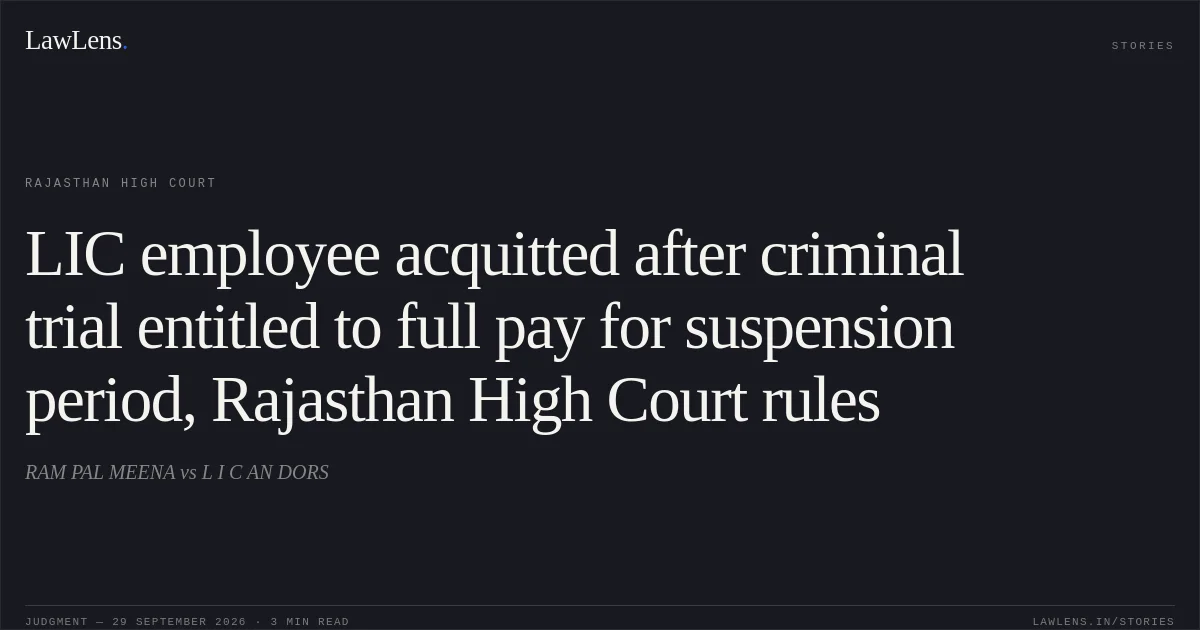
The petitioner, an LIC clerk, was suspended on 24 August 2009 solely because he was facing a criminal trial; LIC initiated no departmental inquiry. After a full trial, he was acquitted, and his suspension was revoked.
Source reference: paras. 2–7, 22–24; pp. 2–3, 9–10LIC first treated the suspension period as duty and granted full pay and allowances, but later cancelled that decision and treated the period as not spent on duty, reasoning that the acquittal was not “honourable.” The petitioner’s appeal was disposed of without relief.
Source reference: paras. 2–7, 22–24; pp. 2–3, 9–10He challenged both orders before the High Court.
Source reference: para. 1; p. 1Issues
1. Whether an employee suspended solely due to a criminal case, and later acquitted after trial, is entitled under Rule 38(a) of the LIC (Staff) Rules, 1960 to full pay and allowances where the acquittal is described as being on benefit of doubt.
Source reference: paras. 25–28, 32; pp. 10–11, 15–162. Whether Rule 38(b) could govern the treatment of the suspension period where no departmental inquiry was initiated.
Source reference: paras. 10, 17, 27; pp. 4, 6, 10–113. Whether LIC could cancel its earlier order granting full benefits and substitute an order denying them.
Source reference: paras. 7, 11, 24, 34; pp. 3–4, 9–10, 16Law Applied
Rules 36 and 38 of the Life Insurance Corporation of India (Staff) Rules, 1960 govern suspension and the treatment of the suspension period.
Source reference: paras. 19–20; pp. 7–9Rule 36 permits suspension where disciplinary proceedings are contemplated or pending, or where a criminal case is under investigation or trial; Rule 38(a) provides for full pay and allowances, less subsistence allowance, and treatment of the absence as duty where the employee is honourably acquitted, while Rule 38(b) provides for such proportion of pay and allowances as the competent authority prescribes in other cases.
Source reference: paras. 19–20; pp. 7–9The Court relied on The Deputy Inspector General of Police v. S. Samuthiram, (2013) 1 SCC 598, and Union of India v. Methu Meda, (2022) 1 SCC 1, concerning the judicially developed meaning of “honourable acquittal”; it also referred to Shri Sanjay v. LIC & Ors. and Food Corporation of India & Ors. v. Ved Prakash Malhotra on acquittal after a full trial and review of the evidence.
Source reference: paras. 28–31; pp. 11–15The Court further noted that Section 12 of the Probation of Offenders Act, 1958 protects service benefits in the circumstances specified there.
Source reference: para. 33; p. 16Reasoning
The petitioner’s suspension arose only from the criminal case, and no departmental inquiry followed his acquittal. The Court therefore held that Rule 38(b), which it read as applying to cases involving disciplinary authority action, did not govern these facts.
Source reference: paras. 22–27; pp. 9–11Although the trial court had granted the petitioner the benefit of doubt, the acquittal followed a full trial and consideration of the evidence. Applying the principles in S. Samuthiram and Methu Meda, the Court concluded that the absence of the words “honourably acquitted” in the criminal judgment did not justify denying the service benefits at issue; it found no legally sustainable distinction for this purpose between the petitioner’s acquittal and an honourable acquittal.
Source reference: paras. 28–33; pp. 11–16The Court accordingly rejected LIC’s interpretation of Rule 38(a) and set aside the later order denying benefits.
Source reference: paras. 32–34; pp. 15–16Holding
The High Court allowed the writ petition, quashed LIC’s order dated 12 February 2014 and the appellate order dated 22 November 2014, and restored the order dated 29 January 2014.
It directed LIC to treat the suspension period from 24 August 2009 to 9 January 2014 as duty for all practical purposes, pay full salary and allowances, and extend consequential benefits within 60 days of receipt of the certified judgment.
Source reference: para. 34; p. 16Acts & Sections Cited
4 provisions across 2 statutes referred to in this judgment. Each provision opens on LawLens.
Life Insurance Corporation Act, 19561
Probation of Offenders Act, 19583
Original Court PDF
RAM PAL MEENAvsL I C AN DORS
Click to open original judgment
Original judgment, available to read, download and summarize on LawLens.in