Facts
The petitioner, a Head Clerk, was served with a charge-sheet dated 9 February 2017 and denied the allegations. An Inquiry Officer and Presenting Officer were appointed, following which the Inquiry Officer submitted his report. The Disciplinary Authority supplied the inquiry report to the petitioner along with a show-cause notice dated 22 February 2021. The petitioner submitted a detailed reply on 16 March 2021 and further written submissions during the personal hearing held on 28 July 2021.
Source reference: p.1, para.2By order dated 25 August 2021, the Disciplinary Authority withheld two annual increments with cumulative effect and transferred the petitioner to another college. The petitioner contended that his replies and written submissions had not been considered and that the punishment order was non-speaking and unreasoned.
Source reference: p.3, paras.5–7His departmental appeal was rejected on 15 March 2022. He therefore invoked Article 226 of the Constitution seeking quashing of both orders and consequential benefits.
Source reference: p.2, para.2; p.6, para.12; p.1, para.1Issues
Whether the Disciplinary Authority’s punishment order was invalid for being non-speaking and for failing to consider the petitioner’s reply and written submissions?
Source reference: p.3, paras.6–8Whether reasons supplied by the appellate authority could cure the absence of reasons in the original punishment order?
Source reference: p.6, para.12Whether the petitioner was entitled to consequential benefits upon quashing of the punishment and appellate orders?
Source reference: p.8, paras.13–15Law Applied
The Court applied the principle that a disciplinary authority exercising quasi-judicial power must pass a reasoned, speaking order after objectively considering the delinquent employee’s defence.
Source reference: p.3, paras.6–8In State of Punjab v. Bandip Singh, (2016) 1 SCC 724, the Supreme Court held that every administrative or executive decision affecting rights must be composite and self-sustaining and must contain the reasons prevailing upon the decision-maker.
Source reference: p.4, paras.9–10Kranti Associates (P) Ltd. v. Masood Ahmed Khan, (2010) 9 SCC 496, establishes that recording reasons is an essential component of fair decision-making, restrains arbitrary exercise of power, facilitates judicial review, and requires reasons to be cogent, clear and succinct.
Source reference: p.5, para.11Under Oryx Fisheries (P) Ltd. v. Union of India, (2010) 13 SCC 427, deficiencies in the original order cannot be cured by providing reasons for the first time in the appellate order.
Source reference: p.6–8, para.12The disciplinary action was also purportedly taken under the Madhya Pradesh Civil Services (Conduct) Rules, 1965.
Source reference: p.3, paras.5–6Reasoning
The Court examined the punishment order and found that it merely recorded that the petitioner had been given an opportunity to submit a reply and appear at the hearing, and then concluded that the proved misconduct was committed knowingly and warranted punishment.
Source reference: p.3, para.5It did not meaningfully address the specific grounds raised in the petitioner’s reply dated 16 March 2021 or his written submissions dated 28 July 2021.
Source reference: p.3, paras.6–8Since the Disciplinary Authority was exercising quasi-judicial power, it was required to demonstrate through reasons that the petitioner’s defence and the relevant facts had been objectively considered.
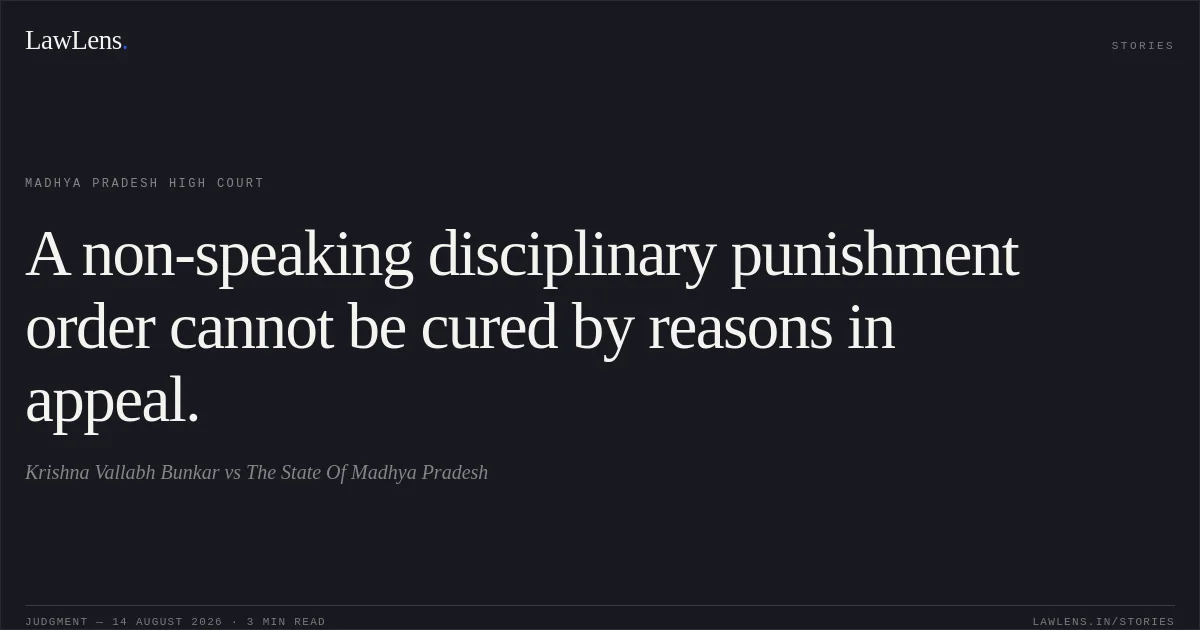
Source reference: p.3, paras.6–8The Court further held that the appellate authority’s reasons could not substitute for reasons that were absent from the original punishment order, because an appeal cannot serve as a complete substitute for a procedurally valid initial decision.
Source reference: p.6–8, para.12The punishment order was therefore vitiated by non-application of mind and failure to provide reasons.
Source reference: no citationHolding
The Court answered the issues in favour of the petitioner.
It quashed the punishment order dated 25 August 2021 and the appellate order dated 15 March 2022 on the ground that the original disciplinary order was non-speaking and unreasoned.
Source reference: p.8, para.13The respondents were directed to grant all consequential benefits to the petitioner within three months from receipt of the certified copy of the judgment.
Source reference: p.8, para.14The respondents were, however, granted liberty to take action against the petitioner afresh in accordance with law, if so advised. The writ petition was accordingly disposed of.
Source reference: p.8, para.15Original Court PDF
Krishna Vallabh BunkarvsThe State Of Madhya Pradesh
Click to open original judgment
Original judgment, available to read, download and summarize on LawLens.in