Facts
The petitioner, working as a Matron at District Hospital, Bhind, was suspended on 17 February 2024 following a complaint and was served with a charge-sheet dated 28 March 2024.
Source reference: pp. 1–3, paras. 1–4A departmental enquiry was conducted, and the Inquiry Officer submitted a report finding the charges partly proved.
Source reference: pp. 1–3, paras. 1–4The disciplinary authority supplied the enquiry report to the petitioner, who submitted a detailed reply dated 20 May 2024.
Source reference: pp. 1–3, paras. 1–4By order dated 16 January 2025, the Collector, Bhind, imposed the punishment of withholding two annual increments with cumulative effect.
Source reference: pp. 1–3, paras. 1–4Her departmental appeal was rejected by the Commissioner, Chambal Division, on 8 July 2026.
Source reference: pp. 1–3, paras. 1–4Issues
Whether the disciplinary authority’s order imposing punishment was invalid for being non-speaking and for failing to consider the petitioner’s reply to the enquiry report
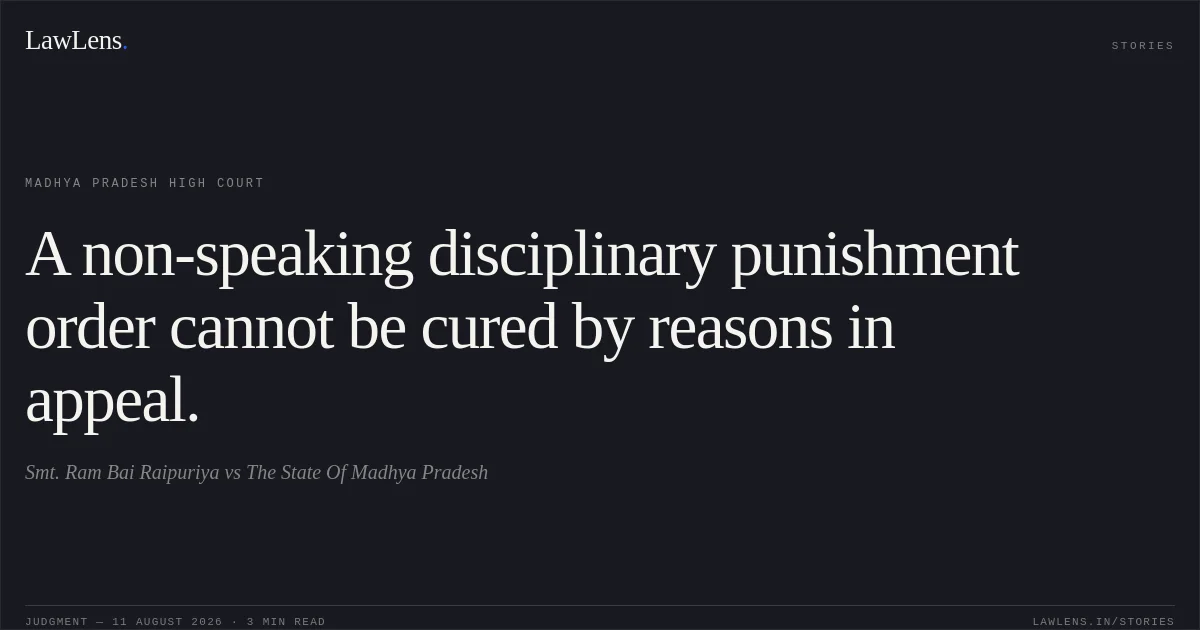
Source reference: pp. 3–4, paras. 7–10Whether the appellate authority could cure the absence of reasons in the original disciplinary order by passing a reasoned appellate order
Source reference: pp. 5–8, paras. 14–15Whether the petitioner was entitled to consequential benefits after quashing of the disciplinary and appellate orders
Source reference: p. 8, paras. 15–17Law Applied
The Court exercised judicial review under Article 226 of the Constitution of India.
Source reference: p. 4, paras. 8–10It held that a disciplinary authority exercising quasi-judicial power must apply its mind to the material on record, consider the delinquent employee’s defence, and record cogent reasons in a speaking order.
Source reference: p. 4, paras. 8–10Relying on State of Punjab v. Bandip Singh, (2016) 1 SCC 724, the Court reiterated that administrative and executive decisions affecting rights must be self-contained and supported by reasons.
Source reference: pp. 4–5, paras. 11–12It further applied Kranti Associates Pvt. Ltd. v. Masood Ahmed Khan, (2010) 9 SCC 496, which establishes that recording reasons is an essential component of fair decision-making, restrains arbitrariness, and facilitates judicial review.
Source reference: pp. 5–6, para. 13Under Oryx Fisheries Pvt. Ltd. v. Union of India, (2010) 13 SCC 427, reasons absent from the original order cannot be supplied or cured through the appellate order; an appeal is not a substitute for a procedurally valid original decision.
Source reference: pp. 6–8, para. 14Reasoning
The punishment order merely recorded the issuance of the charge-sheet, the commencement of the departmental enquiry, receipt of the enquiry report, and the proposed punishment; it did not analyse the evidence, the findings, or the petitioner’s detailed reply dated 20 May 2024.
Source reference: pp. 3–4, paras. 7–9Since the disciplinary authority was exercising quasi-judicial power, it was required to provide reasons demonstrating objective consideration of the petitioner’s defence.
Source reference: pp. 3–4, paras. 7–9The absence of such reasons rendered the order non-speaking and legally unsustainable.
Source reference: pp. 3–4, paras. 7–9The State’s contention that the appellate authority had examined the record could not cure the defect, because reasons must exist in the original disciplinary order itself and cannot be supplied for the first time in appeal.
Source reference: pp. 6–8, para. 14Accordingly, both the punishment order and the consequential appellate order were liable to be quashed.
Source reference: pp. 6–8, para. 14Holding
The Court answered the issues in favour of the petitioner.
It set aside the disciplinary authority’s order dated 16 January 2025 and the appellate order dated 8 July 2026 on the ground that the original punishment order was non-speaking and unreasoned.
Source reference: p. 8, paras. 15–16The respondents were directed to grant all consequential benefits to the petitioner within three months from receipt of the certified copy of the judgment.
Source reference: pp. 8–9, paras. 16–17Liberty was reserved to the respondents to proceed against the petitioner afresh in accordance with law, if so advised.
Source reference: pp. 8–9, paras. 16–17The writ petition was accordingly disposed of.
Source reference: pp. 8–9, paras. 16–17Original Court PDF
Smt. Ram Bai RaipuriyavsThe State Of Madhya Pradesh
Click to open original judgment
Original judgment, available to read, download and summarize on LawLens.in