01Facts
The petitioner, appointed as a Junior Engineer in April 1999, had received the first and second time-bound upgradations after completing 9 and 18 years of service and was working as Assistant Engineer (In-charge).
¶ 2His ACRs for 2010–2020 were allegedly graded “Excellent”, but his ACR for 1 April 2020 to 31 March 2021 was graded “C” by the Reporting Officer.
¶ 2The petitioner challenged the grading, asserting that he had performed diligently during the COVID-19 period and that the forwarding authority had supported his representation by letter dated 9 May 2022.
¶ 7–8Respondent No. 4’s subsequent comments dated 29 December 2022 reportedly appreciated the petitioner’s performance and stated that no complaint had been received against him during the relevant period.
¶ 2The Committee, in its meeting dated 27 October 2023, rejected the challenge and maintained the “C” grading, principally stating that no special facts had been presented by the petitioner; it also noted that the reviewing and accepting authorities had retired.
¶ 5–6The petitioner contended that the adverse grading affected his third upgradation, which was granted only from April 2022 despite his completing 30 years of service in April 2021.
¶ 2The respondents defended the decision by relying on the petitioner’s average knowledge of S.T.M. work, prior disciplinary material including a minor punishment of censure, and Circular dated 19 July 1990.
¶ 302Issues
i.1. Whether the Committee’s decision dated 27 October 2023 maintaining the petitioner’s “C” ACR grading was sustainable when it did not record reasons dealing with the grounds raised in the petitioner’s representation.
¶ 5–6, 13ii.2. Whether the petitioner was entitled to reconsideration of his ACR challenge by a reasoned and speaking order, including consideration of his past ACRs, the comments dated 29 December 2022, and the material relevant to his third upgradation.
¶ 14iii.3. Whether consequential benefits, including an earlier date of third upgradation and arrears, could be granted if the petitioner was found entitled upon reconsideration.
¶ 1503Law Applied
The High Court exercised judicial review under Article 226 of the Constitution and applied the settled rule that administrative or quasi-judicial authorities exercising power affecting civil or service rights must record cogent, clear and self-contained reasons.
¶ 9–11Relying on State of Punjab v. Bandip Singh, (2016) 1 SCC 724, the Court held that administrative decisions must be informed by reasons and cannot be arbitrary, capricious or prejudiced.
¶ 9–11Relying further on Kranti Associates (P) Ltd. v. Masood Ahmed Khan, (2010) 9 SCC 496, the Court reiterated that a quasi-judicial authority must consider relevant factors, explain its conclusions, and issue a speaking order; “rubber-stamp reasons” do not satisfy the requirement of fairness and transparency.
¶ 12The Court also noted the respondents’ reliance on Circular No. 01-05/I/WC/143 dated 19 July 1990, under which overall performance and relevant service conditions were to be considered for upgradation.
¶ 304Reasoning
The Committee’s report merely stated that the petitioner had not produced any special facts warranting interference and consequently affirmed the Reporting Officer’s “C” grading.
¶ 5–6It did not examine or give reasons regarding the petitioner’s positive representation, the forwarding authority’s favourable remarks, the comments dated 29 December 2022, his past ACRs, or the significance of the absence of adverse remarks by the reviewing and accepting authorities.
¶ 2, 6–8Since the Committee was deciding a service-related challenge with potential consequences for the petitioner’s career progression, it was required to disclose the reasons for rejecting his grounds.
¶ 9–13The absence of such reasoning rendered the decision non-speaking and demonstrated non-application of mind under the principles laid down in Bandip Singh and Kranti Associates.
¶ 9–13The Court therefore considered it unnecessary to finally determine the correctness of the “C” grading itself and instead directed a fresh, reasoned reconsideration.
¶ 13–1405Holding
The Court quashed the Committee’s decision dated 27 October 2023 maintaining the petitioner’s “C” grading because it was a non-speaking order unsupported by cogent reasons.
¶ 13The matter was remanded to the competent authority/Committee to reconsider the petitioner’s appeal, taking into account the comments dated 29 December 2022, his past ACRs, all relevant material, and both his earlier and fresh representations.
¶ 14The petitioner was directed to submit a fresh detailed representation within one month, and the authority was directed to complete the exercise within three months of receiving the certified copy of the judgment after affording him a personal hearing.
¶ 14If reconsideration established that the petitioner was entitled to third upgradation from an earlier date, consequential benefits, including arrears, were to be granted in accordance with law.
¶ 15The writ petition was accordingly disposed of.
¶ 16Original Court PDF
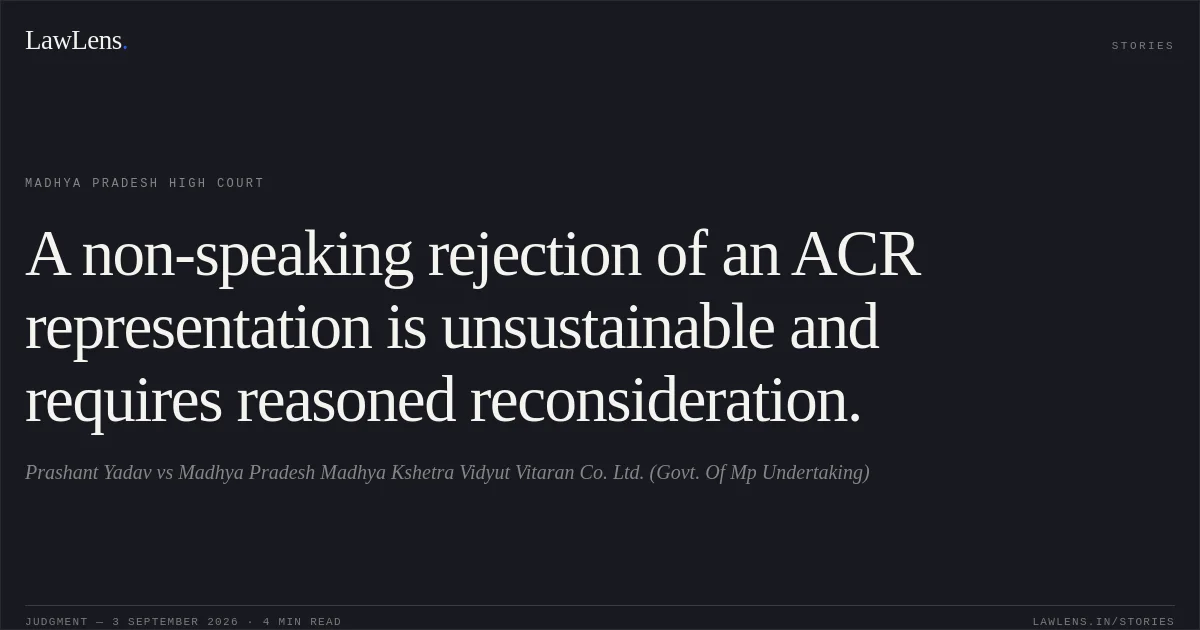
Prashant YadavvsMadhya Pradesh Madhya Kshetra Vidyut Vitaran Co. Ltd. (Govt. Of Mp Undertaking)
Click to open original judgment
Original judgment, available to read, download and summarize on LawLens.in