Facts
The parties entered into a Leave and License Agreement dated 11 April 2019 for the Plaintiff’s operation and management of the Taj Mahal Hotel, New Delhi.
Source reference: p. 2–4The Plaintiff claimed that COVID-19 restrictions triggered the Agreement’s force majeure clause and excused payment of license fees for specified periods; it sought related declarations and adjustment of amounts already paid.
Source reference: p. 2–4NDMC applied under Order VII Rule 11 CPC to reject the plaint, asserting, among other grounds, non-compliance with the notice requirement under Section 385 of the New Delhi Municipal Council Act, 1994 (“NDMC Act”), limitation, the bar under Section 15 of the Public Premises (Eviction of Unauthorized Occupants) Act, 1971, and the proviso to Section 34 of the Specific Relief Act, 1963.
Source reference: p. 4–6The Plaintiff had sent NDMC a notice dated 14 November 2025, describing it as a notice under Section 80 CPC.
Source reference: p. 10–12Issues
1. Whether the plaint was liable to be rejected for failure to serve a notice complying with Section 385 of the NDMC Act.
Source reference: p. 8–162. Whether the suit was barred by limitation at the threshold under Order VII Rule 11 CPC.
Source reference: p. 16–203. Whether the suit was barred by Section 15 of the Public Premises Act or the proviso to Section 34 of the Specific Relief Act.
Source reference: p. 20–21Law Applied
Section 385(1) of the NDMC Act requires written notice before suit in respect of acts done or purportedly done under the Act, specifying the cause of action, relief, compensation claimed, and plaintiff’s name and address; Section 385(2) generally requires such suits to be brought within six months of accrual of the cause of action.
Source reference: p. 8–9The substance of a notice, rather than its label, is material where it contains the particulars required by the statute.
Source reference: p. 15–16Under Order VII Rule 11 CPC, the court assesses the plaint as a whole, principally on its averments; a plaint may be rejected where it is manifestly barred by law, but a limitation issue requiring factual determination is not ordinarily resolved at that stage.
Source reference: p. 20–23*Popat and Kotecha Property v. State Bank of India Staff Assn.*, (2005) 7 SCC 510.
Source reference: p. 20–23Section 15 of the Public Premises Act bars civil-court jurisdiction in matters assigned to the statutory eviction process; the proviso to Section 34 of the Specific Relief Act restricts declaratory relief where further relief is available but omitted.
Source reference: p. 5, 20–21Reasoning
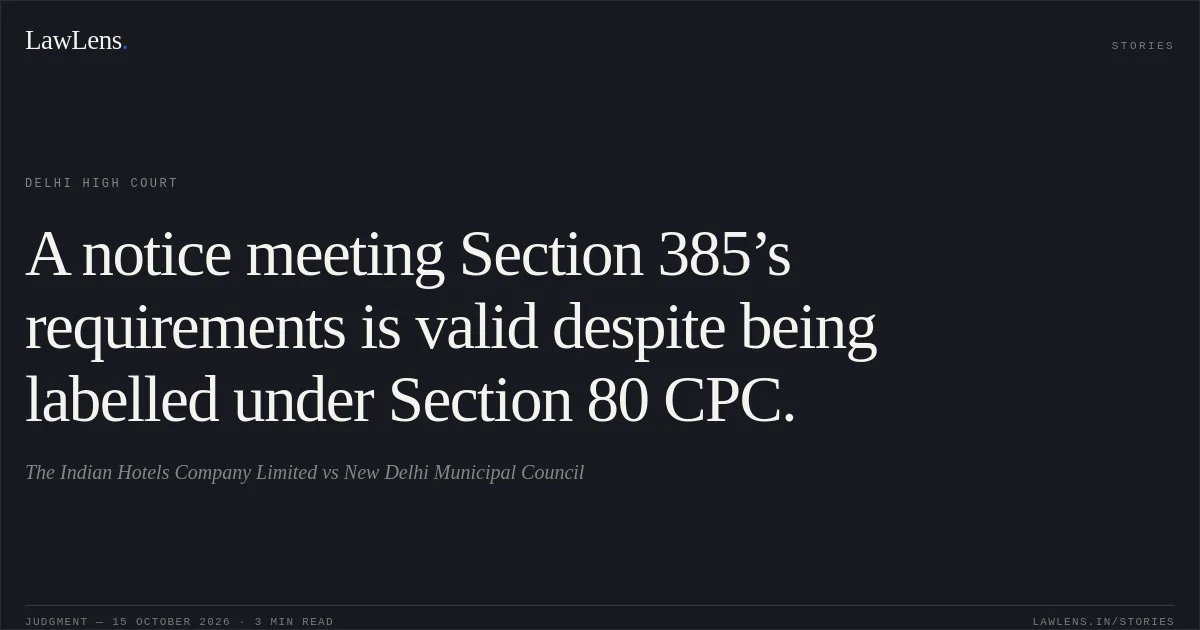
The Court held that Section 385 applied because the Agreement was entered into under the NDMC Act, but found that the 14 November 2025 notice contained the particulars required by Section 385; its description as a Section 80 CPC notice did not invalidate it.
Source reference: p. 15–16As to limitation, the record included further negotiations under the Agreement’s amicable-resolution clause and communications in 2025. Whether those events gave rise to a fresh cause of action was a mixed question of law and fact, not suitable for final determination on the Order VII Rule 11 application.
Source reference: p. 16–20The Court also treated the suit as one seeking enforcement of contractual rights, rather than adjudication of eviction proceedings under the Public Premises Act; it considered consequential relief unnecessary at this stage because no demand notice had been issued and the amounts remained to be crystallized following the declaration sought.
Source reference: p. 20Holding
The Court rejected NDMC’s application under Order VII Rule 11 CPC.
It held that the notice was sufficient in substance under Section 385 of the NDMC Act and that the plaint could not be rejected as time-barred at this stage; the remaining asserted statutory bars did not warrant rejection of the plaint on the material before the Court.
Source reference: p. 20–23The matter was directed to be listed before the Roster Bench on 2 November 2026.
Source reference: p. 23Acts & Sections Cited
9 provisions across 6 statutes referred to in this judgment. Each provision opens on LawLens.
Code of Civil Procedure, 19082
Delhi Municipal Corporation Act, 19572
Limitation Act, 19631
New Delhi Municipal Council Act, 19942
Public Premises (Eviction of Unauthorised Occupants) Act, 19711
Specific Relief Act, 19631
Original Court PDF
The Indian Hotels Company LimitedvsNew Delhi Municipal Council
Click to open original judgment
Original judgment, available to read, download and summarize on LawLens.in
![The competent authority must decide the appeal by a reasoned, speaking order within four weeks.. DR NISHANT GOYAL vs HEALTH. CAT - ['Delhi']. LawLens](/stories/thumbnails/the-competent-authority-must-decide-the-appeal-by-a-reasoned-speaking-order-within-four-we-51ef3c532385466483f4156703e7e0bc.webp)
![Competent authority must decide the pending representation by a reasoned order within four weeks.. AJAY YADAV vs MUNICIPAL CORPORATION OF DELHI (GNCTD). CAT - ['Delhi']. LawLens](/stories/thumbnails/competent-authority-must-decide-the-pending-representation-by-a-reasoned-order-within-four-1bec6310839148709c127f0a0c64e2b5.webp)
