Facts
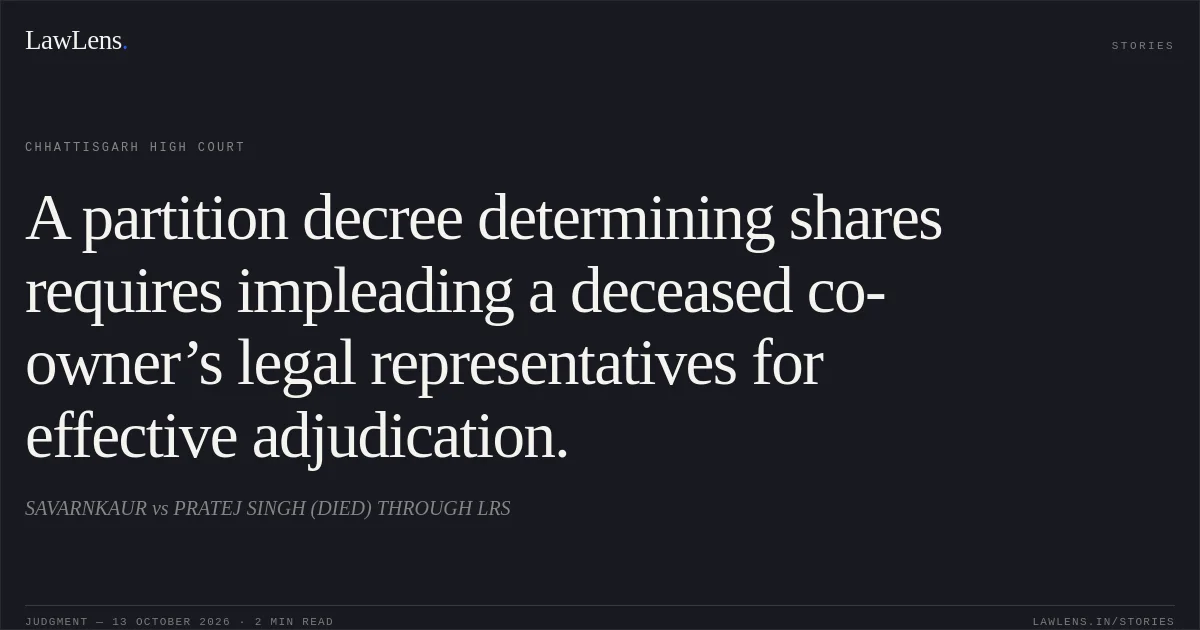
The dispute concerned a family property purchased by Mohini Devi, whose six children were said to be entitled to shares in it.
Source reference: para. 3, 6–8, 15Pratej Singh sued for partition and separate possession of a one-sixth share; the trial court decreed the suit and also recognised the other family members’ shares.
Source reference: para. 3, 6–8, 15During the suit, defendant Iqbal died. Her legal representatives were not brought on record, and her name was deleted from the array of parties.
Source reference: para. 19, 25The defendants appealed, arguing that the suit had abated in its entirety and that the decree could not stand without Iqbal’s legal representatives.
Source reference: para. 19–20Issues
Whether the entire suit abated because Iqbal’s legal representatives were not brought on record.
Source reference: para. 18(i)Whether the trial court’s decree granting a one-sixth share suffered from an illegality or infirmity warranting appellate interference.
Source reference: para. 18(ii)Law Applied
Under Order XXII Rule 4 of the Code of Civil Procedure, 1908, the court may, in an appropriate case, exempt a plaintiff from substituting the legal representatives of a deceased defendant; whether abatement is total or partial depends on the facts and the effect of proceeding without the deceased party’s representatives (T. Gnanavel v. T.S. Kanagaraj, as discussed at para. 26).
Source reference: para. 26Applying the principles summarised in Suresh Chandra (Dead) v. Parasram, 2025 SCC OnLine SC 1427, total abatement is not automatic: the court considers, among other matters, whether proceeding would produce contradictory or irreconcilable decrees, whether effective relief can be granted against the surviving parties, and whether the rights are separately adjudicable.
Source reference: para. 29–32Separately, Order I Rule 10 CPC permits the addition of necessary parties whose presence is required for effective and complete adjudication.
Source reference: para. 35Reasoning
The High Court held that non-substitution of Iqbal’s legal representatives did not, by itself, cause the entire suit to abate. The surviving parties’ rights could be adjudicated separately, and an effective decree could be passed against them without necessarily creating contradictory decrees.
Source reference: para. 31–32However, Iqbal had a potential share in the property, and her legal representatives’ entitlement—and whether they intended to relinquish that entitlement—had not been examined. Given the dispute over possession, their absence risked prejudice and made the decree concerning the parties’ respective shares potentially ineffective in execution. They were therefore necessary parties, and the trial court erred in proceeding without them.
Source reference: para. 33–35Holding
The Court answered the first issue in the negative: the entire suit had not abated.
It nevertheless held that the decree could not be sustained because Iqbal’s legal representatives were necessary for effective adjudication.
Source reference: para. 36–37The appeal was allowed, the trial court’s judgment and decree were set aside, and the matter was remanded for retrial after impleading Iqbal’s legal representatives and hearing all concerned parties.
Source reference: para. 36–37The trial court was directed to decide the suit within three months of receiving the record, and the parties were directed to appear on 17 November 2026.
Source reference: para. 38Acts & Sections Cited
4 provisions across 4 statutes referred to in this judgment. Each provision opens on LawLens.
Code of Civil Procedure, 19081
Code of Criminal Procedure, 19731
Registration Act, 19081
Hindu Succession Act, 19561
Original Court PDF
SAVARNKAURvsPRATEJ SINGH (DIED) THROUGH LRS
Click to open original judgment
Original judgment, available to read, download and summarize on LawLens.in