Facts
The plaintiff sought partition and separate possession of a share in property at Kyasanur.
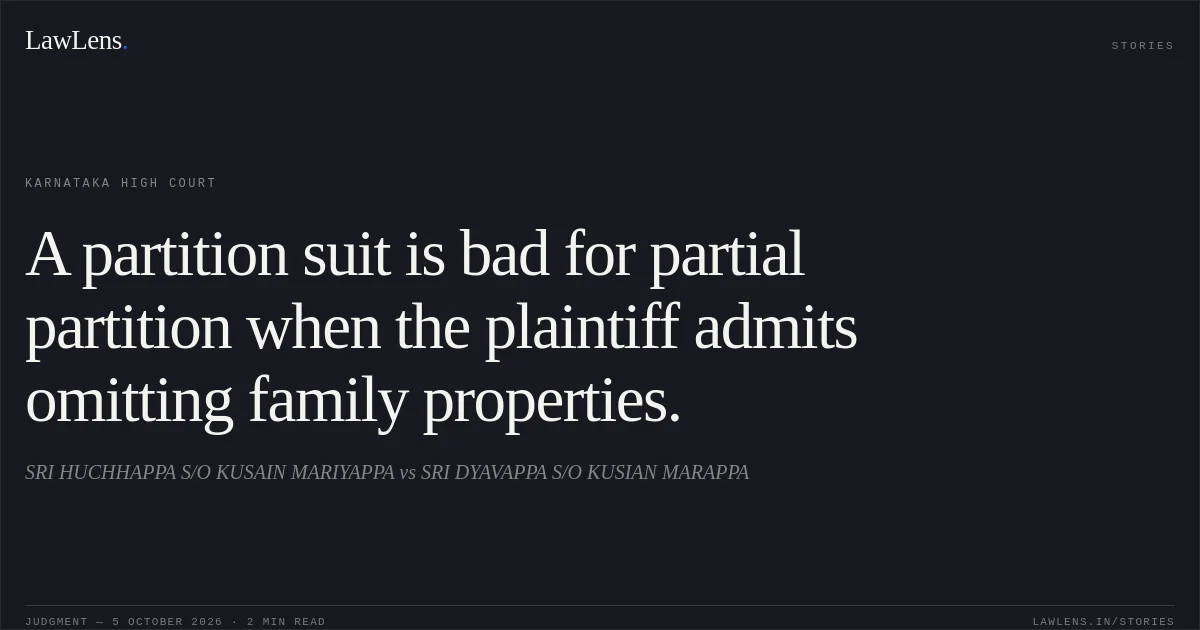
Source reference: no citationDefendant No. 1 contended that the suit was bad for partial partition because it omitted properties at Chikkalavathi said to be part of the joint family estate.
Source reference: no citationThe Trial Court decreed the suit, but the Lower Appellate Court allowed the appeal and dismissed it on the ground of partial partition.
Source reference: no citationIn the second appeal, the plaintiff argued that the defendants had not proved that the Chikkalavathi properties were joint family properties
Source reference: para. 3–8Issues
1. Whether the plaintiff could maintain a partition suit confined to the Kyasanur property despite the defence that properties at Chikkalavathi formed part of the joint family estate
Source reference: para. 92. Whether the Lower Appellate Court’s finding that the suit was bad for partial partition warranted interference in second appeal
Source reference: paras. 9, 15Law Applied
Under Section 100 of the Code of Civil Procedure, a second appeal lies only where a substantial question of law arises.
Source reference: para. 1A partition suit ordinarily must include all properties forming part of the joint family estate, subject to recognised exceptions; where non-inclusion is specifically pleaded, the claim must be considered against the pleadings and evidence concerning the omitted properties
Source reference: para. 9Reasoning
The Court held that, notwithstanding the initial burden on defendant No. 1, the plaintiff’s own admissions supplied material supporting the defence: his father and uncles held lands at Chikkalavathi, his father cultivated lands there as a tenant, the plaintiff had lived and cultivated there, and there had been a partition between the plaintiff and his uncles concerning one survey number.
Source reference: paras. 10–12The plaintiff also claimed that Survey No. 22 was self-acquired, but the Court considered his age at the alleged time of purchase and the absence of cogent evidence establishing his independent means.
Source reference: para. 13Taken cumulatively, the admissions supported the conclusion that the plaintiff could not seek partition of only the Kyasanur property while excluding the Chikkalavathi properties.
Source reference: paras. 14–15Holding
The Court found no substantial question of law warranting interference with the Lower Appellate Court’s decision.
It dismissed the Regular Second Appeal, leaving the dismissal of the plaintiff’s suit in force.
Source reference: para. 15Acts & Sections Cited
1 provisions across 1 statute referred to in this judgment. Each provision opens on LawLens.
Code of Civil Procedure, 19081
Original Court PDF
SRI HUCHHAPPA S/O KUSAIN MARIYAPPAvsSRI DYAVAPPA S/O KUSIAN MARAPPA
Click to open original judgment
Original judgment, available to read, download and summarize on LawLens.in