Facts
The parties entered into a Settlement Agreement dated 30 November 2015 concerning division of property bearing Nos. B-2 and B-3, Main Market, Gokapuri, Delhi.
Source reference: p.2; para. 2Under the Agreement, the basement was to be divided equally, with one portion allotted to the Respondent/Decree Holder and the remaining portion to be divided between the Appellant’s daughters.
Source reference: p.2; para. 2The Appellant subsequently alleged that the Municipal Corporation of Delhi (“MCD”) had declared the entire basement illegal and dangerous and that, with the Respondent’s consent, he filled and closed the basement with malba and other material in 2019.
Source reference: p.2; paras. 3–5In Execution Petition No. 202/2023, the Appellant raised objections seeking to resist enforcement of the Settlement Agreement.
Source reference: p.3; para. 7The learned Executing Court dismissed those objections by order dated 29 May 2026, holding that the Appellant had produced no material proving either the MCD’s alleged declaration or the Respondent’s consent.
Source reference: p.3; para. 7The Appellant challenged that order under Order XXI Rule 58 CPC.
Source reference: p.1; para. 1Issues
1. Whether the Appellant could resist execution of the Settlement Agreement on the basis that the basement had allegedly been declared illegal and dangerous by the MCD, when no supporting order, notice, or document had been produced.
Source reference: pp. 5–6; paras. 14–152. Whether the alleged consent of the Respondent, or any arrangement between the Appellant and his daughters, could defeat or modify the Respondent’s crystallised rights under the Settlement Agreement.
Source reference: pp. 4–5; paras. 10–133. Whether the Executing Court had committed any error of law, perversity, or material irregularity in dismissing the Appellant’s objections.
Source reference: p. 6; para. 17Law Applied
The Court applied Order XXI Rule 58 of the Code of Civil Procedure, 1908, governing objections in execution proceedings.
Source reference: no citationIt reiterated that an executing court must enforce the decree or settlement according to its terms and cannot travel beyond or substantially alter them.
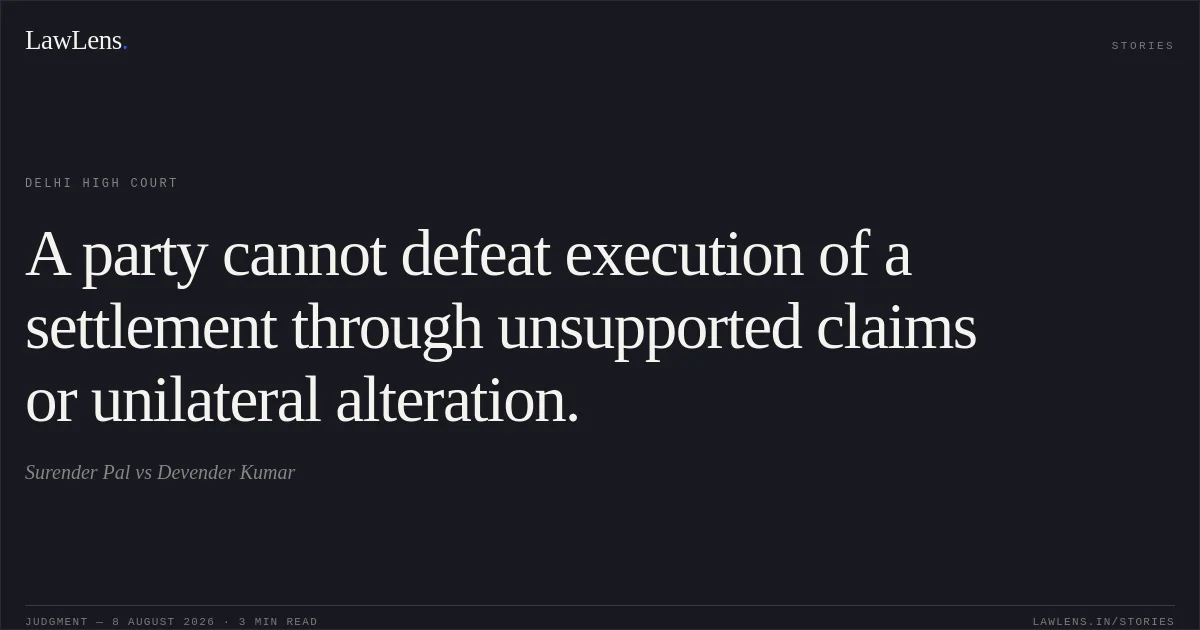
Source reference: p.6; para. 16A party cannot rely on its own unilateral act or wrong to defeat an accrued right of the decree-holder; filling or closing the basement could not render the Settlement Agreement unenforceable without proof that the Respondent had agreed to such alteration.
Source reference: pp.4–5; para. 12Alleged consent or subsequent arrangements must be established through cogent and reliable material, and an intra-family arrangement between the Appellant and his daughters could not prejudice rights arising from an agreement to which the Respondent was a party.
Source reference: p.5; para. 13No specific judicial precedent was cited in the judgment.
Source reference: no citationReasoning
The Court held that the Appellant’s challenge rested entirely on two unsupported assertions: that the MCD had declared the basement illegal and dangerous, and that the Respondent had consented to its closure and filling.
Source reference: p.4; para. 8The Settlement Agreement was undisputed and had crystallised the Respondent’s right to a specified share in the basement.
Source reference: p.4; para. 9Since the Appellant produced no MCD notice, order, demolition direction, communication, or other documentary evidence, the plea of impossibility or alteration arising from MCD action was unsubstantiated.
Source reference: pp.5–6; paras. 14–15Likewise, no evidence established the Respondent’s consent.
Source reference: no citationThe Respondent’s continued pursuit of his rights under the Settlement Agreement was inconsistent with the alleged consent.
Source reference: p.4; para. 11The Appellant therefore could not rely on his own act of filling the basement, or on any alleged consent given by his daughters, to defeat the Respondent’s independent contractual and execution rights.
Source reference: p.5; paras. 12–13Holding
The High Court found no error of law, perversity, or material irregularity in the Executing Court’s order.
It held that the Appellant failed to substantiate either the alleged MCD declaration or the Respondent’s consent, and could not unilaterally defeat the Settlement Agreement dated 30 November 2015.
Source reference: pp.6–7; paras. 17–19The appeal was dismissed, the impugned order dated 29 May 2026 was upheld, and all pending applications were disposed of.
Source reference: p.7; paras. 19–21The Court clarified that its judgment would not affect any independent right or remedy otherwise available to either party in law.
Source reference: p.7; paras. 19–21Original Court PDF
Surender PalvsDevender Kumar
Click to open original judgment
Original judgment, available to read, download and summarize on LawLens.in