Facts
The respondent/plaintiff sued to recover ₹8,00,000, alleging that he had advanced ₹7,00,000 towards the appellant/defendant’s purchase of a flat and a further ₹1,00,000 for the same purpose
Source reference: para. 2–12The appellant denied the loan and was proceeded ex parte; her application to set aside that order was dismissed, and the Trial Court decreed the suit for ₹8,00,000 with interest at 5% per annum from the date of institution
Source reference: para. 24–30During execution, the parties jointly recorded a settlement for ₹9,50,000; ₹1,98,000 was paid to the respondent, and the remaining ₹7,52,000 was deposited in the High Court
Source reference: para. 32–43, 61–69Issues
1. Whether the respondent proved that the appellant was liable to repay the claimed ₹8,00,000, notwithstanding the appellant’s challenge to the ex parte decree and the evidence supporting the alleged loan
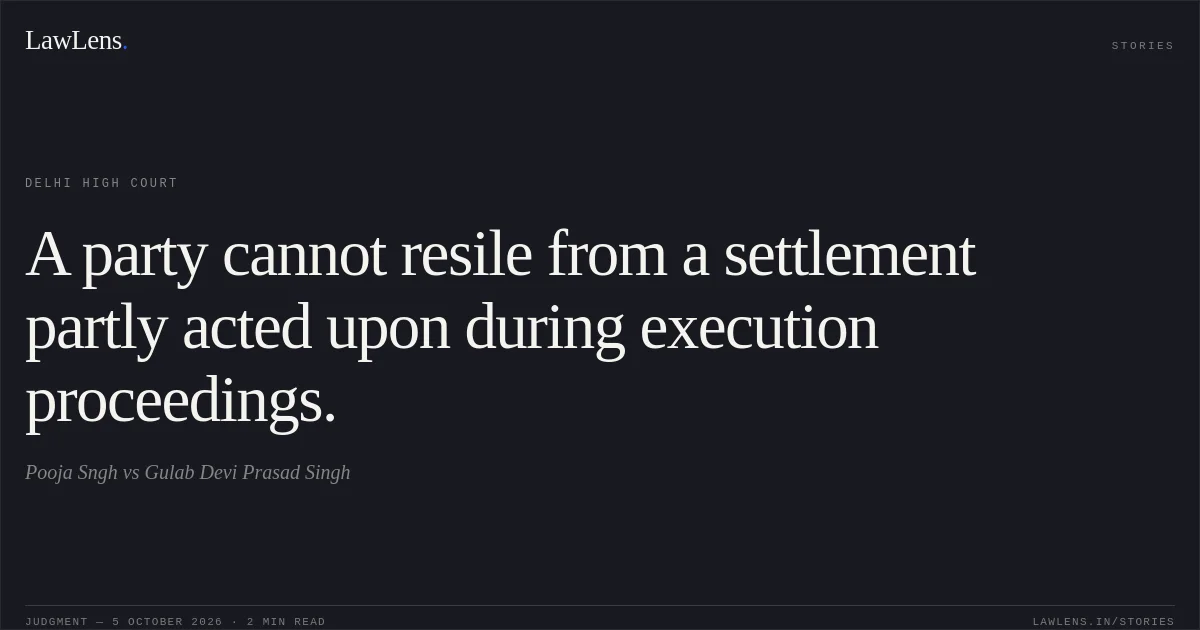
Source reference: para. 44–602. Whether the parties’ subsequent settlement in execution, partly acted upon and followed by deposit of the balance, resolved the monetary dispute in the appeal
Source reference: para. 65–72Law Applied
The appeal arose under Section 96 of the Code of Civil Procedure, 1908, which provides for a first appeal from an original decree
Source reference: para. 1In assessing the decree, the Court scrutinised the plaintiff’s evidence notwithstanding the defendant’s ex parte status, including the unrebutted oral testimony and documentary record
Source reference: para. 26–29Section 34 CPC was applied by the Trial Court to award reasonable interest; the claimed 24% was considered excessive and unsupported, and interest was awarded at 5% per annum from institution of the suit
Source reference: para. 30The judgment cited no precedent establishing a separate rule on proof of loans or settlements; it applied the principle that a party who has acted upon a settlement cannot resile from it
Source reference: para. 65–71Reasoning
The Court found that the bank statements established transfers totalling ₹7,00,000, while the sale deed in the appellant’s name recorded the same amounts and substantially corresponding transaction references; the plaintiff was also a witness to that deed.
Source reference: para. 45–51This corroborated his evidence that the payments were made towards the appellant’s flat purchase, and his testimony that they were loans remained unrebutted.
Source reference: para. 45–51The further ₹1,00,000 payment was also reflected in the bank statement and supported by the plaintiff’s unrebutted testimony.
Source reference: para. 52–58The appellant led no evidence to prove her assertion that the plaintiff had borrowed ₹3,00,000 from her husband.
Source reference: para. 59–60The Court also found no adequate explanation for the appellant’s prolonged inaction after dismissal of her application concerning the ex parte order.
Source reference: para. 61–64Independently, the parties’ execution settlement had been partly performed, and the balance had been deposited; the appellant could not resile from that arrangement.
Source reference: para. 65–70Holding
The Court held that the Trial Court had rightly decreed the suit, but that the parties’ subsequent settlement fixed the appellant’s liability at ₹9,50,000.
As ₹1,98,000 had been paid and the remaining ₹7,52,000 deposited in Court, that balance was directed to be released to the respondent.
Source reference: para. 71–73The appeal was disposed of in terms of the settlement, and pending applications were also disposed of.
Source reference: para. 71–73Acts & Sections Cited
3 provisions across 1 statute referred to in this judgment. Each provision opens on LawLens.
Code of Civil Procedure, 19083
Original Court PDF
Pooja SnghvsGulab Devi Prasad Singh
Click to open original judgment
Original judgment, available to read, download and summarize on LawLens.in