Facts
The petitioner and respondent executed an MoU dated 31 May 2012 concerning the petitioner’s investment of ₹30 lakh for the provisional allotment of a commercial unit in the respondent’s project.
Source reference: p.1–3The respondent paid assured returns until April 2018, then stopped.
Source reference: p.1–3The respondent later demanded further amounts and cancelled the MoU and allotment.
Source reference: p.1–3The petitioner disputed the cancellation and invoked arbitration under Clause 41, but the respondent did not agree to appoint an arbitrator.
Source reference: p.1–3The petitioner therefore sought appointment under Section 11(6) of the Arbitration and Conciliation Act, 1996.
Source reference: p.1–3Clause 41 provided for a sole arbitrator appointed by the respondent’s Chairman-cum-Managing Director.
Source reference: p.1–3Issues
1. Whether Clause 41’s provision authorising the respondent’s Chairman-cum-Managing Director to appoint the sole arbitrator was enforceable.
Source reference: p.3–42. Whether the Court should appoint an independent sole arbitrator under Section 11(6) while preserving the parties’ agreement to arbitrate.
Source reference: p.5–6Law Applied
Section 11 of the Arbitration and Conciliation Act, 1996 empowers the Court, at the referral stage, to conduct a prima facie inquiry into the existence of an arbitration agreement; contested or laborious issues are ordinarily for the arbitral tribunal under Section 16 (SBI General Insurance Co. Ltd. v. Krish Spinning).
Source reference: p.3Under TRF Ltd. v. Energo Engineering Projects Ltd. and Perkins Eastman Architects DPC v. HSCC (India) Ltd., a person ineligible to act as arbitrator cannot appoint another arbitrator, and an interested party’s unilateral appointment power is impermissible.
Source reference: p.4–5The judgment also relies on Bharat Broadband Network Ltd. v. United Telecoms Ltd., Proddatur Cable TV Digi Services v. Siti Cable Network Ltd., Central Organisation for Railway Electrification v. ECI-SPIC-SMO-MCML (JV), and Hindustan Construction Co. Ltd. v. Bihar Rajya Pul Nirman Nigam Ltd. for the principles of impartiality, equality between parties, and severability of an invalid appointment mechanism from the parties’ substantive agreement to arbitrate.
Source reference: p.5–6Reasoning
Clause 41 contained an arbitration agreement, which the respondent did not dispute; the contest concerned only the authority to appoint the arbitrator.
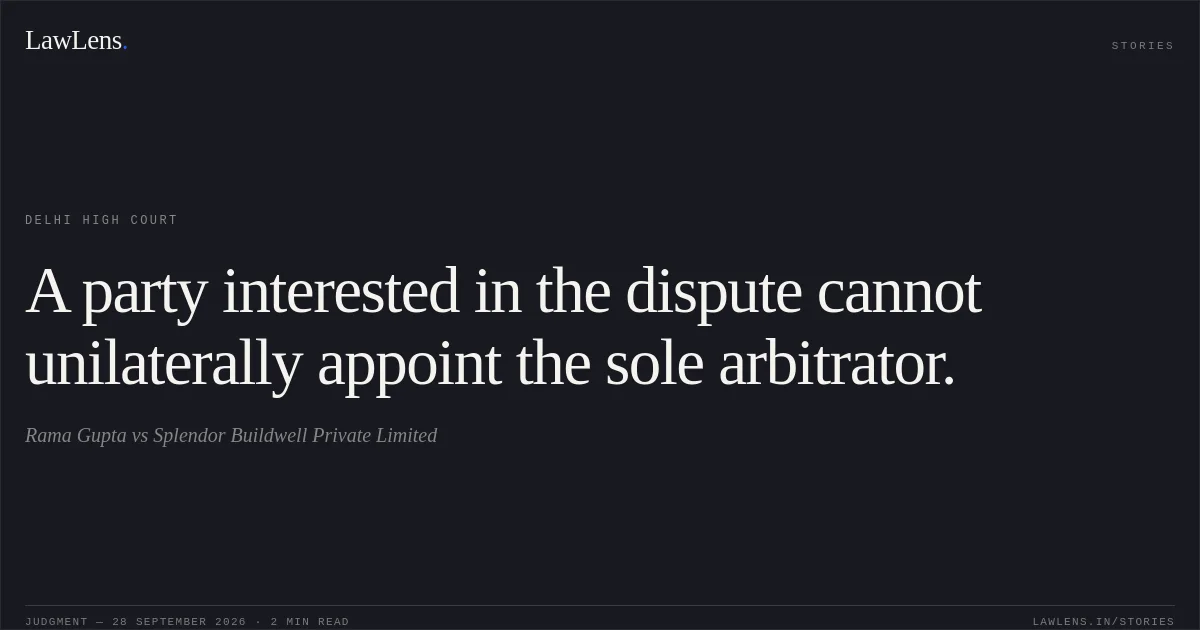
Source reference: p.3–4Applying Perkins and the related authorities, the Court held that the respondent’s Chairman-cum-Managing Director, as an official of a party interested in the dispute, could not control the appointment of the sole arbitrator.
Source reference: p.4–6That appointment mechanism was therefore void and unenforceable, but its invalidity did not defeat the parties’ remaining agreement to arbitrate.
Source reference: p.4–6The Court consequently appointed an independent arbitrator.
Source reference: p.4–6Holding
The petition was allowed.
The Court appointed Ms. Samridhi Vats, Advocate, as sole arbitrator to adjudicate the disputes, with the proceedings under the aegis of DIAC and fees as per the applicable DIAC Rules.
Source reference: p.6–7The arbitrator was directed to make the disclosure required by Section 12 of the 1996 Act.
Source reference: p.6–7The Court left the merits and the parties’ contentions open and permitted the respondent to bring any counterclaim before the arbitrator.
Source reference: p.6–7Acts & Sections Cited
3 provisions across 1 statute referred to in this judgment. Each provision opens on LawLens.
Arbitration and Conciliation Act, 19963
Original Court PDF
Rama GuptavsSplendor Buildwell Private Limited
Click to open original judgment
Original judgment, available to read, download and summarize on LawLens.in