Facts
The parties were involved in cross-suits concerning land at Survey No. 39, including a disputed 39-guntha parcel. During the suits, they executed a registered family-settlement MOU dated 4 November 2023. Under it, the defendant agreed to execute a relinquishment deed concerning the disputed parcel, while the plaintiff agreed to transfer leasehold rights in Government land at Survey No. 66 paiki to the defendant.
Source reference: p. 20–21, paras. 9.2–9.3The parties jointly applied for a consent decree on 6 November 2023. The plaintiff’s daughters withdrew related civil suits, and a revenue revision was rejected after the defendant relied on the MOU.
Source reference: p. 21–23, paras. 9.4–9.7The defendant later sought to withdraw his consent, asserting that the settlement had failed and that the transfer of Government-land leasehold rights was unlawful.
Source reference: p. 23–25, paras. 9.8–9.10The Trial Court upheld the MOU and granted relief in accordance with it; the first appellate court dismissed the defendant’s appeals. The defendant then filed these second appeals under Section 100 CPC.
Source reference: p. 23–25, paras. 9.8–9.10Issues
1. Whether the registered MOU was a lawful and binding family settlement capable of adjusting the parties’ claims and supporting a consent decree under Order XXIII Rule 3 CPC.
Source reference: p. 23–30, paras. 9.8–132. Whether the defendant could withdraw his consent after the parties had acted on the MOU, including by withdrawing related suits and relying on it in revenue proceedings.
Source reference: p. 21–23, 28–30, paras. 9.4–9.8, 12–12.23. Whether the concurrent decisions disclosed a substantial question of law warranting interference under Section 100 CPC.
Source reference: p. 30–36, paras. 13–16.3Law Applied
Under Order XXIII Rule 3 CPC, the court that records a compromise must determine a dispute over whether the suit has been adjusted by a lawful agreement.
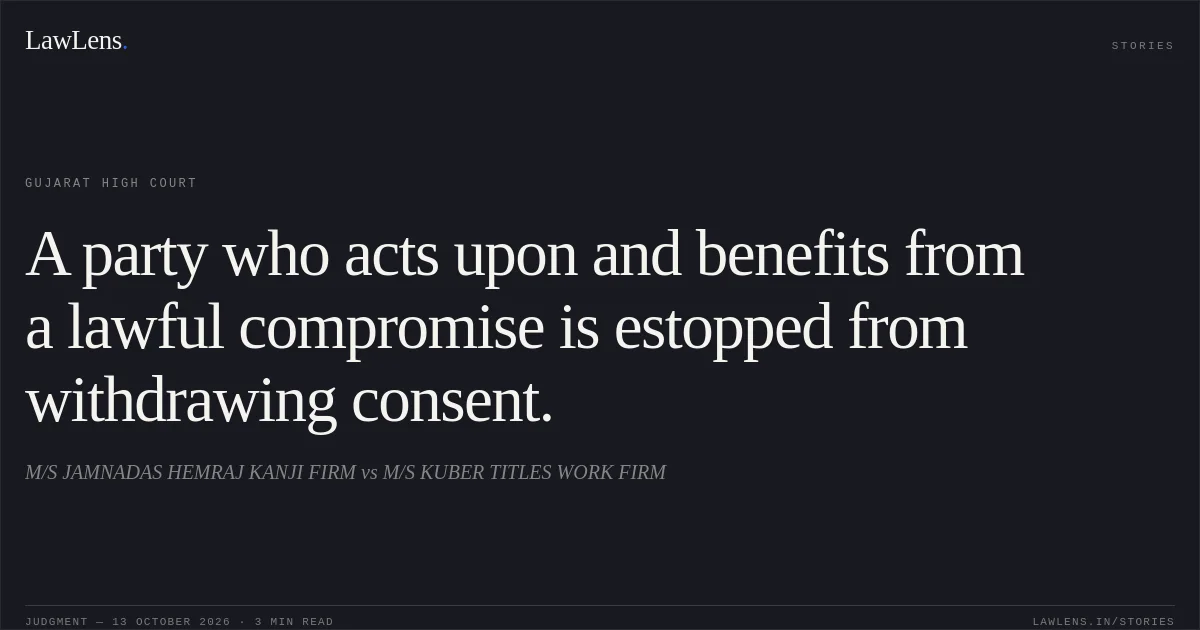
Source reference: p. 28–30, paras. 12–13A family settlement may be enforced where it is lawful and the parties have acted upon it; a party who knowingly accepts benefits under a settlement may be estopped from resiling from it, though estoppel cannot override a prohibition of law.
Source reference: p. 28–30, paras. 12–13Section 100 CPC limits second appeals to cases involving a substantial question of law; concurrent factual findings are not ordinarily disturbed unless, for example, they are perverse, unsupported by evidence, or contrary to mandatory law.
Source reference: p. 31–36, paras. 15–16.3The Court also considered the appellant’s arguments under Section 23 of the Contract Act but found no basis to treat the settlement as unlawful.
Source reference: p. 11–14, 25–28, paras. 6.2–6.7, 10–11.1Reasoning
The Court found that the MOU provided for a relinquishment deed—not a sale without consideration—in respect of the 39-guntha parcel, as part of a broader family settlement involving reciprocal arrangements and the parties’ resolution of other disputes.
Source reference: p. 25–26, para. 10.1As to Survey No. 66 paiki, the MOU concerned transfer of leasehold rights, not ownership of Government land; the Court found no material establishing that such rights could not be transferred, and observed that any required permissions or implementing documents could be addressed in execution.
Source reference: p. 26–28, paras. 11–11.1The defendant had signed the registered MOU, jointly sought a consent decree, and obtained benefits after related claims were withdrawn and the MOU was relied upon in revenue proceedings. In the absence of evidence of fraud or coercion, the Court held that he could not resile from the settlement; nor did the 60-day implementation period invalidate it, particularly as the joint application for a decree had been filed within that period.
Source reference: p. 22–23, 28–30, paras. 9.6–9.8, 12–12.2The concurrent findings disclosed no substantial question of law requiring intervention.
Source reference: p. 30–36, paras. 13–16.3Holding
The Court held that the MOU was lawful and binding, that the defendant was estopped from withdrawing his consent after acting upon and benefiting from the settlement, and that no substantial question of law arose in the second appeals.
Both appeals were dismissed with costs of ₹50,000 payable by the appellant to the respondent; the judgments and decrees below were confirmed, and the connected civil applications were disposed of.
Source reference: p. 36–37, paras. 17–18Acts & Sections Cited
2 provisions across 2 statutes referred to in this judgment. Each provision opens on LawLens.
Code of Civil Procedure, 19081
Indian Contract Act, 18721
Original Court PDF
M/S JAMNADAS HEMRAJ KANJI FIRMvsM/S KUBER TITLES WORK FIRM
Click to open original judgment
Original judgment, available to read, download and summarize on LawLens.in