Facts
The complainant appealed the acquittal of two accused by the Special (POCSO) Court, Godhra, on charges under Sections 363, 366, 376(2)(n) and 114 IPC and Sections 4, 6 and 12 of the POCSO Act.
Source reference: paras. 1, 3, 7; pp. 1–2The prosecution alleged that accused No. 1 enticed the victim, aged about 16 years and 6 months, took her to Halol, and repeatedly had sexual intercourse with her, while accused No. 2 assisted him.
Source reference: paras. 1, 3, 7; pp. 1–2The trial court found the victim to be a child under the POCSO Act but acquitted the accused, principally because she did not support the prosecution allegations and the other evidence did not establish the charges beyond reasonable doubt.
Source reference: paras. 1, 3, 7; pp. 1–2The complainant challenged that acquittal, arguing that the medical, documentary and witness evidence had been wrongly disregarded.
Source reference: paras. 8–11; pp. 3–4Issues
Whether the trial court’s acquittal was perverse or otherwise warranted appellate interference
Source reference: paras. 12–14, 20; pp. 4–5, 8Whether the prosecution established the foundational facts necessary to prove the alleged offences and raise the presumptions under Sections 29 and 30 of the POCSO Act, notwithstanding the victim’s evidence
Source reference: paras. 15, 18–19; pp. 5, 7–8Law Applied
In an appeal against acquittal, the appellate court must respect the reinforced presumption of innocence and should interfere only where compelling circumstances show that the acquittal is perverse; where the trial court’s view is reasonable and possible, a different possible view is insufficient to justify interference (Tulasareddi @ Mudakappa & Anr. v. State of Karnataka & Ors., 2026 INSC 67).
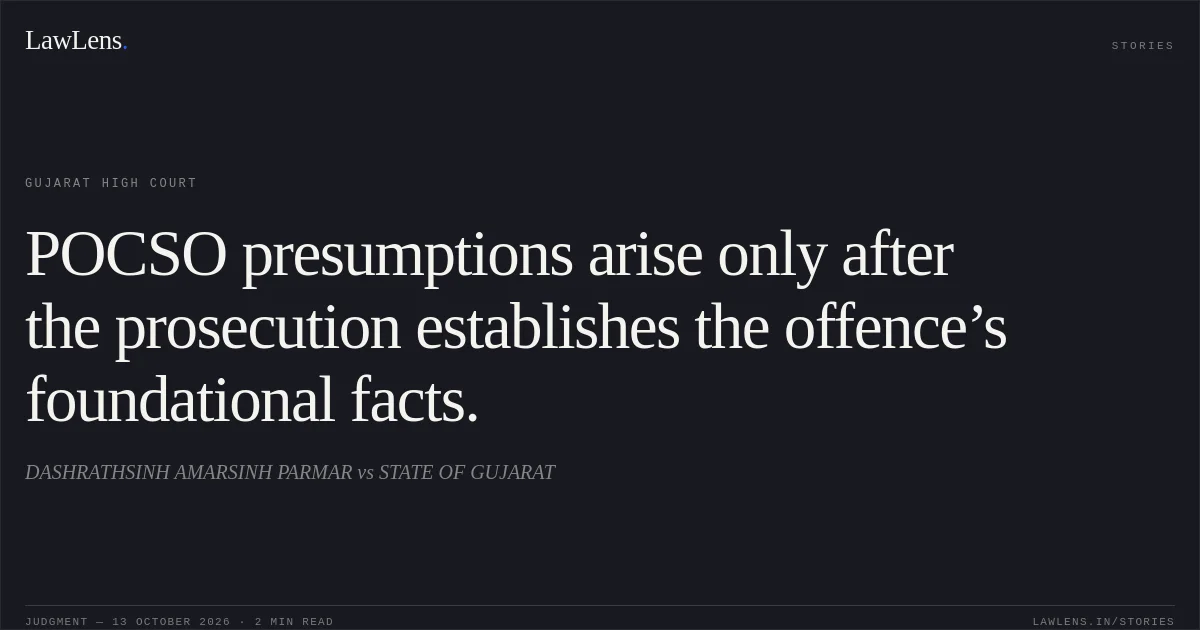
Source reference: para. 14; p. 5Under Sections 29 and 30 of the POCSO Act, the statutory presumptions arise only after the prosecution establishes the foundational facts of the offence.
Source reference: para. 19; pp. 7–8A statement under Section 164 CrPC is not substantive evidence and, without being tested in cross-examination, cannot by itself prove the charge.
Source reference: para. 16; p. 6Reasoning
The victim testified that she had left home because her parents were pressing her to marry, but did not implicate either accused in enticing or taking her, staying with her at Halol, or having sexual intercourse with her.
Source reference: para. 16; p. 6The court found that the parents were not eyewitnesses, the evidence of PW-7 and PW-8 did not prove the alleged tenancy beyond reasonable doubt, and the medical histories and evidence of hymenal rupture did not independently establish the accused’s involvement.
Source reference: para. 18; p. 7The panch evidence could not fill the evidentiary gap, and the victim’s Section 164 statement could not substitute for substantive testimony.
Source reference: paras. 16, 18; pp. 6–7Because the prosecution had not established the foundational facts, the POCSO presumptions did not arise; the trial court’s acquittal was a reasonable and possible view.
Source reference: paras. 19–20; p. 8Holding
The High Court held that the prosecution had not established the alleged offences or the foundational facts necessary to invoke Sections 29 and 30 of the POCSO Act.
Finding no perversity or compelling reason to interfere with the acquittal, it dismissed the appeal at the admission stage.
Source reference: paras. 19–21; p. 8Acts & Sections Cited
15 provisions across 4 statutes referred to in this judgment. Each provision opens on LawLens.
Indian Penal Code, 18604
Protection of Children from Sexual Offences Act, 20126
Bharatiya Nagarik Suraksha Sanhita, 20231
Code of Criminal Procedure, 19734
Original Court PDF
DASHRATHSINH AMARSINH PARMARvsSTATE OF GUJARAT
Click to open original judgment
Original judgment, available to read, download and summarize on LawLens.in