Facts
On 14 June 2023, the appellant was travelling as a passenger in Tractor No. GJ-27-DM-5539 when State Transport Bus No. GJ-18-ZT-1408, driven by respondent No. 1, collided with the tractor from behind, allegedly due to rash and negligent driving.
Source reference: p.2The appellant sustained multiple fractures, underwent surgery and prolonged treatment, and claimed compensation of ₹7,00,000 under the Motor Vehicles Act.
Source reference: p.2The Motor Accident Claims Tribunal, Kheda at Nadiad, partly allowed the claim petition and awarded ₹1,73,484 with interest at 7.5% per annum, while attributing 10% negligence to the appellant.
Source reference: p.2; p.10The appellant challenged the award seeking enhancement of compensation and deletion of the finding of contributory negligence.
Source reference: pp.3–6Issues
Whether the compensation awarded by the Tribunal required enhancement by reassessing the appellant’s income, adding future prospects, and increasing the amounts awarded under non-pecuniary heads?
Source reference: pp.3–4, 7–10Whether the Tribunal was justified in attributing 10% negligence to the appellant, who was travelling as a passenger in the tractor, or whether the accident resulted from the composite negligence of the two vehicle drivers?
Source reference: pp.4–6, 10–11Law Applied
The Court applied the principle that, where actual income is not proved, compensation may be assessed on the basis of the applicable minimum-wage notification.
Source reference: p.7Relying on National Insurance Co. Ltd. v. Pranay Sethi, AIR 2017 SC 5157, and Sidram v. Divisional Manager, United India Insurance Co. Ltd., (2023) 3 SCC 439, it held that 25% must be added to the income of a 47-year-old claimant towards future prospects.
Source reference: p.4; p.7The Court applied the multiplier method for computing future loss of income and treated the established functional disability of 12% of the whole body as the basis for that computation.
Source reference: p.7On negligence, the Court relied on Khenyei v. New India Assurance Co. Ltd., (2015) 9 SCC 273, which establishes that in cases of composite negligence the claimant may recover the entire compensation from any one of the joint tort-feasors, since their liability is joint and several.
Source reference: pp.4–6, 10–11Reasoning
Since the appellant’s income as a labourer was not proved by cogent evidence, the Court substituted the Tribunal’s assessment of ₹8,000 per month with the applicable minimum wage for a skilled worker, namely ₹12,324 per month.
Source reference: p.7Applying the 25% future-prospects addition, the monthly income became ₹15,405; after applying 12% functional disability and the multiplier of 13, the Court calculated future loss of income at ₹2,88,444.
Source reference: p.7The actual loss of income for two months was reassessed at ₹24,648.
Source reference: p.8Considering the multiple fractures, surgery, hospitalisation and subsequent outpatient treatment, the Court enhanced compensation for pain, shock and suffering from ₹12,000 to ₹45,000 and for special diet, transportation and attendant charges from ₹10,000 to ₹25,000.
Source reference: p.9The medical-expenses award of ₹5,000 was left undisturbed.
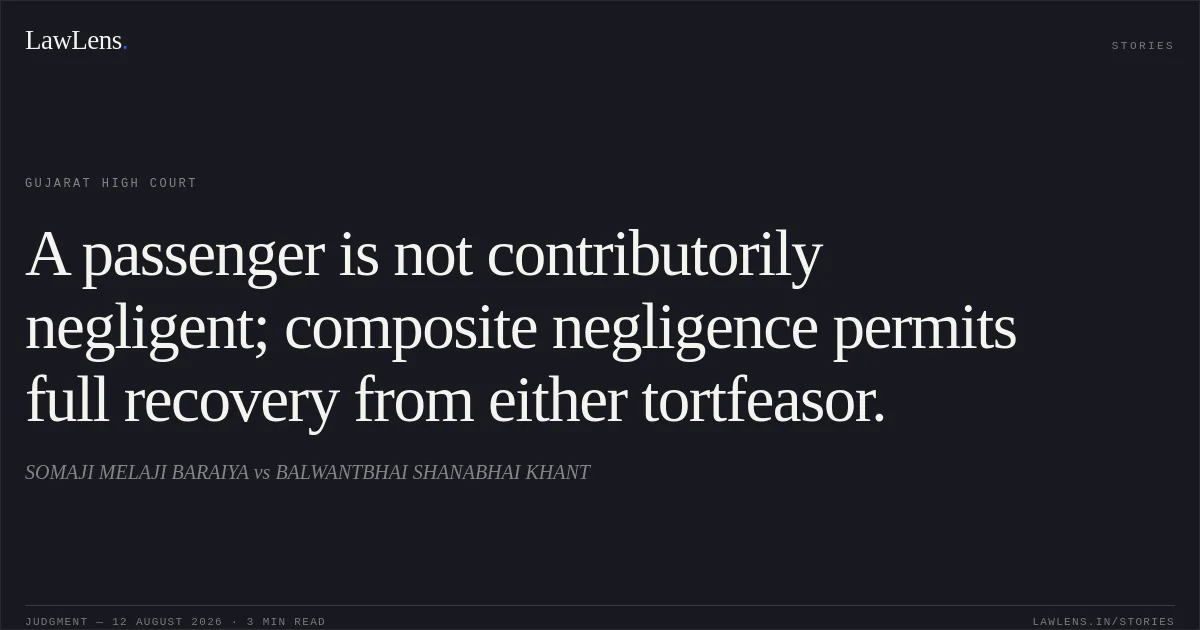
Source reference: p.8On negligence, the Court held that the appellant, being a passenger, could not be treated as negligent merely because he was travelling in the tractor.
Source reference: p.10The accident was attributable to the composite negligence of the bus and tractor drivers; consequently, under Khenyei, the appellant was entitled to recover the compensation from either tort-feasor.
Source reference: p.10Holding
The appeal was partly allowed.
The total compensation was enhanced from ₹1,73,484 to ₹3,88,092, resulting in additional compensation of ₹2,14,608.
Source reference: p.9The finding attributing 10% negligence to the appellant was quashed and set aside.
Source reference: p.10The additional amount was made payable with interest at 7.5% per annum from the date of filing of the claim petition until realisation.
Source reference: p.12Respondent No. 2-Corporation was directed to deposit the additional compensation and interest before the Tribunal within six weeks, after which the Tribunal was directed to disburse the entire awarded amount subject to verification and deduction of any deficit court fee.
Source reference: p.13Original Court PDF
SOMAJI MELAJI BARAIYAvsBALWANTBHAI SHANABHAI KHANT
Click to open original judgment
Original judgment, available to read, download and summarize on LawLens.in