Facts
On 4 January 2021, the claimants were travelling as passengers in a Chhakdo bearing registration No. GJ-12-BW-6342 when it collided with a Dumper bearing registration No. GJ-12-BW-0421. The claimants alleged that the accident occurred due to the rash and negligent driving of both vehicles and that they sustained grievous injuries as a result.
Source reference: p.2, para. 2They filed separate motor accident claim petitions, being MACP Nos. 568 and 569 of 2021. The Motor Accident Claims Tribunal, Bhuj, rejected both petitions, holding that the claimants had filed them with a malicious intention and had manipulated the facts.
Source reference: p.4, para. 6The Tribunal also relied substantially on the FIR, which attributed the accident to the driver of the Chhakdo. The claimants challenged the rejection before the Gujarat High Court, contending that the case involved composite negligence and that their oral evidence ought to have been preferred over the FIR.
Source reference: pp.2–4, paras. 3–5Issues
Whether the Tribunal was justified in rejecting the claim petitions when the claimants were passengers and the accident involved the composite negligence of two vehicles?
Source reference: p.4, para. 6Whether the Tribunal erred in giving greater weight to the FIR than to the oral evidence recorded before it regarding the manner in which the accident occurred?
Source reference: p.6, para. 7Whether the impugned judgment and awards required to be set aside and the matters remanded for fresh adjudication?
Source reference: p.6, para. 8Law Applied
The Court applied the principle of composite negligence, under which an injured claimant may recover the entire compensation from any one of the joint tortfeasors without the necessity of establishing the precise degree of negligence attributable to each tortfeasor.
Source reference: p.4, para. 6The Court relied on Khenyei v. New India Assurance Co. Ltd., 2015 ACJ 1441 (SC), as referred to in Manomati Chouhan & Anr. v. Oriental Insurance Co. Ltd. & Ors., 2026 ACJ 742, concerning the rights of claimants in cases of composite negligence. It also relied on National Insurance Co. Ltd. v. Challa Bharathamma, 2004 ACJ 2094 (SC) regarding the insurer’s obligation to satisfy an award and its right, where applicable, to recover the amount from the insured.
Source reference: p.5, para. 6Further, relying on National Insurance Co. Ltd. v. Chamundeswari & Ors., 2021 (18) SCC 596, the Court held that where evidence recorded before the Tribunal conflicts with the FIR, the Tribunal must give appropriate weight to the evidence led before it rather than mechanically relying on the FIR.
Source reference: p.6, para. 7Reasoning
The High Court noted that the claimants were admittedly passengers and were not driving either of the vehicles; therefore, no negligence could be attributed to them.
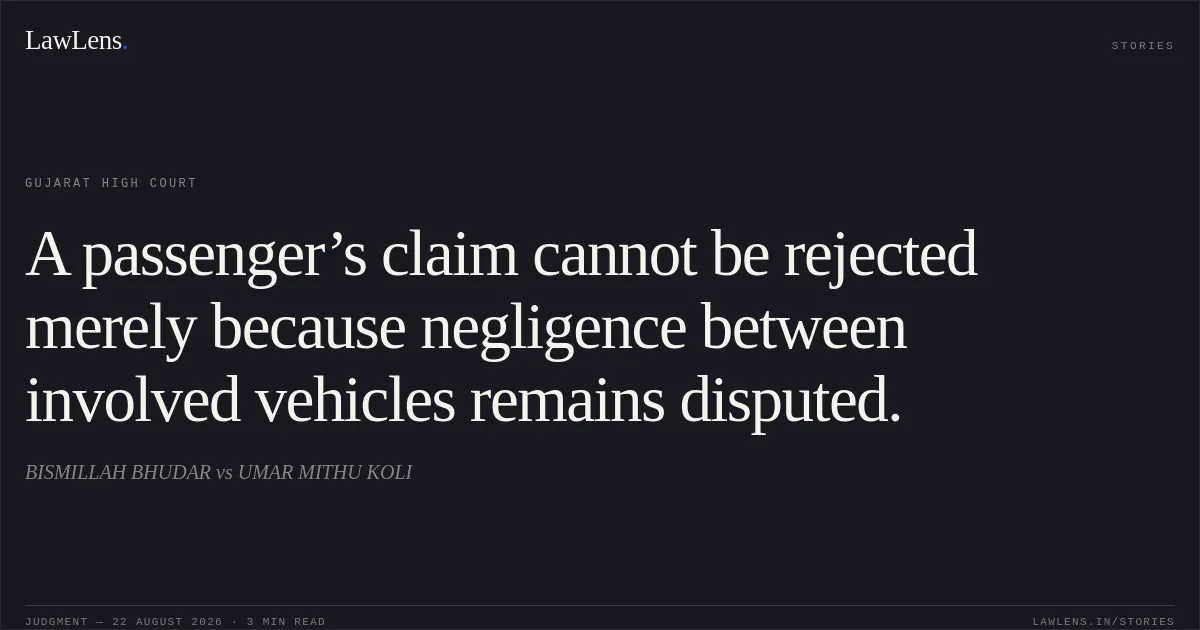
Source reference: p.4, para. 6Since the accident involved both the Chhakdo and the Dumper, the pleaded case disclosed, at least prima facie, a case of composite negligence. Consequently, the Tribunal could not reject the claims merely because the precise negligence of each driver had not been established.
Source reference: p.4, para. 6The Court further found that the Tribunal had placed excessive reliance on the FIR, despite the claimants having subsequently filed affidavits and given oral evidence supporting their case. In accordance with Chamundeswari, such oral and documentary evidence had to be properly assessed, and the FIR could not automatically prevail over evidence recorded during the proceedings.
Source reference: p.6, para. 7The findings that the claimants had maliciously instituted the proceedings and manipulated the facts were therefore held unsustainable without a proper evaluation of the entire evidence.
Source reference: no citationHolding
The Gujarat High Court held that the Tribunal’s findings on negligence were unsustainable.
It accordingly set aside the judgment and awards dated 3 August 2024 in MACP Nos. 568 and 569 of 2021 and remanded both matters to the Tribunal for fresh adjudication after giving the parties an opportunity to lead evidence.
Source reference: p.6, para. 8The Tribunal was directed to decide the matters, preferably within six months, and the parties were directed to cooperate and avoid unnecessary adjournments.
Source reference: p.6, para. 9The record and proceedings were ordered to be transmitted to the Tribunal forthwith.
Source reference: p.7, para. 10Original Court PDF
BISMILLAH BHUDARvsUMAR MITHU KOLI
Click to open original judgment
Original judgment, available to read, download and summarize on LawLens.in