Facts
The deceased held a valid ticket for travel from Mehsana Junction to New Delhi on 9 June 2019. During the journey, he fell from the train near Rewari, was taken to hospital, and later died
Source reference: p.2, para. 2The Railway Claims Tribunal dismissed the family’s compensation claim, inferring from the DRM report and the absence of a scheduled stop at Rewari that the deceased had tried to alight from the moving train
Source reference: p.2, para. 3On appeal, the High Court noted that the deceased’s bona fide passenger status was no longer disputed; the issue was whether the fall constituted an untoward incident or fell within the self-inflicted injury exception
Source reference: p.3, para. 6Issues
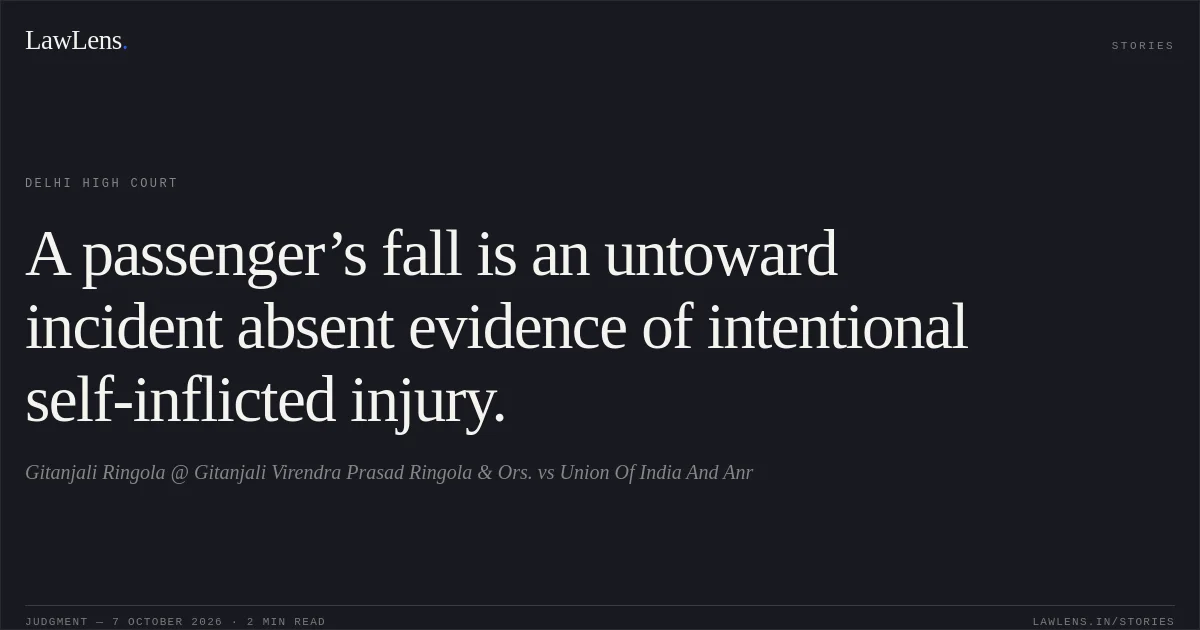
Whether the deceased’s fall from the train was an “untoward incident” under Section 123(c)(2) of the Railways Act, 1989
Source reference: p.3, para. 6Whether the evidence established that the deceased intentionally attempted to alight from the moving train, bringing the case within the self-inflicted injury exception under Section 124-A
Source reference: pp. 4–5, paras. 8–10Law Applied
Section 123(c)(2) of the Railways Act, 1989 includes the accidental falling of a passenger from a train carrying passengers as an “untoward incident”; liability under Section 124-A is subject to the exceptions in its proviso
Source reference: p.3, para. 7In Union of India v. Prabhakaran Vijaya Kumar, (2008) 9 SCC 527, the Supreme Court recognised the beneficial nature of the compensation provision
Source reference: p.3, para. 7In Union of India v. Rina Devi, (2019) 3 SCC 572, the Court explained that an injury is self-inflicted only where the circumstances establish the passenger’s intention to inflict it; negligence alone is insufficient
Source reference: p.3, para. 7Reasoning
The record established that the deceased fell from the train, but did not establish that he had tried to get down from it.
Source reference: pp. 4–5, paras. 9–10, 13The RPF constable arrived after the occurrence, while the statement attributing a jump to the deceased relied on information from an unidentified, unexamined person; no railway staff member gave eyewitness evidence.
Source reference: pp. 4–5, paras. 9–10, 13The Tribunal’s inference from the train’s lack of a scheduled stop at Rewari and the deceased’s employment near Dharuheda did not prove his conduct at the time of the fall.
Source reference: pp. 5–6, paras. 11, 13Accordingly, the evidence did not establish the intention required to invoke the self-inflicted injury exception.
Source reference: p.6, para. 14Holding
The High Court held that the fall constituted an “untoward incident” under Section 123(c)(2), set aside the Tribunal’s judgment, and remanded the matter for assessment of compensation.
It directed the Tribunal to have the compensation disbursed within two months of receipt of the order and listed the matter before the Tribunal on 30 November 2026.
Source reference: pp. 6–7, para. 15The appeal was allowed and disposed of.
Source reference: p.7, para. 16Acts & Sections Cited
2 provisions across 2 statutes referred to in this judgment. Each provision opens on LawLens.
Railway Claims Tribunal Act, 19871
Railways Act, 19891
Original Court PDF
Gitanjali Ringola @ Gitanjali Virendra Prasad Ringola & Ors.vsUnion Of India And Anr
Click to open original judgment
Original judgment, available to read, download and summarize on LawLens.in