Facts
The petitioner sought a direction under Article 226 for the authorities to consider his representation and convene a peace committee meeting concerning the customary selection of a poosari for Arulmigu Nallathangal Kovil.
Source reference: para. 3, 6The temple land had been purchased for the temple, and the sale deed named the sixth respondent as headman/leader.
Source reference: para. 4, 9The petitioner alleged that the sixth respondent opposed the customary appointment and claimed ownership of the land.
Source reference: para. 7–8The authorities stated that a meeting had previously been convened before the Tahsildar, but the petitioner had not attended, and that the dispute could give rise to a law-and-order issue.
Source reference: para. 8Issues
Whether the Revenue Divisional Officer should convene a peace committee meeting to facilitate an amicable resolution of the dispute concerning the customary ceremonies and selection of a poosari.
Source reference: para. 3, 10Whether any settlement reached at such a meeting would bind the parties.
Source reference: para. 11Law Applied
The petition invoked the High Court’s jurisdiction under Article 226 of the Constitution of India.
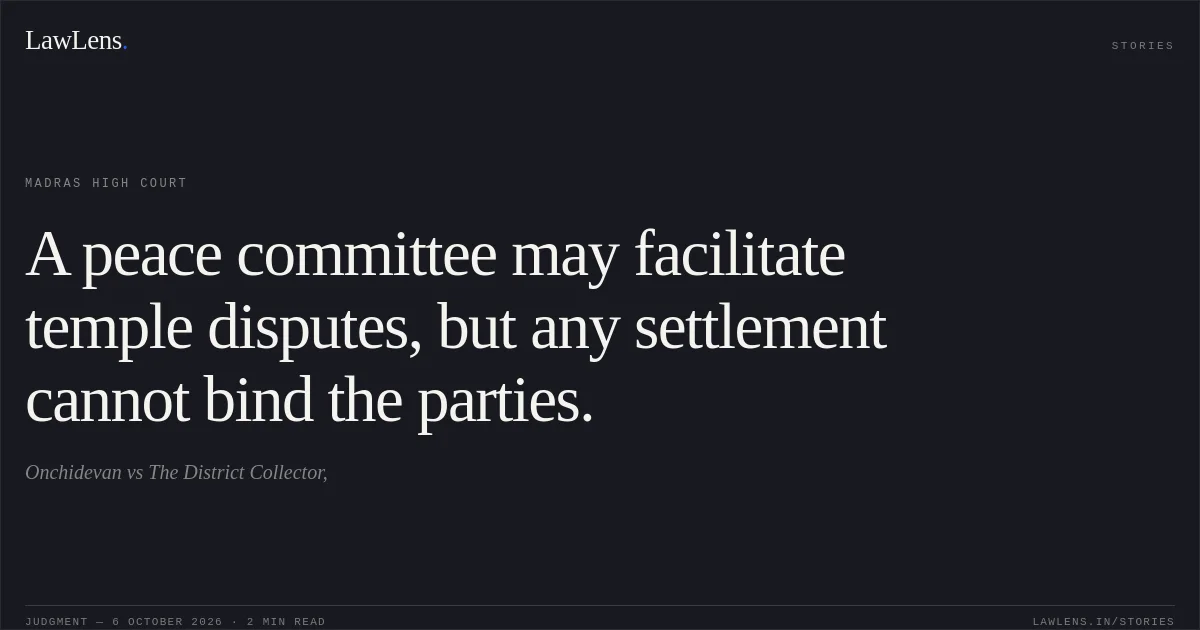
Source reference: no citationThe Court treated a peace committee meeting as a means by which the Revenue Divisional Officer could persuade the parties to reach an amicable settlement, not as a forum to determine their rights; any settlement would not bind them.
Source reference: para. 11No specific statute or precedent was identified in the order.
Source reference: no citationReasoning
Given that the Kumbabhishekam had taken place and further ceremonies were reportedly required under family custom, the Court considered a meeting among members of all five families, including the petitioner and the sixth respondent, appropriate to seek an amicable resolution.
Source reference: para. 10However, because the sixth respondent disputed the petitioner’s position and claimed ownership of the land, the Court confined the authority’s role to facilitating settlement and clarified that any settlement would not bind the parties.
Source reference: para. 7–8, 11Holding
The writ petition was disposed of with a direction to the second respondent, the Revenue Divisional Officer, to convene a meeting as expeditiously as possible, preferably within seven days of receiving a copy of the order.
The parties remained free to arrive at an appropriate decision; no costs were ordered, and the connected miscellaneous petition was closed.
Source reference: para. 13Original Court PDF
OnchidevanvsThe District Collector,
Click to open original judgment
Original judgment, available to read, download and summarize on LawLens.in