Facts
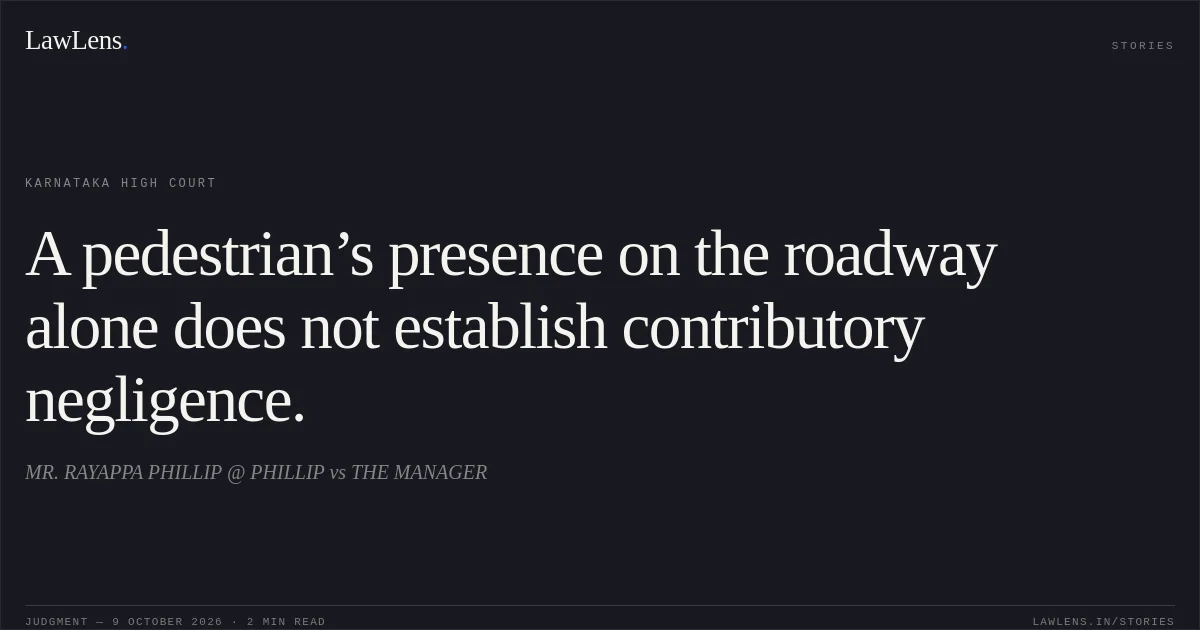
The claimant sustained fractures to both bones of his left leg when a motorcycle struck him from behind while he was walking on the left side of a road in Bengaluru.
Source reference: pp. 3–4, 11He was treated as an inpatient for eight days.
Source reference: pp. 3–4, 11The Tribunal assessed compensation at ₹5,94,200, but deducted 20% for contributory negligence because the claimant was walking on the tar road rather than the footpath, leaving ₹4,75,360 payable.
Source reference: pp. 5–6The claimant appealed, challenging the negligence finding and seeking enhancement of compensation.
Source reference: p. 6Issues
1. Whether the claimant was contributorily negligent merely because he was walking on the tar road, and whether the Tribunal’s 20% deduction should be set aside.
Source reference: pp. 8–10, paras. 12–172. Whether the claimant was entitled to enhancement of the compensation awarded by the Tribunal.
Source reference: p. 8, para. 12; p. 12, para. 19Law Applied
Under Section 166 of the Motor Vehicles Act, 1988, a claimant may seek compensation for injuries caused in a motor accident; the appeal was brought under Section 173(1) of the Act.
Source reference: pp. 2–3Relying on Smt. K. Anusha & Ors. v. Regional Manager, Shriram General Insurance Co. Ltd., 2021 (4) TAC 341, the Court stated that contributory negligence requires an act or omission materially contributing to the accident or damage; merely failing to take extraordinary precautions to avoid a collision does not establish it.
Source reference: p. 10, para. 16The Court also referred to Sarla Verma v. Delhi Transport Corporation, AIR 2009 SC 3104, in upholding the Tribunal’s approach to the multiplier, alongside the KSLSA chart.
Source reference: p. 12, para. 19Reasoning
The evidence showed that the claimant was walking on the left side of the road when the motorcycle struck him from behind.
Source reference: pp. 9–10, paras. 14–15The spot sketch placed the accident approximately two feet from the footpath, and the road was 20 feet wide, leaving the motorcyclist room to avoid the collision.
Source reference: pp. 9–10, paras. 14–15The claimant’s presence on the tar road, without evidence of conduct materially contributing to the accident, did not establish contributory negligence under K. Anusha; the Tribunal’s 20% deduction was therefore erroneous.
Source reference: p. 10, paras. 16–17However, the Court upheld the Tribunal’s assessment of 15% whole-body disability, its findings on age, income and multiplier, and the compensation under the other heads as reasonable.
Source reference: pp. 11–12, paras. 18–19Holding
The Court allowed the appeal in part and set aside the finding of 20% contributory negligence.
It left the Tribunal’s total compensation of ₹5,94,200 otherwise unaltered and directed the insurance company to pay the entire amount with interest at 6% per annum; no order as to costs was made.
Source reference: pp. 12–13, para. 20Acts & Sections Cited
2 provisions across 1 statute referred to in this judgment. Each provision opens on LawLens.
Motor Vehicles Act, 19882
Original Court PDF
MR. RAYAPPA PHILLIP @ PHILLIPvsTHE MANAGER
Click to open original judgment
Original judgment, available to read, download and summarize on LawLens.in
![A candidate who participates without objection cannot challenge the selection process after an unsuccessful result.. DR M HARISHANKAR vs Indian Council Of Medical Research. CAT - ['Chennai']. LawLens](/stories/thumbnails/a-candidate-who-participates-without-objection-cannot-challenge-the-selection-process-afte-1be69bf44f794a2ab5dae60a521c31dd.webp)