Facts
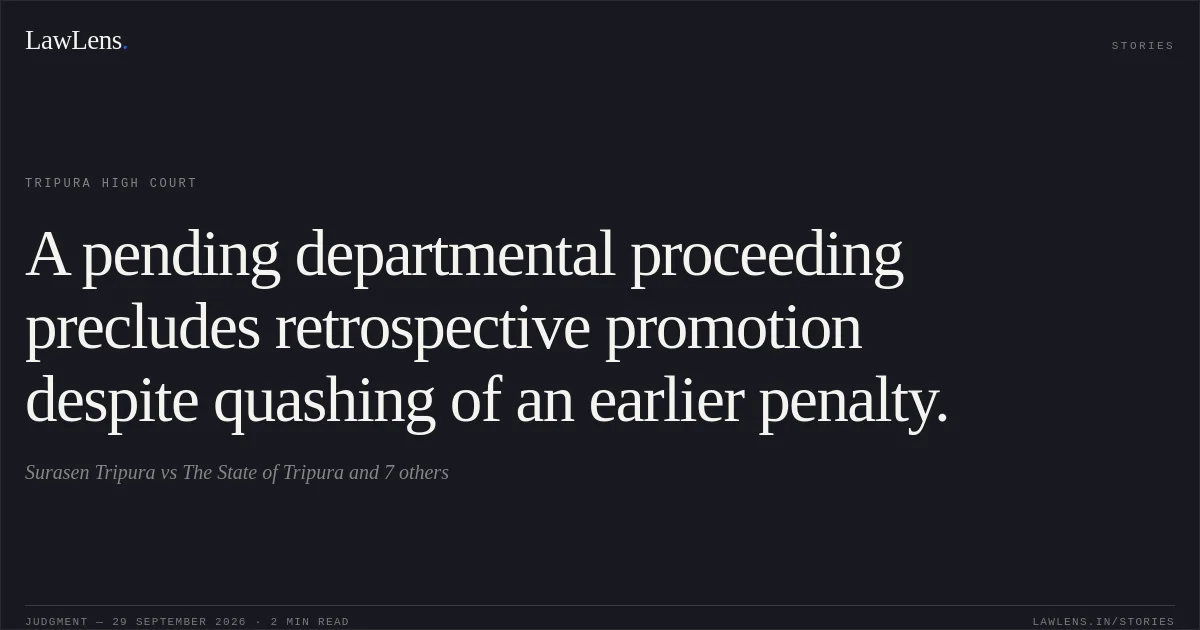
The petitioner, an Inspector of Police, was not considered for promotion to TPS Grade-II when juniors were promoted in 2021 and 2023, initially because a departmental penalty was in force.
Source reference: p.3–7The penalty was later quashed in separate proceedings, with the petitioner held entitled to benefits as if no penalty had been imposed; the State’s appeal was dismissed, and the respondents released financial benefits but did not promote him.
Source reference: p.3–7, 10–13Meanwhile, a further departmental proceeding had been initiated against the petitioner by memorandum dated 24 January 2024, and remained pending.
Source reference: p.8–9, 19–21He sought to quash the promotion orders insofar as they promoted his juniors and to obtain retrospective promotion from the dates of their promotions.
Source reference: p.2Issues
1. Whether, after the earlier penalty was quashed, the petitioner was entitled to retrospective promotion from the dates on which his juniors were promoted.
Source reference: p.13, 18–212. Whether the Court could direct a review DPC and promotion while a subsequent departmental proceeding against the petitioner remained pending.
Source reference: p.19–21Law Applied
Under Union of India v. K.V. Jankiraman, disciplinary proceedings are treated as pending for sealed-cover purposes once a charge memorandum is issued; where an employee is fully exonerated, consequential benefits may be due, though entitlement to arrears depends on the circumstances.
Source reference: p.14–16The Court also relied on State of Tamil Nadu v. K.S. Murugesan, which states that promotion is not automatic and that an employee has a right to consideration, not promotion; a subsisting penalty may affect promotion consideration.
Source reference: p.17–18It referred to Swapan Das v. State of Tripura as authority for consequential consideration through a review DPC, including retrospective promotion where appropriate after a penalty is set aside.
Source reference: p.19–20The Court further noted the limited scope of review under Article 226 in disciplinary matters.
Source reference: p.21Reasoning
The Court accepted that quashing the earlier penalty removed the bar arising from that penalty and that the petitioner had not received promotion while juniors were promoted.
Source reference: p.18–19However, it treated the subsequent departmental proceeding, initiated by a memorandum and accompanied by framed charges, as a reason not to direct a review DPC or retrospective promotion while that proceeding remained unresolved.
Source reference: p.19–21Although the petitioner alleged that the proceeding was being used to deny promotion, the Court declined to grant the requested relief at that stage and instead required the department to conclude the proceeding within a fixed period.
Source reference: p.20–21Holding
The Court dismissed the writ petition and declined to quash the promotion orders or grant retrospective promotion while the subsequent departmental proceeding remained pending.
It directed the respondents to complete that proceeding within six months from delivery of the judgment, failing which it would be treated as abated.
Source reference: p.22After its outcome, the petitioner may submit a representation raising his promotion-related grievances.
Source reference: p.22Acts & Sections Cited
1 provisions across 1 statute referred to in this judgment. Linked provisions open on LawLens.
Sexual Harassment Of Women At Workplace (Prevention, Prohibition And Redressal) Act, 20131
Original Court PDF
Surasen TripuravsThe State of Tripura and 7 others
Click to open original judgment
Original judgment, available to read, download and summarize on LawLens.in