Facts
The claimant was riding a Hero Honda Ambition motorcycle belonging to respondent no. 2 when, on 07.02.2006, he lost control near Balijan on National Highway 37 due to poor road conditions and fog, sustaining serious injuries and alleged permanent disability
Source reference: p.3, para. 4He filed a claim under Sections 166 and 140 of the Motor Vehicles Act, seeking compensation of ₹12,50,000 against the owner and insurer.
Source reference: p.3, para. 3The Motor Accident Claims Tribunal found that the claimant himself was responsible for the accident and therefore was not entitled to compensation under Section 166; that finding was not challenged and attained finality.
Source reference: p.4, para. 7The Tribunal nevertheless suo motu converted the claim into one under Section 163A and awarded ₹3,45,000 with 6% interest against the insurer.
Source reference: pp.4–5, paras. 8–9The insurer appealed, contending that the claimant, being a borrower and permissive user, had stepped into the shoes of the owner and that the claim under Section 163A was not maintainable.
Source reference: p.5, para. 11Issues
Whether a borrower or permissive user of a motor vehicle, who himself was riding it and caused the accident, can claim compensation under Section 163A against the vehicle’s owner or insurer
Source reference: p.5, paras. 10–11; p.12, para. 18Whether the Tribunal could suo motu convert a claim originally filed under Section 166 into a claim under Section 163A without notice to the parties
Source reference: p.5, para. 11Whether the claimant was entitled to any amount under a personal accident coverage clause in the insurance policy.
Source reference: p.13, para. 21Law Applied
Section 163A of the Motor Vehicles Act creates a no-fault, structured-formula remedy for death or permanent disablement arising from the use of a motor vehicle, without requiring proof of negligence.
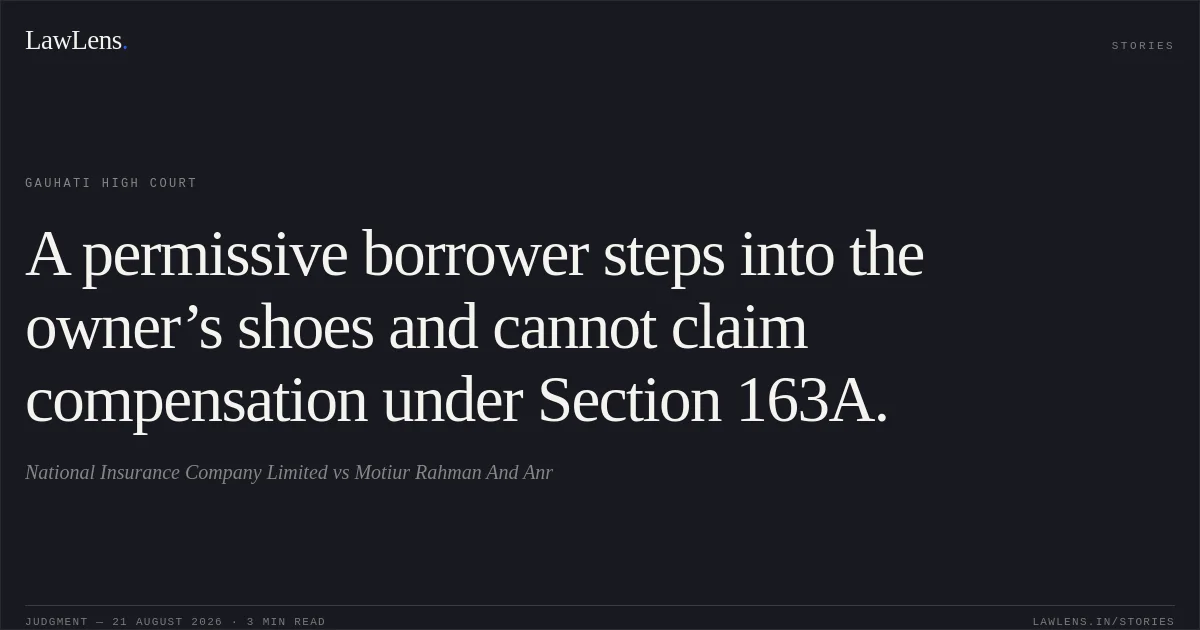
Source reference: pp.5–6, paras. 12–13However, the claimant must be a third party; a person who borrows and drives the vehicle steps into the shoes of its owner and cannot maintain a Section 163A claim against the owner or insurer of that vehicle, because a person cannot simultaneously be the claimant and the person liable to pay compensation.
Source reference: pp.6–12, paras. 14–16.1This principle was established in Ningamma v. United India Insurance Co. Ltd., (2009) 13 SCC 710, and reaffirmed in Ramkhiladi v. United India Insurance Co. Ltd., (2020) 2 SCC 550.
Source reference: pp.6–12, paras. 14–16.1The coordinate Bench decision in National Insurance Co. Ltd. v. Bikash Ghosh, MAC Appeal No. 79/2020, followed the same rule.
Source reference: p.12, para. 17The insurer’s liability is governed by the insurance contract and ordinarily extends to third-party liability, although a separate personal accident cover may be payable if included in the policy.
Source reference: pp.10–12, para. 16.1Reasoning
The claimant was not a third party vis-à-vis the motorcycle because he had borrowed it from its owner and was himself riding it when the accident occurred.
Source reference: pp.6–12, paras. 15.1, 16.1; p.12, para. 18The Tribunal had already conclusively found that the claimant caused the accident, and that finding was unchallenged.
Source reference: p.4, para. 7Applying Ningamma and Ramkhiladi, the Court held that the claimant had stepped into the shoes of the owner; permitting him to claim against the owner and the insurer under Section 163A would effectively allow him to claim compensation against himself.
Source reference: pp.6–12, paras. 15.1, 16.1; p.12, para. 18Consequently, the claimant was not entitled to compensation under Section 166 because his own negligence was established, nor under Section 163A because he was not a third party.
Source reference: p.13, paras. 19–20The Court found it unnecessary to decide the procedural question concerning the Tribunal’s suo motu conversion of the claim.
Source reference: no citationHowever, since the accident occurred during the policy period and no evidence had been led regarding personal accident coverage, the Court preserved the claimant’s entitlement to any such amount provided under the policy.
Source reference: p.13, para. 21Holding
The appeal was allowed, and the Tribunal’s award of ₹3,45,000 with interest was set aside and quashed.
The Court held that the claimant could not recover compensation from the owner’s insurer under either Section 166 or Section 163A, having caused the accident while driving a borrowed vehicle and thereby having assumed the position of the owner.
Source reference: p.13, paras. 19–20Nevertheless, the insurer was directed to determine and pay, if applicable, the amount payable under the policy’s personal accident coverage, with 6% interest from the date of filing of the claim until realization, and to complete that process within two months.
Source reference: p.13, para. 21There was no order as to costs.
Source reference: p.13, para. 22Acts & Sections Cited
6 provisions across 1 statute referred to in this judgment. Each provision opens on LawLens.
Motor Vehicles Act, 19886
Original Court PDF
National Insurance Company LimitedvsMotiur Rahman And Anr
Click to open original judgment
Original judgment, available to read, download and summarize on LawLens.in