Facts
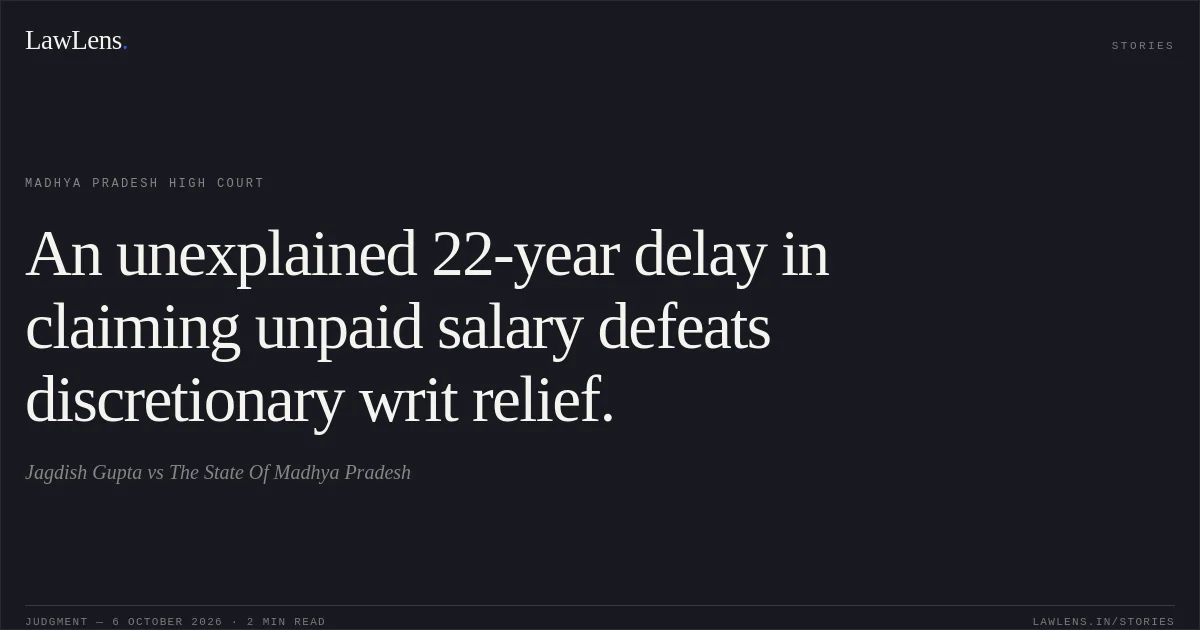
The petitioner, appointed as a Laboratory Assistant on 2 August 1971 and retired on 30 November 2014, claimed approximately ₹1,00,000 in unpaid salary for the 2004–05 academic year.
Source reference: para. 2, 5, 8He alleged that his salary was withheld after a copying malpractice case led to cancellation of his school’s recognition for that year.
Source reference: para. 3–4He maintained that the school remained recognised for Classes 9 and 11, where he taught, and relied on proceedings in which the school’s recognition was restored for Classes 10 and 12.
Source reference: para. 3–4He sought payment with 12% interest.
Source reference: no citationThe State opposed the petition.
Source reference: no citationThe Court noted that the petition was filed nearly 22 years after the claimed non-payment, that the petitioner had not specifically explained the delay, and that the school had not been joined as a party.
Source reference: para. 9, 15–16Issues
1. Whether the petitioner’s claim for unpaid salary for 2004–05 could be considered under Article 226 despite the nearly 22-year delay and absence of a satisfactory explanation.
Source reference: para. 9–10, 162. Whether the petitioner’s representations, including the representation dated 21 September 2026, justified entertaining the stale claim.
Source reference: para. 15Law Applied
Article 226 relief is discretionary, and a High Court may decline to exercise its jurisdiction where a claimant’s delay or neglect, considered alongside the circumstances, makes relief inequitable.
Source reference: para. 13Delay and laches are relevant to equitable relief; a litigant who has slept on a right is not ordinarily entitled to discretionary relief, and a later judgment in another person’s case does not by itself explain the delay.
Source reference: para. 11, 14Merely submitting a representation, or its non-consideration, does not provide a valid ground for condoning delay.
Source reference: para. 15Reasoning
The salary claim concerned the 2004–05 academic year, but the petitioner approached the Court only after nearly 22 years and did not specifically explain that delay in the petition.
Source reference: para. 9His reliance on representations did not cure the delay; the Court found that only one representation, dated 21 September 2026, was on record and that its non-consideration was not a sufficient explanation.
Source reference: para. 15In the absence of a satisfactory basis to entertain the stale claim, the Court declined to examine it for relief under Article 226.
Source reference: para. 16Holding
The Court held that the inordinate delay was not satisfactorily explained and that no case for interference was made out.
It dismissed the writ petition, leaving the petitioner without the requested unpaid salary and interest.
Source reference: para. 16Original Court PDF
Jagdish GuptavsThe State Of Madhya Pradesh
Click to open original judgment
Original judgment, available to read, download and summarize on LawLens.in