Facts
The Assistant Commissioner (competent authority) passed an order on 09.09.2003 granting occupancy rights for certain lands under Section 7A of the Karnataka Land Reforms Act, 1961, in favor of the petitioners (Revanna and Muniraju).
Source reference: p. 9Following a subsequent family partition decree in 2008, the RTCs were updated to reflect individual allotments.
Source reference: p. 10In 2011, the respondents (Chinnappa Reddy and Krishna Reddy) challenged the 2003 grant before the Karnataka Appellate Tribunal (KAT).
Source reference: p. 10The KAT, vide order dated 30.11.2017, condoned the delay and set aside the occupancy grant.
Source reference: p. 10The petitioners challenged this reversal in WP No. 20376/2018, while the respondents filed WP No. 6806/2021 seeking a mandamus to delete the petitioners' names from revenue records based on the KAT order.
Source reference: p. 14-15Issues
1. Whether a person claiming to be a tenant, who has failed to file an application in Form No. 7 or Form No. 7A within the prescribed time under the Karnataka Land Reforms Act, has the locus standi to challenge an order conferring occupancy rights on another tenant?
Source reference: p. 9 / para. 1Law Applied
The court applied Section 118(2) of the Karnataka Land Reforms Act, 1961, which provides for appeals against orders of the competent authority.
Source reference: p. 12The court strictly interpreted Rule 17(6) of the Karnataka Land Reforms Rules, 1974, which mandates the clubbing of rival applications for occupancy rights.
Source reference: p. 13-14The court relied on the Division Bench precedent in Basappa Gurusangappa Baragundi v. The Land Tribunal, Badami (AIR 1980 KAR. 175), which established that while the Tribunal must consider all timely rival applications together—even if it necessitates setting aside an earlier valid order—this obligation is strictly contingent upon the rival claimant having filed an application within the statutory time limit.
Source reference: p. 12-13Reasoning
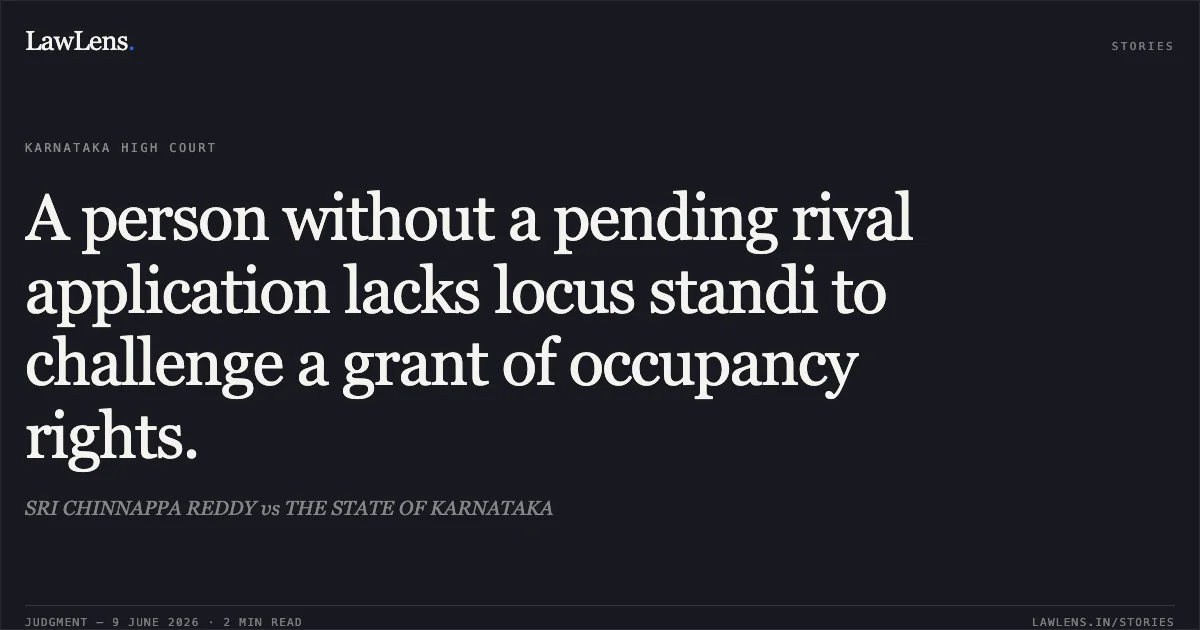
The court reasoned that for a party to have locus standi to challenge a grant of occupancy rights, they must be "rival claimants".
Source reference: p. 11Under the scheme of the Act and the Rules, a person only acquires the status of a claimant by filing Form No. 7 or Form No. 7A within the prescribed period.
Source reference: p. 11, 14The Court observed that while the respondents claimed a tenancy interest, they admittedly never filed the requisite statutory forms.
Source reference: p. 11, 14Applying the Basappa Gurusangappa Baragundi principle, the Court held that the legal necessity to set aside an existing grant to reconsider rival claims arises only if multiple valid applications are pending on file.
Source reference: p. 13-14Since the respondents were not applicants under the Act, they were strangers to the proceedings and had no standing to invoke the appellate jurisdiction of the Tribunal to question the 2003 order.
Source reference: p. 14Holding
The High Court answered the issue in the negative, holding that a non-applicant has no locus standi to challenge an occupancy grant.
The Court allowed WP No. 20376/2018, setting aside the Karnataka Appellate Tribunal’s order dated 30.11.2017. Consequently, WP No. 6806/2021 was dismissed as infructuous, as the basis for seeking the deletion of the petitioners' names (the KAT order) was nullified. The occupancy rights granted to the petitioners in 2003 were effectively restored.
Source reference: p. 15Acts & Sections Cited
2 provisions across 2 statutes referred to in this judgment. Each provision opens on LawLens.
KARNATAKA LAND REFORMS ACT, 19611
Code of Civil Procedure, 19081
Original Court PDF
SRI CHINNAPPA REDDYvsTHE STATE OF KARNATAKA
Click to open original judgment
Original judgment, available to read, download and summarize on LawLens.in