Facts
The petitioner-informant sought cancellation of the regular bail granted to Dhanik Chandra in a case alleging attempted murder by firearm under Sections 109(1) and 3(5) of the Bharatiya Nyaya Sanhita, 2023 (BNS), and Section 27 of the Arms Act.
Source reference: p. 1–2The injured brother’s account, as recorded in the informant’s fardbeyan, attributed one shot to Chandra; the injured’s statement in the case diary attributed to him the shot that struck the abdomen.
Source reference: p. 4–5The injured suffered firearm injuries, including stomach perforations, and underwent emergency surgery; police had also seized two empty cartridges and one live cartridge near the scene.
Source reference: p. 4–5The Sessions Court granted Chandra bail, principally relying on the discrepancy about which assailant caused which injury and on the period of custody.
Source reference: p. 5–6The informant challenged that order under Section 483(3) BNSS, contending that it was perverse and ignored material evidence.
Source reference: p. 1, 6–10Issues
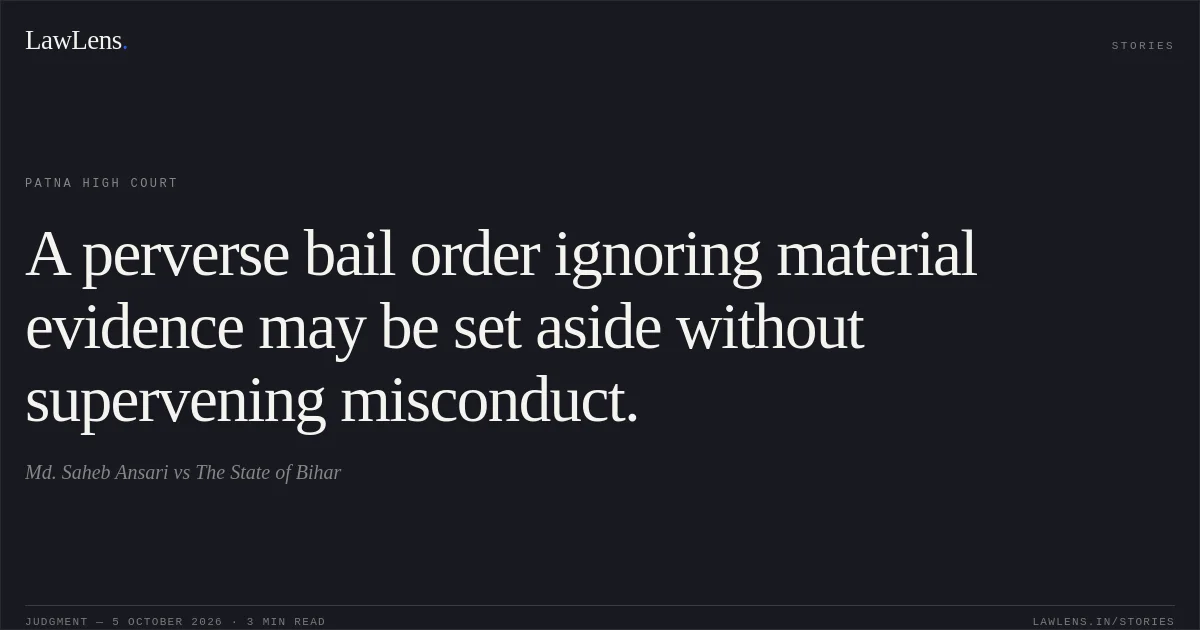
Whether the bail order could be set aside as perverse or legally unsustainable, despite the absence of alleged post-release misconduct, where it relied on an immaterial discrepancy and overlooked relevant evidence.
Source reference: p. 11–16Whether the discrepancy between the fardbeyan and the injured’s statement, concerning which part of the body was struck by Chandra’s shot, justified granting him bail.
Source reference: p. 16–20Law Applied
Section 483(3) BNSS provided the basis for the application to cancel bail.
Source reference: no citationThe Court distinguished cancellation for supervening misconduct—which generally requires cogent and overwhelming circumstances, as stated in Dolat Ram v. State of Haryana—from setting aside a bail order that was perverse, unjustified, or passed in disregard of relevant material.
Source reference: p. 12–16Relying on Puran v. Rambilas, Neeru Yadav v. State of U.P., Deepak Yadav v. State of U.P., and State of Karnataka v. Sri Darshan, the Court held that a superior court may annul a bail order for legal infirmity without proof of later misconduct; relevant grounds include reliance on untenable grounds, overlooking material evidence, or granting bail despite the serious nature of the accusation.
Source reference: p. 11–15The Court also considered the bail factors in Prasanta Kumar Sarkar v. Ashis Chatterjee, including the prima facie case, gravity of the accusation, potential punishment, and risk of witness influence.
Source reference: p. 15Sections 109(1) and 3(5) BNS were relevant to the alleged attempted murder and common-intention liability; where two accused allegedly acted together, identifying which one caused a particular injury does not by itself determine either’s liability.
Source reference: p. 19–20Reasoning
The discrepancy did not remove Chandra from the occurrence: both accounts placed him there and attributed a shot to him.
Source reference: p. 16–18On the injured’s account, Chandra fired the shot that struck the abdomen and caused the gravest injury; the medical evidence supported the existence and seriousness of the injuries.
Source reference: p. 16–18The Court held that the Sessions Court wrongly treated the discrepancy as favouring Chandra, without addressing the medical evidence, the cartridge seizure, the alleged common intention, the seriousness of the injuries, or the stage of the investigation.
Source reference: p. 18–21Because the bail order rested on an untenable consideration and ignored material evidence, its validity could be reviewed independently of whether Chandra later misused bail.
Source reference: p. 21–23Holding
The Patna High Court allowed the application, set aside the Sessions Court’s order, and cancelled Chandra’s bail and bail bonds.
It directed him to surrender within three weeks, failing which the Senior Superintendent of Police, Bhagalpur, was to take steps to secure his arrest.
Source reference: p. 24–25The trial court was directed to proceed promptly and endeavour to examine the injured and informant first, preferably within three months after charge-framing; the police were directed to ensure their attendance and take necessary safety measures.
Source reference: p. 24–25The Court clarified that its observations were confined to the bail application and would not affect the trial on the merits.
Source reference: p. 25Acts & Sections Cited
4 provisions across 3 statutes referred to in this judgment. Each provision opens on LawLens.
Bharatiya Nagarik Suraksha Sanhita, 20231
Bharatiya Nyaya Sanhita, 20232
Arms Act, 19591
Original Court PDF
Md. Saheb AnsarivsThe State of Bihar
Click to open original judgment
Original judgment, available to read, download and summarize on LawLens.in