Facts
The petitioner, claiming to be an agriculturist and resident of Jaswantgarh (Bhemal), Taluka Danta, District Banaskantha, filed a public interest litigation alleging illegal quarrying, mining, and operation of asphalt plants in Jaswantgarh and nearby villages.
Source reference: para. 2–4He alleged that approximately 49 quarries and 21 asphalt plants were operating without valid environmental clearance, beyond lease areas, without requisite consent from the Gujarat Pollution Control Board, and without adequate dust-control, safety, or transport-regulation measures.
Source reference: para. 5The petitioner further alleged that blasting, overloaded mineral-transport vehicles, dust pollution, and quarrying had damaged houses, roads, agricultural land, groundwater recharge, and natural drainage, besides creating health and environmental hazards.
Source reference: para. 6–8Although the petition referred generally to quarry leaseholders, it did not identify or implead any specific leaseholder alleged to be violating statutory or environmental requirements.
Source reference: para. 9He had also complained to the Gujarat Pollution Control Board and filed an application before the National Green Tribunal raising substantially the same environmental grievances.
Source reference: para. 12Issues
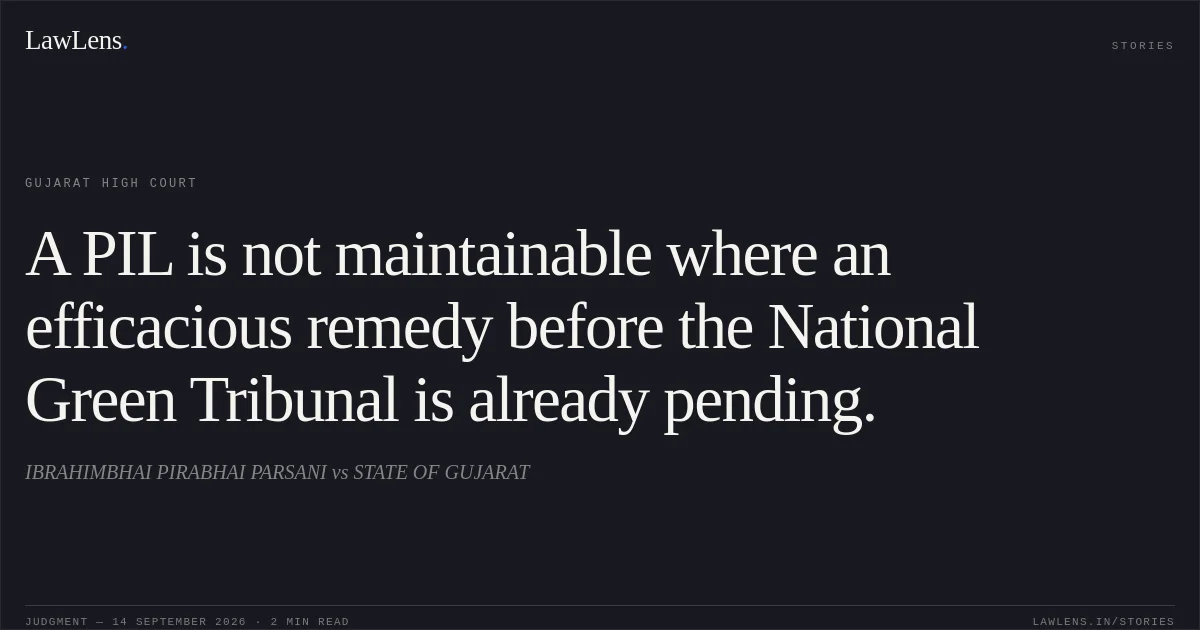
Whether the writ petition filed as a public interest litigation was maintainable when the petitioner had already approached the National Green Tribunal with respect to the same environmental grievances.
Source reference: para. 12–14Whether the High Court should entertain general allegations of illegal quarrying and environmental violations when the specific quarry leaseholders allegedly responsible had neither been identified nor impleaded.
Source reference: para. 9Law Applied
The Court applied the principle that a writ petition may be declined where the petitioner has an alternative efficacious statutory remedy, particularly before a specialised forum competent to adjudicate the subject matter.
Source reference: no citationThe Court recognised that the National Green Tribunal is empowered to consider environmental grievances concerning mining and quarrying activities and to take appropriate action against violators.
Source reference: para. 13The Court also proceeded on the basis that a PIL must contain specific and substantiated allegations against identifiable parties; general allegations against unidentified quarry operators, without impleading the concerned persons, do not warrant writ relief.
Source reference: para. 9Reasoning
The Court found that the petitioner’s allegations concerned environmental violations arising from quarrying and asphalt-plant operations, matters falling within the jurisdiction and expertise of the National Green Tribunal.
Source reference: para. 13Since the petitioner had already filed an application before the Tribunal concerning the same issues, the Tribunal constituted an alternative and efficacious remedy.
Source reference: para. 12–14The Court therefore considered that the petitioner should pursue that pending proceeding rather than maintain a parallel PIL before the High Court.
Source reference: para. 12–14The Court also noted the absence of specific allegations against identifiable quarry leaseholders and the failure to implead them, further weakening the basis for entertaining the PIL.
Source reference: para. 9Holding
The High Court dismissed the writ petition as misconceived and not maintainable.
It held that, having already approached the National Green Tribunal for redressal of the environmental grievances, the petitioner’s appropriate course was to pursue that pending application, as the Tribunal was competent to initiate action against any violators.
Source reference: para. 13–14No further relief or directions were granted.
Source reference: no citationOriginal Court PDF
IBRAHIMBHAI PIRABHAI PARSANIvsSTATE OF GUJARAT
Click to open original judgment
Original judgment, available to read, download and summarize on LawLens.in