Facts
The applicants, stated to be Directors of Pranil Educational LLP, were accused in FIR No. 11191039260357 of 2026 registered at Sabarmati Police Station under Sections 316(2), 318(4) and 54 of the Bharatiya Nyaya Sanhita, 2023 (“BNS”).
Source reference: p.1; para. 2The complainant alleged that she and her family engaged the applicants for obtaining Canadian permanent-resident and subsequently work-permit visas.
Source reference: pp.2–4; para. 3.1The applicants allegedly received approximately ₹16,05,000 through cheques and bank payments, issued receipts, and assured completion of the visa process.
Source reference: pp.2–4; para. 3.1When the visa process did not progress and the complainant sought a refund, the applicants allegedly failed to return the money.
Source reference: pp.4–8; paras. 4.1, 5.1The applicants relied on a Canadian refusal letter and contended that the application had failed due to the complainant’s own deficiencies.
Source reference: pp.4–8; paras. 4.1, 5.1The State opposed quashing, stating that the investigation had only commenced, that three other persons had made similar allegations, and that the applicants had other antecedents involving comparable offences.
Source reference: pp.5–6, 8–9; paras. 4.2, 7–7.1Issues
Whether the allegations in the FIR prima facie disclosed the offences under Sections 316(2), 318(4) and 54 of the BNS so as to justify continuation of the investigation.
Source reference: pp.6–8; paras. 5–6Whether the FIR was liable to be quashed on the ground that the offences of criminal breach of trust and cheating could not coexist, or that the dispute was essentially contractual/civil in nature.
Source reference: pp.4, 6–8; paras. 4.1, 6Whether the High Court should exercise its inherent jurisdiction under Section 528 of the BNSS when the investigation was at an initial and crucial stage.
Source reference: pp.9–11; paras. 8–9Whether the applicants’ alleged cooperation with the police and the principles concerning arrest in offences punishable up to seven years, as discussed in Arnesh Kumar v. State of Bihar, warranted quashing or other interference.
Source reference: pp.4–5; para. 4.1Law Applied
The Court applied Section 528 of the BNSS, which preserves the High Court’s inherent jurisdiction to prevent abuse of process and secure the ends of justice, together with the constitutional jurisdiction under Article 226.
Source reference: p.1; para. 2It considered the offences alleged under Sections 316(2), 318(4) and 54 of the BNS.
Source reference: p.1; para. 2The Court relied principally on CBI v. Ravi Shankar Srivastava, (2006) 7 SCC 188, for the rule that quashing should ordinarily not be undertaken when the investigation is incomplete, the facts are hazy, and the allegations prima facie disclose an offence; the Court must not conduct a meticulous assessment of evidence or determine whether conviction is ultimately sustainable.
Source reference: pp.9–11; para. 8The Court also considered the applicants’ reliance on Arnesh Kumar v. State of Bihar, (2014) 8 SCC 273, concerning the non-automatic nature of arrest in offences punishable up to seven years, but treated that issue as distinct from the question whether the FIR itself should be quashed.
Source reference: pp.4–5; para. 4.1Reasoning
The Court found that the FIR alleged that the applicants collected substantial sums on assurances of obtaining Canadian visas, issued receipts, entered into an agreement containing a refund clause, and thereafter failed to complete the process or refund the money.
Source reference: pp.6–8; paras. 5–6The investigation had also collected receipts and the agreement, while the Canadian refusal letter did not conclusively establish that the applicants had acted bona fide or that the complainant alone was responsible for the failure of the visa application.
Source reference: pp.6–8; paras. 5–6The allegations, viewed at the FIR stage, suggested that assurances may have been made without the intention of fulfilling them and that money had been obtained on that basis.
Source reference: no citationThe Court therefore declined to accept the applicants’ contention that the matter was merely contractual or that cheating and breach of trust could not coexist.
Source reference: no citationApplying the restrictive principles governing inherent powers, particularly the principle that the Court should not stifle a legitimate prosecution while investigation is underway, the Court held that no exceptional ground for quashing was established.
Source reference: pp.9–11; paras. 8–9The existence of similar complaints and other FIRs further supported allowing the investigation to proceed.
Source reference: pp.8–9; paras. 7–7.1Holding
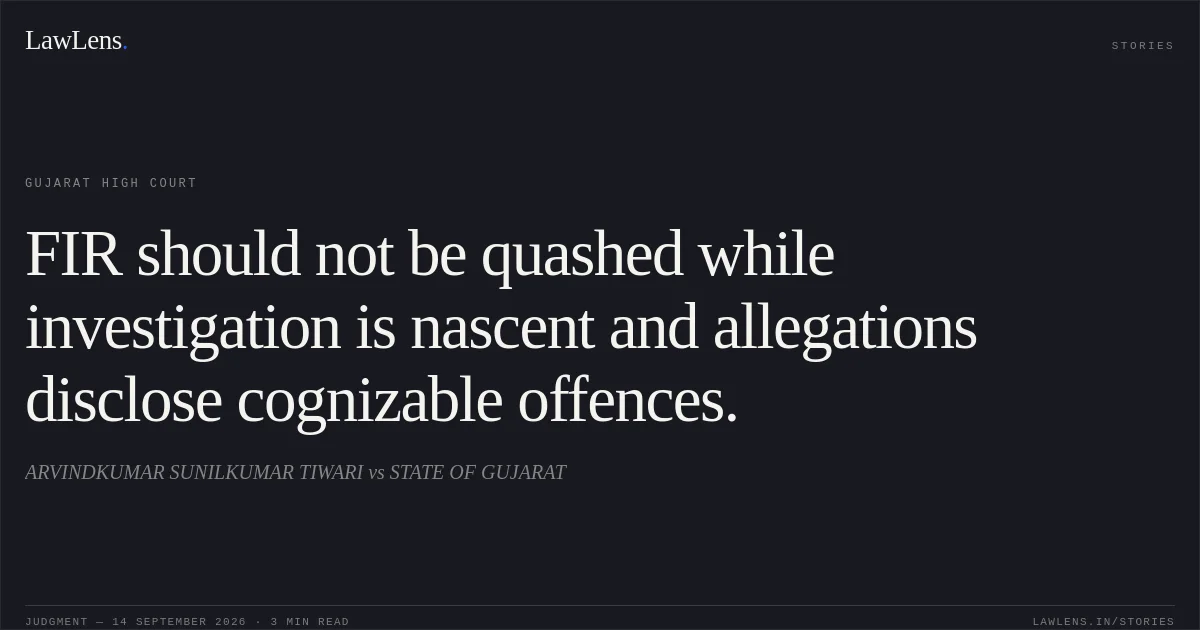
The High Court held that the allegations and material collected during the preliminary investigation disclosed a prima facie cognizable case and that the investigation was at a crucial stage.
It therefore declined to quash FIR No. 11191039260357 of 2026 or otherwise interfere under Section 528 of the BNSS.
Source reference: pp.8–12; paras. 6, 8–10The application was rejected, and the rule was discharged.
Source reference: p.12; para. 10Acts & Sections Cited
8 provisions across 4 statutes referred to in this judgment. Each provision opens on LawLens.
Bharatiya Nagarik Suraksha Sanhita, 20231
Bharatiya Nyaya Sanhita, 20233
Code of Criminal Procedure, 19732
Indian Penal Code, 18602
Original Court PDF
ARVINDKUMAR SUNILKUMAR TIWARIvsSTATE OF GUJARAT
Click to open original judgment
Original judgment, available to read, download and summarize on LawLens.in