Facts
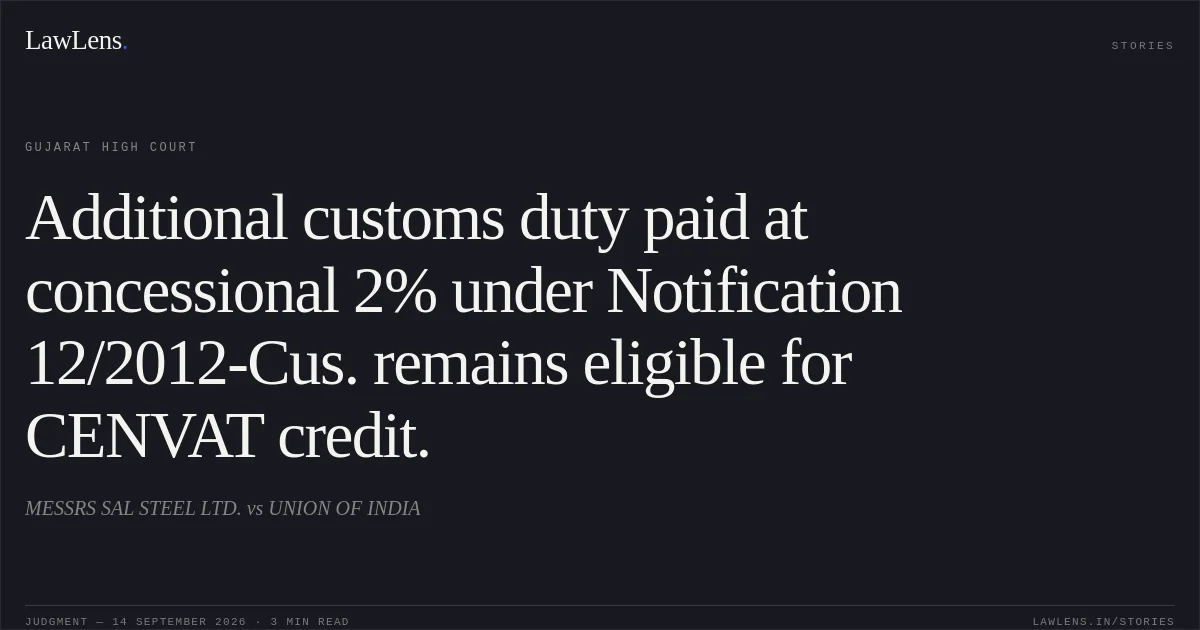
The petitioners imported coal and paid additional customs duty/CVD at 2% under Notification No. 12/2012-Customs dated 17.03.2012.
Source reference: paras. 3–5; pp. 2–4Following the audit objection, a show-cause notice dated 06.08.2018 proposed denial of CENVAT credit of ₹1,50,25,460 for the period April 2015 to June 2017, invoking the extended limitation period.
Source reference: paras. 3–5; pp. 2–4The petitioners relied on the Tribunal’s decision in M/s Asahi Songwon Colors Ltd., but the Joint Commissioner, by order dated 03.07.2019, disallowed the credit, demanded interest, and imposed an equivalent penalty.
Source reference: paras. 3–5; pp. 2–4The petitioners challenged that order under Article 226 of the Constitution.
Source reference: paras. 3–5; pp. 2–4Although a statutory tax appeal was available, the High Court entertained the writ petition in view of the subsequent decision of the Coordinate Bench in Tax Appeal No. 252 of 2023 and the lapse of approximately seven years.
Source reference: paras. 3–5; pp. 2–4Issues
Whether CENVAT credit was admissible on the 2% CVD paid on imported coal under Notification No. 12/2012-Customs dated 17.03.2012.
Source reference: para. 5; pp. 4–6Whether payment of CVD at a concessional rate, lower than the excise duty otherwise leviable on domestically manufactured coal, disqualified the petitioners from claiming credit under Rule 3(1)(vii) of the CENVAT Credit Rules, 2004.
Source reference: para. 5; pp. 4–6Whether the impugned adjudication order dated 03.07.2019 was liable to be quashed and the petitioners permitted to avail and utilise the disputed CENVAT credit.
Source reference: para. 6; p. 7Law Applied
The Court applied Section 3(1) of the Customs Tariff Act, 1975, which imposes additional customs duty/CVD on imported goods to counterbalance the excise duty leviable on comparable goods manufactured in India.
Source reference: para. 5; pp. 4–5It relied on Section 25(1) of the Customs Act, 1962, under which the Central Government may grant exemption or prescribe a reduced rate of customs duty in the public interest; accordingly, Notification No. 12/2012-Customs validly prescribed CVD at 2% on the imported coal.
Source reference: para. 5; p. 5Rule 3(1)(vii) of the CENVAT Credit Rules, 2004 permits credit of additional duty leviable under Section 3 of the Customs Tariff Act, equivalent to the specified excise duty.
Source reference: para. 5; pp. 4–6The Court held, following the Coordinate Bench’s judgment dated 25.08.2026 in Tax Appeal No. 252 of 2023, that CVD paid at the concessional rate under Notification No. 12/2012-Customs is nevertheless equivalent, for purposes of Rule 3(1)(vii), to the applicable excise duty and is eligible for CENVAT credit.
Source reference: para. 5; pp. 4–6Reasoning
The Court treated the concessional 2% CVD as duty legally payable under the Customs Tariff Act pursuant to Notification No. 12/2012-Customs.
Source reference: paras. 5–6; pp. 3–7The Revenue’s contention that credit was unavailable because the petitioners had paid CVD at 2% rather than the higher excise-duty rate was rejected.
Source reference: paras. 5–6; pp. 3–7Since the reduced rate was prescribed by the Central Government under Section 25(1) of the Customs Act, the payment retained its character as valid CVD for the purposes of Rule 3(1)(vii) of the CENVAT Credit Rules.
Source reference: paras. 5–6; pp. 3–7The Coordinate Bench had already determined the identical legal issue in favour of the assessee, and the respondents could not dispute that the present case was covered by that decision.
Source reference: paras. 5–6; pp. 3–7In these circumstances, the Court declined to relegate the petitioners to the alternative appellate remedy and found the denial of credit unsustainable.
Source reference: paras. 5–6; pp. 3–7Holding
The Court held that the petitioners were entitled to avail and utilise CENVAT credit of the 2% CVD paid on imported coal under Notification No. 12/2012-Customs for the period April 2015 to June 2017.
The Joint Commissioner’s order dated 03.07.2019, which disallowed credit of ₹1,50,25,460 and imposed interest and penalty, was quashed and set aside.
Source reference: para. 6; p. 7The respondents were directed to permit the petitioners to avail and utilise the disputed CENVAT credit.
Source reference: para. 6; p. 7The writ petition was accordingly allowed.
Source reference: para. 6; p. 7Acts & Sections Cited
2 provisions across 2 statutes referred to in this judgment. Each provision opens on LawLens.
Customs Tariff Act, 19751
Customs Act,19621
Original Court PDF
MESSRS SAL STEEL LTD.vsUNION OF INDIA
Click to open original judgment
Original judgment, available to read, download and summarize on LawLens.in