01Facts
On 16 February 2024, the deceased was travelling as a pillion rider when a dumper struck the motorcycle from behind, causing fatal injuries.
p. 2 · ¶ 4–4.2The deceased’s legal representatives filed a claim under Section 166 of the Motor Vehicles Act, 1988, alleging that he earned ₹12,000 per month as a mason.
p. 2 · ¶ 4–4.2The Tribunal awarded compensation after deducting 10% for negligence attributed to the motorcycle driver.
p. 2, 7 · ¶ 4.3, 7.2The claimants appealed under Section 173, challenging the assessment of compensation and the deduction for negligence.
pp. 3–5 · ¶ 3, 5–5.202Issues
i.Whether the Tribunal’s assessment of compensation required enhancement, including reassessment of dependency and non-pecuniary damages.
p. 3, 7 · ¶ 5, 7.1–7.2ii.Whether negligence attributed to the motorcycle driver could justify reducing the compensation payable to the deceased pillion rider’s claimants.
pp. 3–5 · ¶ 5–5.103Law Applied
Sections 166 and 173 of the Motor Vehicles Act, 1988 provide for a claim for compensation and an appeal against the Tribunal’s award.
Compensation under the Act must be just and fair, assessed liberally and on a realistic basis.
p. 6 · ¶ 7In National Insurance Co. Ltd. v. Pranay Sethi, (2017) 16 SCC 680, the Supreme Court prescribed conventional sums for loss of estate and funeral expenses; United India Insurance Co. Ltd. v. Satinder Kaur, (2021) 11 SCC 780, governs consortium awards.
p. 7 · ¶ 7.1Under Khenyei v. New India Assurance Co. Ltd., (2015) 9 SCC 273, composite negligence is distinct from contributory negligence, and a claimant may recover the full compensation from any joint tortfeasor.
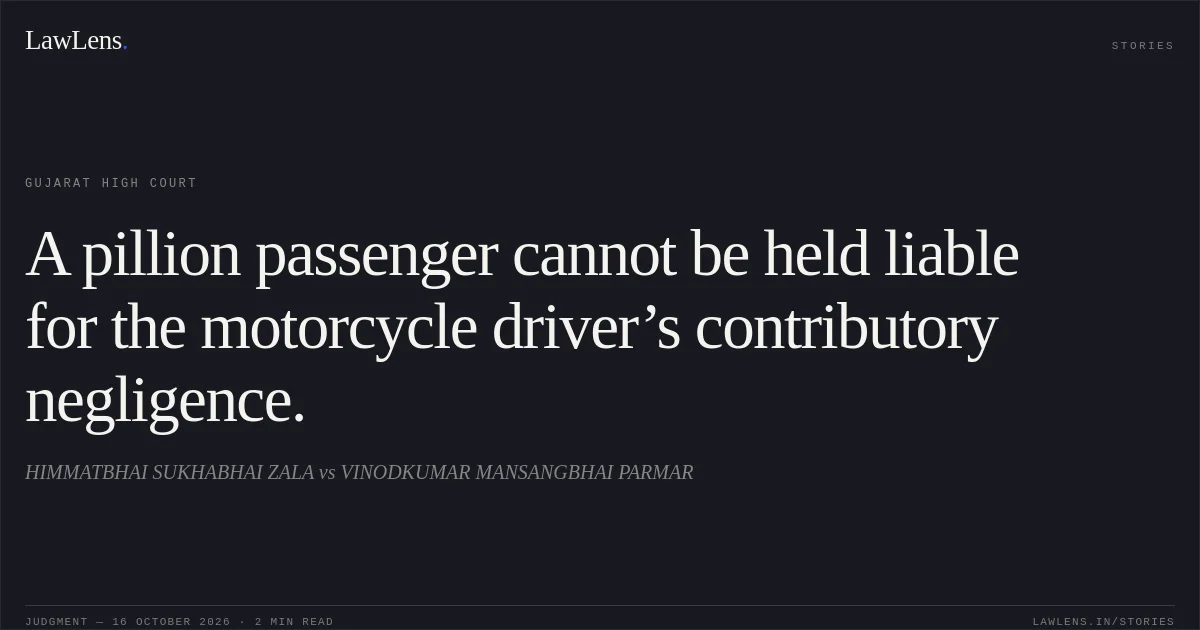
pp. 3–4 · ¶ 5A vehicle driver’s negligence is not imputed to a passenger travelling in that vehicle.
pp. 4–5 · ¶ 5.1, quoting Union of India v. United India Insurance Co. Ltd., (1997) 8 SCC 683, as discussed in Sushma v. Nitin Ganapati Rangole, AIR 2024 SC 4627Provisions in the judgment · 2 · Linked ones open on LawLens
Motor Vehicles Act, 1988 Section 173Section 166
04Reasoning
The High Court found that the Tribunal had not properly considered the deceased’s monthly income and recalculated compensation, including dependency loss of ₹17,98,680, consortium of ₹1,93,600, and loss of estate and funeral expenses of ₹36,300.
p. 7 · ¶ 7.1–7.2It also considered the claimants’ objection to attributing the motorcycle driver’s negligence to the pillion rider, relying on the distinction between composite and contributory negligence and the rule against imputing a driver’s negligence to a passenger.
pp. 3–5 · ¶ 5–5.1The Court set aside the Tribunal’s finding in paragraph 17 and modified the award, although it did not separately explain how the negligence issue affected the revised computation.
p. 8 · ¶ 9.1–9.205Holding
The appeal was allowed in part.
pp. 7–8 · ¶ 7.2–9.2The claimants were awarded an additional ₹8,99,980, with interest at 7.5% per annum from the date of filing the claim petition until realisation; the remaining directions of the Tribunal were preserved.
pp. 7–8 · ¶ 7.2–9.2The insurer was directed to deposit the enhanced amount with interest within six weeks, and the Tribunal was directed to disburse the amounts in accordance with the judgment.
p. 8 · ¶ 9.3–9.5Original Court PDF
HIMMATBHAI SUKHABHAI ZALAvsVINODKUMAR MANSANGBHAI PARMAR
Click to open original judgment
Original judgment, available to read, download and summarize on LawLens.in