01Facts
On 12 August 2008, the claimant was a passenger in a Bolero Jeep that collided with a Taurus truck parked on the highway.
pp. 1–2The claimant sustained multiple injuries resulting in permanent functional disability.
pp. 1–2The Tribunal attributed the entire negligence to the Jeep’s driver, awarded Rs. 5,23,247 with interest at 7% per annum, and exonerated the truck’s owner and insurer.
pp. 1–2National Insurance Company appealed, arguing that negligence should also be attributed to the truck’s driver; the claimant cross-objected, seeking enhanced compensation.
pp. 1–302Issues
i.1. Whether the Tribunal erred in attributing the entire negligence to the Jeep’s driver and failing to apportion negligence between the drivers of the Jeep and the stationary truck.
p. 3, 7ii.2. Whether the compensation awarded by the Tribunal should be enhanced, including by reassessing the claimant’s income and applying the appropriate multiplier and future prospects.
pp. 8–903Law Applied
Sections 122 and 126 of the Motor Vehicles Act, 1988, and Regulation 15 of the Rules of the Road Regulations, 1989, were applied to the truck driver’s conduct in leaving a vehicle stationary on a public highway without adequate precautions.
p. 7Relying on Oriental Insurance Company Limited v. Kalu Ram, 2026 INSC 653, the Court held that a rear-end collision alone does not establish negligence by the approaching vehicle’s driver; negligence must be assessed from the totality of the circumstances, and an adverse inference may be drawn where a driver fails to testify.
pp. 5–6Where an injured claimant’s loss results from the composite negligence of multiple drivers, the claimant may recover the entire compensation jointly and severally from any liable party.
p. 7For compensation assessment, the Court applied a multiplier of 14 for a claimant aged 42 and added 25% for future prospects.
p. 8Provisions in the judgment · 2 · Linked ones open on LawLens
Motor Vehicles Act, 1988 Section 122Section 126
04Reasoning
The Tribunal’s finding was undermined by its reference to a Matador that was not involved in the accident.
pp. 6–7The claimant’s evidence was that the Jeep was travelling at excessive speed and that the truck was parked on the road without warning signals; neither driver testified, and the insurers did not effectively secure their attendance.
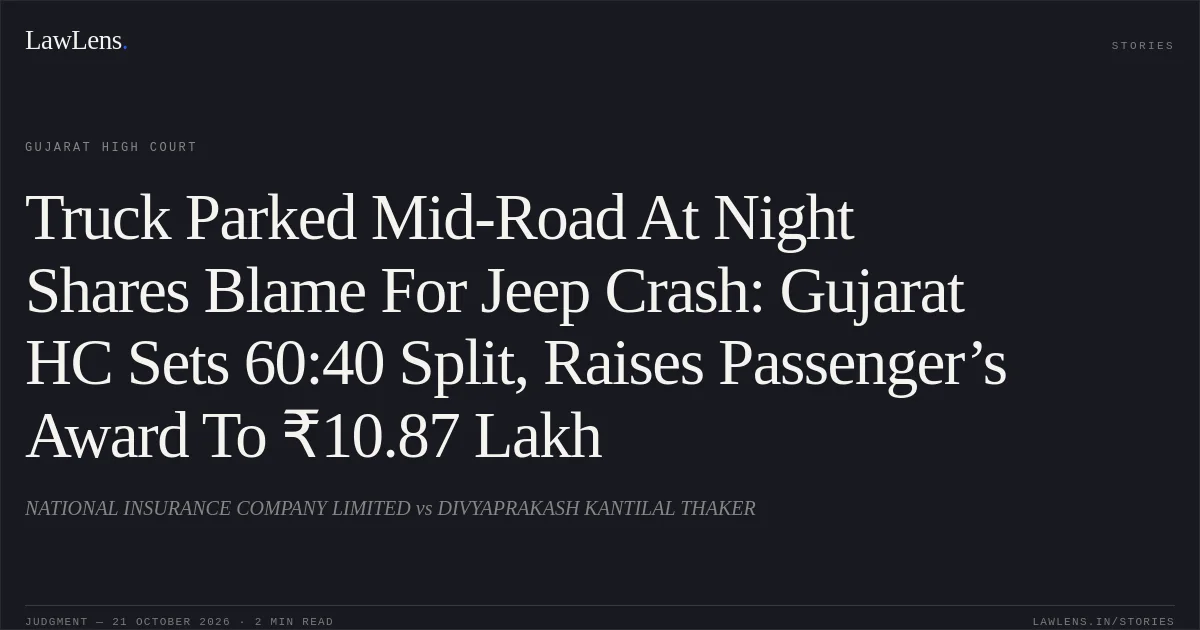
p. 7Considering the circumstances and the truck’s failure to take precautions, the Court found the Tribunal had erred in placing all negligence on the Jeep’s driver. It apportioned negligence 60% to the Jeep’s driver and 40% to the truck’s driver, while preserving the claimant’s right to recover on a joint-and-several basis.
p. 7On the cross-objection, it found the Tribunal had assessed income too conservatively despite the ITR and recalculated compensation using the appropriate multiplier and future prospects.
pp. 8–905Holding
The appeal and cross-objection were allowed to the stated extent.
pp. 8–10Negligence was apportioned 60:40 between the Jeep and truck drivers, respectively, and total compensation was enhanced to Rs. 10,87,214—an additional Rs. 5,63,967—with interest at 7% per annum from the date of the claim petition until realization.
pp. 8–10The claimant may recover the compensation jointly and severally from the opponents held liable; amounts already paid or deposited are to be adjusted.
p. 10Original Court PDF
NATIONAL INSURANCE COMPANY LIMITEDvsDIVYAPRAKASH KANTILAL THAKER
Click to open original judgment
Original judgment, available to read, download and summarize on LawLens.in