01Facts
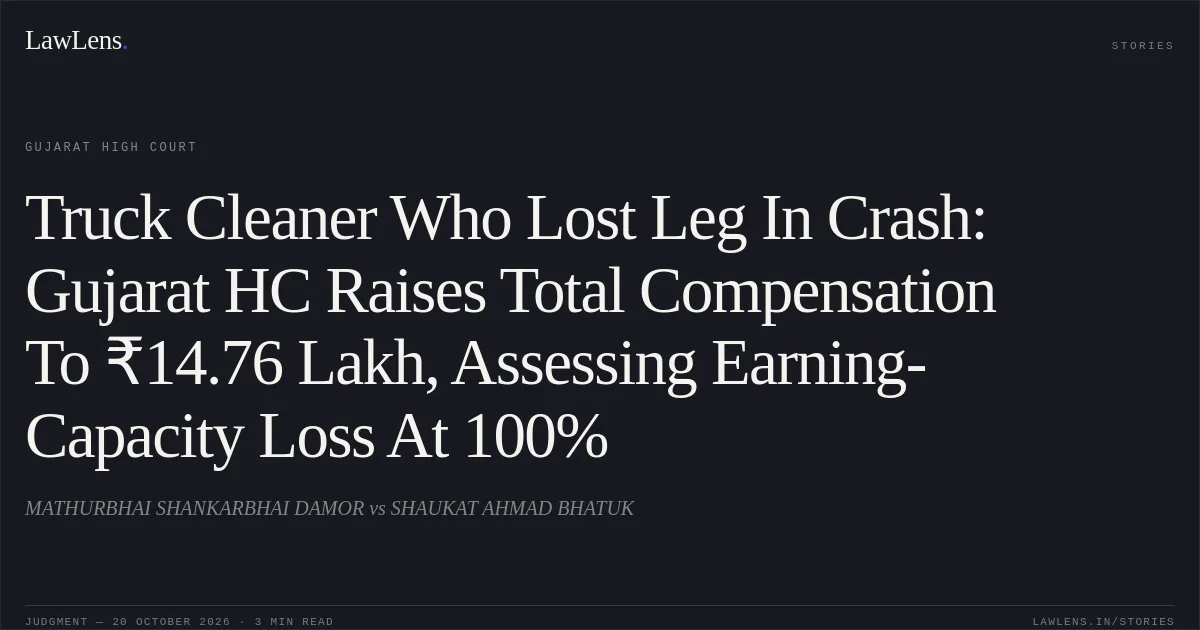
The claimant was working as a cleaner/second driver in a truck involved in a collision on 13 April 2008.
p. 2He sustained serious injuries, resulting in amputation of his left leg below the knee, 17 cm below the knee.
p. 2 · p. 4The Tribunal awarded Rs. 4,77,800 with 9% annual interest, apportioned liability 75% to opponents Nos. 1–3 and 25% to opponents Nos. 4–6.
p. 1The claimant appealed, seeking enhancement, including assessment of his functional disability at 100% and recovery of the compensation from any of the joint tortfeasors.
p. 3 · p. 402Issues
i.1. Whether the claimant’s below-knee amputation, having regard to his work as a cleaner/second driver, amounted to 100% functional disability for assessing loss of future earning capacity.
pp. 3–5ii.2. Whether the Tribunal’s award required enhancement under the heads of future loss of income and non-pecuniary and related expenses.
pp. 3–4 · pp. 10–11iii.3. Whether the respondents/insurance companies could be held jointly and severally liable for the entire compensation, rather than only their apportioned shares.
pp. 3–4 · p. 1203Law Applied
Under Section 173 of the Motor Vehicles Act, 1988, an aggrieved party may appeal a motor accident compensation award.
p. 1Applying Raj Kumar v. Ajay Kumar, (2011) 1 SCC 343, the court recognised that physical disability and loss of earning capacity are distinct: the latter must be assessed by considering the injury’s impact on the claimant’s actual occupation and earning capacity, rather than mechanically equating it with the medical disability percentage.
pp. 5–9The court also relied on Mahadevbhai Samtabhai Prajapati v. Ayeshaben Ibrahimbhai Manasiya, First Appeal No. 503 of 2016, as an analogous amputation case in which 100% functional disability was assessed for a manual labourer.
pp. 4–5The judgment referred to M. Paramesh v. VRL Logistics Ltd., 2026 INSC 655, in discussing the assessment of compensation for loss of future earning capacity.
pp. 5–6In cases of composite negligence, the claimant may recover the entire compensation from any or all joint tortfeasors; an insurer paying more than its share may seek recovery from the other liable parties.
pp. 3–4 · p. 12Provisions in the judgment · 1 · Linked ones open on LawLens
Motor Vehicles Act, 1988 Section 173
04Reasoning
The court considered the claimant’s amputation alongside his work as a cleaner and second driver, which required the use of his lower limbs and substantial physical effort.
pp. 4–5It concluded that he could no longer perform his primary vocation and assessed his functional disability, for loss of future earning capacity, at 100%.
pp. 4–5It accordingly recalculated compensation, including future loss of income, pain and suffering, medical expenses, special diet, attendant and transportation charges, a prosthetic leg, and loss of amenities.
pp. 10–11The court also replaced the Tribunal’s apportioned liability direction with joint and several liability for the entire award, while preserving the right of an insurer that paid more than its share to recover the excess from the other opponents.
p. 1205Holding
The appeal was partly allowed.
pp. 10–12The court fixed total compensation at Rs. 14,76,400, less the Rs. 4,77,800 already awarded, and directed payment of an additional Rs. 9,98,600 with 9% annual interest from the date of the claim petition until realisation.
pp. 10–12The Rs. 3,00,000 awarded for special diet, attendant charges, transportation, and a prosthetic leg carries no interest.
p. 12The respondents/insurance companies were held jointly and severally liable for the entire awarded amount; the remaining Tribunal directions were left unchanged, subject to the court’s further directions on deposit and disbursement.
pp. 12–13Original Court PDF
MATHURBHAI SHANKARBHAI DAMORvsSHAUKAT AHMAD BHATUK
Click to open original judgment
Original judgment, available to read, download and summarize on LawLens.in