Facts
On 17 August 2008, the deceased, Patel Prigneshkumar Shankarlal, was travelling as a pillion rider on motorcycle No. GJ-8L-7756, driven by his friend Patel Swapnil, from Unjha towards Ambaji. A car bearing registration No. GJ-8F-7604 allegedly came from behind in a rash and negligent manner and collided with the motorcycle. The deceased sustained injuries and was declared brought dead at Palanpur Orthopedic Hospital. An FIR was registered at Palanpur Police Station as C.R. No. I-184 of 2008.
Source reference: p.2, para. 2The deceased’s parents and widow instituted a claim petition under Section 166 of the Motor Vehicles Act, 1988, claiming Rs.10,00,000 as compensation. The Motor Accident Claims Tribunal, Mahesana, awarded Rs.3,21,000 with interest at 7.5% per annum, after attributing 50% contributory negligence to the deceased. The claimants challenged that award in the present appeal under Section 173 of the Act.
Source reference: p.2, paras. 2.1, 3–4Issues
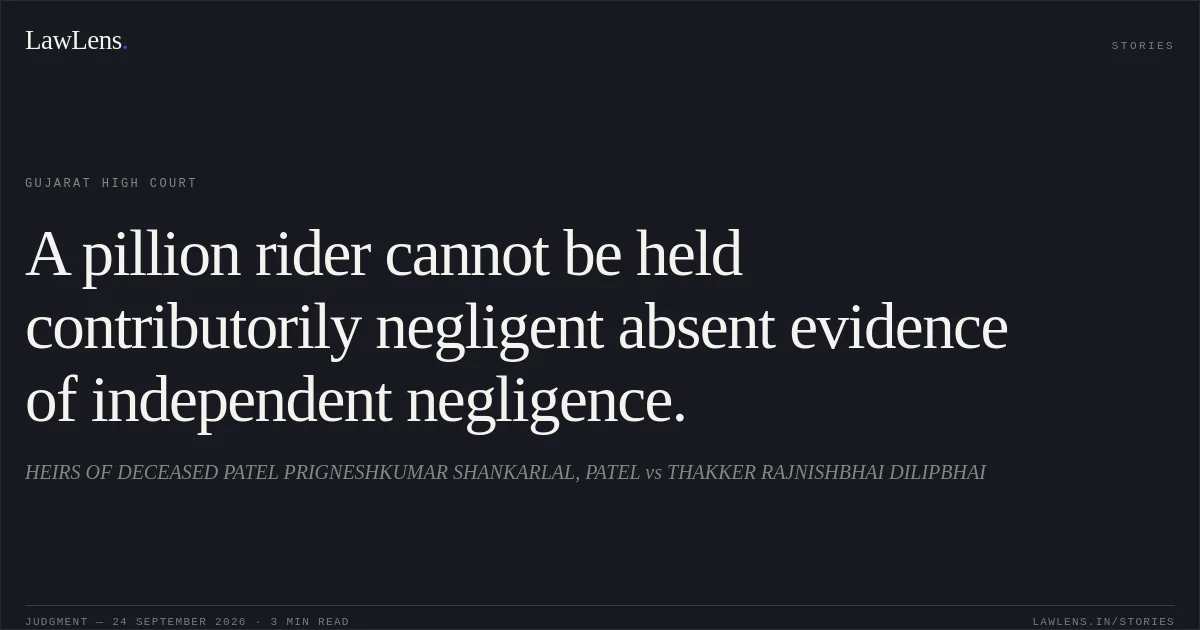
Whether the Tribunal was justified in attributing 50% contributory negligence to the deceased, who was travelling as a pillion rider when the motorcycle was hit from behind by the offending car?
Source reference: p.4, para. 10; p.2, para. 3Whether the compensation awarded by the Tribunal was required to be recomputed in accordance with the principles governing income, future prospects, deductions, multiplier, and conventional heads of compensation?
Source reference: p.4, para. 10; p.5, para. 12What amount of just and fair compensation, with applicable interest, were the claimants entitled to receive?
Source reference: p.5, para. 12; p.6, para. 13Law Applied
The Court applied Section 173 of the Motor Vehicles Act, 1988, governing appeals against awards of a Claims Tribunal, and Section 166, under which compensation may be claimed for death arising from a motor vehicle accident.
Source reference: p.1, para. 1; p.2, para. 2.1It reiterated that the Motor Vehicles Act is beneficial legislation and that motor accident claims are determined on the basis of preponderance of probabilities rather than proof beyond reasonable doubt, relying on Rajwati alias Rajjo v. United India Insurance Co. Ltd., 2022 SCC OnLine SC 1699, and Sunita v. Rajasthan SRTC, (2013) 9 SCC 166.
Source reference: p.3, paras. 7–8The Court further relied on Jiju Kuruvila v. Kunjujamma, regarding the requirement of direct or corroborative evidence before attributing negligence based merely on the position of vehicles after an accident.
Source reference: p.4, para. 9For computation of compensation, it applied National Insurance Co. Ltd. v. Pranay Sethi, (2017) 16 SCC 680, concerning future prospects, multiplier, and conventional heads. In the absence of contrary proof of income, the applicable minimum wage was treated as the deceased’s income, following Hitesh Nagjibhai Patel v. Bababhai Nagjibhai Rabari, 2025 LiveLaw (SC) 871.
Source reference: p.4, paras. 10–11Reasoning
The Court held that the Tribunal’s finding of 50% contributory negligence was erroneous because the deceased was merely a pillion rider and was not shown to have contributed to the accident. The motorcycle was being driven by another person, while the offending car struck it from behind; therefore, the deceased was a victim rather than a tortfeasor.
Source reference: p.4, paras. 6–7Applying the beneficial-object principle and the preponderance-of-probabilities standard, the Court found no factual basis for reducing the compensation on account of contributory negligence.
Source reference: p.3, paras. 7–8; p.4, para. 10For quantification, the Court adopted a monthly income of Rs.2,500 based on minimum wages, added 40% towards future prospects, deducted one-third towards personal expenses, and applied a multiplier of 18. This resulted in a dependency loss of Rs.5,04,144. It further awarded Rs.1,45,200 towards loss of consortium for three claimants, Rs.18,150 towards funeral expenses, and Rs.18,150 towards loss of estate, making the total compensation Rs.6,85,644.
Source reference: p.5, para. 12After deducting the Rs.3,21,000 already awarded by the Tribunal, the enhanced amount payable was calculated at Rs.3,64,644.
Source reference: p.5, para. 12Holding
The appeal was allowed. The Court set aside the finding attributing 50% contributory negligence to the deceased and enhanced the total compensation from Rs.3,21,000 to Rs.6,85,644, with interest at 7.5% per annum from the date of filing of the claim petition until realization.
The Insurance Company was directed to deposit the enhanced amount of Rs.3,64,644 before the concerned Tribunal within eight weeks. The Tribunal was directed to disburse the entire awarded amount, including any amount held in fixed deposit or lying with the Tribunal, with accrued interest, subject to verification, procedural compliance, and deduction of court fees where applicable.
Source reference: p.6, paras. 14.1–14.4Acts & Sections Cited
2 provisions across 1 statute referred to in this judgment. Each provision opens on LawLens.
Motor Vehicles Act, 19882
Original Court PDF
HEIRS OF DECEASED PATEL PRIGNESHKUMAR SHANKARLAL, PATELvsTHAKKER RAJNISHBHAI DILIPBHAI
Click to open original judgment
Original judgment, available to read, download and summarize on LawLens.in