Facts
Late Smt. Rukmani Dei, mother of the parties, owned Ac.0.305 decimals of land at Chauliaganj, Cuttack. By a registered Will dated 14.01.1999, she bequeathed Ac.0.155 decimals to the Petitioner and Ac.0.150 decimals to the Opposite Party, with the respective portions indicated in an appended sketch map.
Source reference: paras. 2(i); p.2The Will was probated on 27.10.2017, Letters of Administration were issued on 26.12.2017, and mutation entries were subsequently made in favour of the respective parties.
Source reference: para. 2(ii); p.2The Opposite Party instituted C.S. No.263 of 2024 seeking, inter alia, partition, demarcation by metes and bounds, eviction and permanent injunction. She pleaded that the property had not been physically partitioned and that, on 15.02.2024, she learned of the Petitioner’s alleged intention to sell or mortgage the property and discovered the exclusive mutation in the Petitioner’s name.
Source reference: paras. 2(iii), 16; pp.2, 14The Petitioner sought rejection of the plaint under Order VII Rule 11(a) and (d) read with Section 151 CPC, contending that the parties’ shares had already been determined and acted upon under the probated Will, that no cause of action remained, and that the suit was barred by limitation, res judicata, estoppel and Section 42 of the Orissa Survey and Settlement Act, 1958.
Source reference: paras. 2(iv), 3(i)–(vii); pp.2–5The Trial Court rejected the application on 28.11.2025, holding that the plaint disclosed a cause of action and that the Defendant’s factual defence could not be considered at the Order VII Rule 11 stage. The Petitioner consequently invoked the revisional jurisdiction of the High Court under Section 115 CPC.
Source reference: paras. 5, 7; pp.8–10Issues
Whether the Trial Court’s rejection of the application under Order VII Rule 11(a) and (d) CPC disclosed a jurisdictional error warranting interference under Section 115 CPC.
Source reference: para. 7; p.10Whether, on a reading of the plaint as a whole, the suit failed to disclose a cause of action because the parties’ shares had already been identified and allegedly physically partitioned under the Will.
Source reference: paras. 20–23; pp.15–17Whether the suit appeared from the plaint to be barred by limitation, res judicata, estoppel or Section 42 of the Orissa Survey and Settlement Act, 1958.
Source reference: paras. 14–19, 25–29; pp.13–19Law Applied
Section 115 CPC permits revisional interference only where the subordinate court has exercised jurisdiction not vested in it, failed to exercise jurisdiction, or acted illegally or with material irregularity; under the Orissa amendment, interference is further permissible where the order, if made in favour of the revisionist, would finally dispose of the suit.
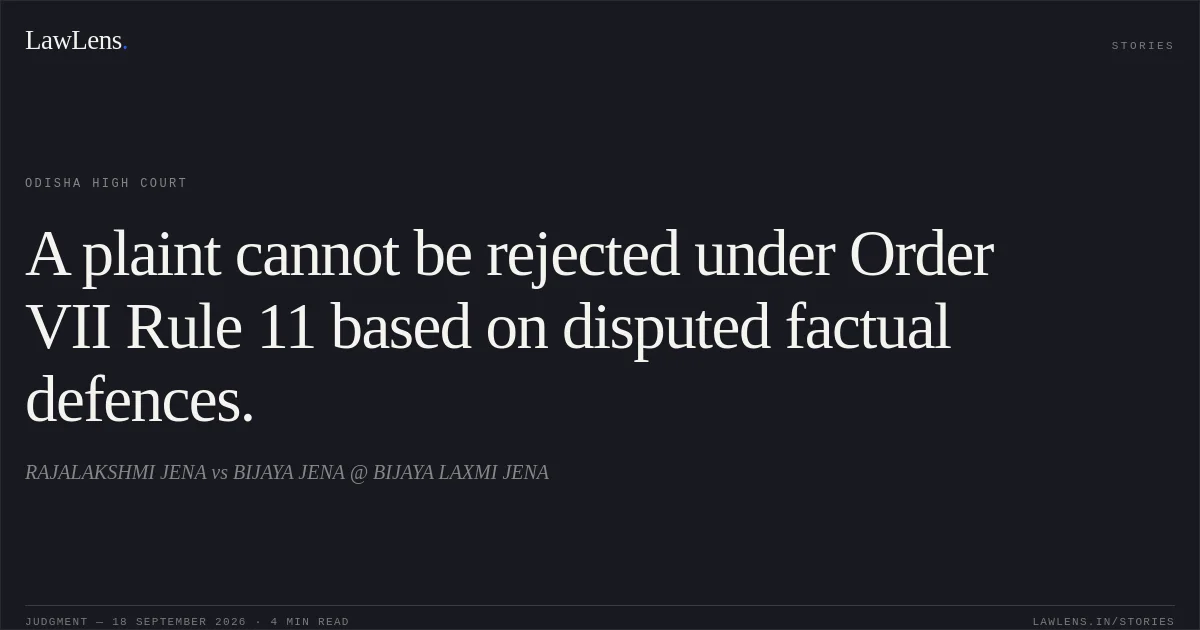
Source reference: para. 8; p.10Order VII Rule 11(a) and (d) CPC requires rejection only where the plaint, read as a whole, discloses no cause of action or appears from its own statements to be barred by law.
Source reference: para. 10; p.11Relying on Church of Christ Charitable Trust & Educational Charitable Society v. Ponniamman Educational Trust, P.V. Guru Raj Reddy v. P. Neeradha Reddy and Kuldeep Singh Pathania v. Bikram Singh Jaryal, the Court held that the plaint and documents forming part of it are germane, while the Defendant’s written statement, defence and disputed evidence are irrelevant at this stage.
Source reference: paras. 11–13; pp.11–13The Court also applied the principle in Frost (International) Ltd. v. Milan Developers & Builders (P) Ltd. that revisional jurisdiction is confined to jurisdictional errors and does not permit correction of mere errors of fact or law.
Source reference: para. 9; p.10Reasoning
The High Court held that the plaint specifically pleaded that, despite the Will and probate, the property had not been physically partitioned by metes and bounds, that the parties continued to be co-sharers, and that a request for partition was refused on 15.02.2024.
Source reference: paras. 16, 21–22; pp.14–16These averments, taken as true for the limited purpose of Order VII Rule 11, disclosed an actionable dispute regarding partition, demarcation and protection of possession.
Source reference: paras. 16, 21–22; pp.14–16The Petitioner’s assertion that the parties had already taken exclusive possession, constructed separate residences and acted upon the mutation entries raised disputed questions of fact that could be decided only at trial and could not be imported from the defence at the threshold.
Source reference: para. 22; p.16The limitation objection was not apparent from the plaint because the plaint relied not merely on the 2017 probate but also on the pleaded 2024 refusal to partition and alleged threatened alienation.
Source reference: paras. 15–19; pp.13–15Probate established the testamentary validity of the Will, but the present suit did not challenge the Will or reopen its probate; it concerned the alleged absence of physical partition and the parties’ enjoyment of the property.
Source reference: paras. 25–26; pp.17–18Similarly, estoppel depended on disputed conduct and possession, while Section 42 of the Orissa Survey and Settlement Act could not bar the entire suit because the principal relief was partition and consequential reliefs, not merely correction of a revenue entry.
Source reference: paras. 27–28; pp.18–19The discrepancy between the pleaded half-share and the specific extent under the Will concerned the relief ultimately grantable, not the existence of a cause of action.
Source reference: para. 24; p.17Holding
The High Court answered the issues against the Petitioner. It held that the plaint disclosed a cause of action and that no bar of limitation, res judicata, estoppel or Section 42 of the Orissa Survey and Settlement Act was apparent on the face of the plaint so as to attract Order VII Rule 11(d) CPC.
Finding no jurisdictional error or material irregularity in the Trial Court’s order, the Court dismissed the Civil Revision Petition and affirmed the order dated 28.11.2025 rejecting the application under Order VII Rule 11(a) and (d) CPC. Any interim order was vacated.
Source reference: paras. 30–32; p.20Acts & Sections Cited
2 provisions across 1 statute referred to in this judgment. Each provision opens on LawLens.
Code of Civil Procedure, 19082
Original Court PDF
RAJALAKSHMI JENAvsBIJAYA JENA @ BIJAYA LAXMI JENA
Click to open original judgment
Original judgment, available to read, download and summarize on LawLens.in