Facts
The Respondent, claiming to be a legal heir of late Smt. Padmawati and asserting an interest in property bearing No. D-37, Kamla Nagar, Delhi, filed Civil Suit No. 3517/2019 seeking a permanent injunction against Appellant No. 1 to restrain alienation or creation of third-party rights.
Source reference: pp. 1–2During that suit, Appellant No. 1’s written statement dated 8 January 2020 relied, for the first time according to the Respondent, upon a registered Gift Deed dated 7 June 2007 and a registered Will allegedly executed by Smt. Padmawati in his favour.
Source reference: pp. 1–2The injunction suit was dismissed on 7 March 2020 on the ground that a bare injunction suit was not maintainable in view of the title dispute; however, liberty was granted to institute a comprehensive suit for declaratory and consequential reliefs.
Source reference: p. 2The Respondent’s appeal against that judgment was withdrawn on 27 May 2024, after which she instituted CS(OS) 464/2024 seeking, inter alia, declarations that the Gift Deed and Will were null and void, partition, and permanent injunction.
Source reference: p. 2The Appellants’ application under Order VII Rule 11 read with Section 151 CPC, alleging that the declaratory relief was barred by limitation under Article 58 of the Limitation Act, was dismissed by the learned Single Judge on 18 August 2025, leading to the present appeal under Section 10 of the Delhi High Court Act, 1966.
Source reference: p. 1Issues
Whether the plaint, read as a whole, disclosed an unequivocal bar of limitation under Article 58 of the Limitation Act so as to warrant rejection under Order VII Rule 11(d) CPC?
Source reference: paras. 9–11; pp. 3–4Whether the Respondent’s reliance on the Supreme Court’s COVID-19 limitation-exclusion orders and the possible benefit of Section 14 of the Limitation Act rendered limitation a matter requiring adjudication at trial rather than rejection at the threshold?
Source reference: paras. 10–13; pp. 4–6Law Applied
Article 58 of the Limitation Act prescribes a three-year limitation period for a suit seeking a declaration, commencing when the right to sue first accrues.
Source reference: para. 11; p. 4Under Order VII Rule 11(d) CPC, a plaint may be rejected only where the suit appears from the statements in the plaint itself to be barred by law; the court must therefore determine whether the plaint leads unequivocally to that conclusion, without relying on the defence.
Source reference: para. 10; p. 4The Supreme Court’s orders in In Re: Cognizance for Extension of Limitation, Suo Motu W.P. (C) No. 3 of 2020, including the order dated 10 January 2022, directed exclusion of the period from 15 March 2020 to 28 February 2022 while computing limitation.
Source reference: para. 11; p. 4Section 14 of the Limitation Act permits exclusion of time spent bona fide and with due diligence in prosecuting an earlier civil proceeding which could not be entertained for want of jurisdiction or a cause of a similar nature; it does not enlarge limitation but only excludes the relevant period.
Source reference: paras. 12–13; pp. 5–6This principle was reaffirmed in Consolidated Engineering Enterprises v. Principal Secretary, Irrigation Department & Ors., (2008) 7 SCC 169.
Source reference: paras. 12–13; pp. 5–6Reasoning
Although the Respondent pleaded knowledge of the Gift Deed and Will on 8 January 2020, which would ordinarily result in expiry of the three-year period under Article 58 on 7 January 2023, the plaint also relied on the Supreme Court’s COVID-19 exclusion orders.
Source reference: para. 11; p. 4After excluding the period from 15 March 2020 to 28 February 2022, the limitation period was extended sufficiently to cover the suit instituted on 27 May 2024.
Source reference: para. 11; pp. 4–5Independently, the plaint disclosed the earlier injunction proceedings, the grant of liberty to pursue comprehensive reliefs, and the subsequent appeal.
Source reference: paras. 12–13; pp. 5–6These facts furnished a possible foundation for invoking Section 14, although the Respondent’s bona fides, due diligence, and satisfaction of the statutory requirements would require evidence.
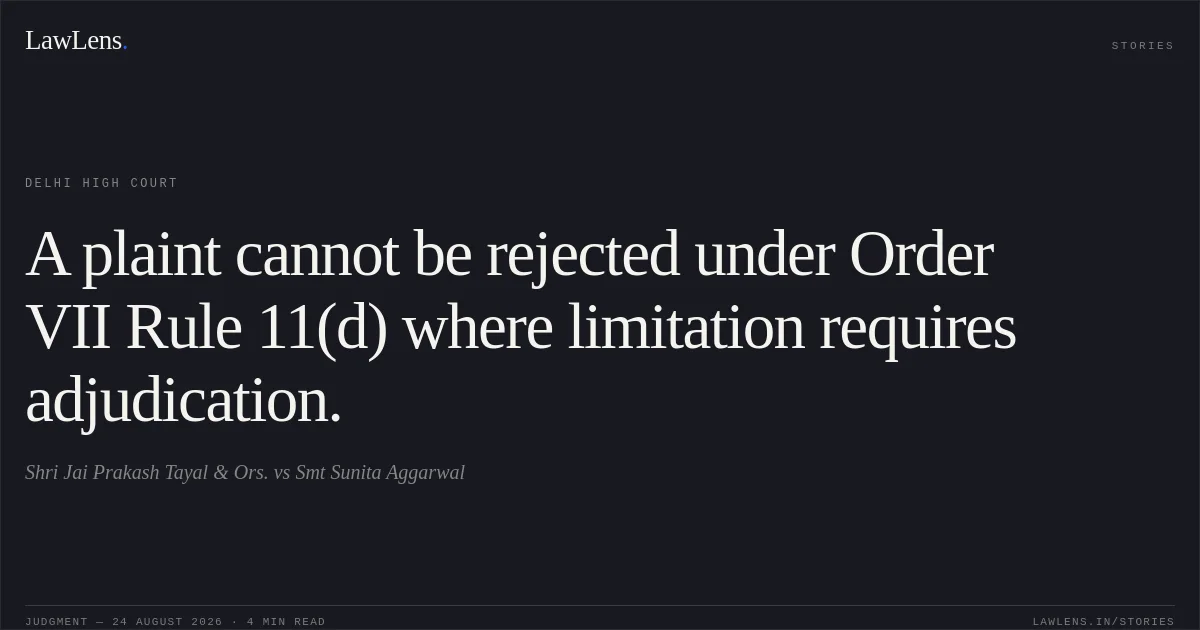
Source reference: paras. 12–13; pp. 5–6Consequently, the plaint did not establish an unequivocal limitation bar on its face, and the Appellants’ objection could not be conclusively determined under Order VII Rule 11(d) CPC.
Source reference: paras. 10, 12–14; pp. 4–6Holding
The Court held that the plaint could not be rejected at the threshold because limitation was not conclusively barred on its face.
The COVID-19 exclusion period and the possible application of Section 14 of the Limitation Act raised matters requiring adjudication in the suit, including after framing of issues and leading of evidence.
Source reference: paras. 11–14; pp. 4–6The appeal was accordingly dismissed; all questions concerning limitation and the merits of the parties’ rival claims were left open for determination in the suit.
Source reference: paras. 15–16; p. 6Pending applications, if any, were disposed of, with no order as to costs.
Source reference: paras. 15–16; p. 6Acts & Sections Cited
3 provisions across 3 statutes referred to in this judgment. Linked provisions open on LawLens.
Delhi High Court Act, 19661
Code of Civil Procedure, 19081
Limitation Act, 19631
Original Court PDF
Shri Jai Prakash Tayal & Ors.vsSmt Sunita Aggarwal
Click to open original judgment
Original judgment, available to read, download and summarize on LawLens.in