Facts
The plaintiff/appellant instituted a suit seeking declarations based on a registered 99-year lease deed executed by defendant no. 2, including a declaration of his leasehold rights and entitlement to conduct business in the suit shop room.
Source reference: paras. 1–2He also sought declarations that a subsequent sale deed executed by defendant no. 2 in favour of defendant no. 1 was illegal, void, inoperative and not binding on him, together with permanent injunctions protecting his possession and business activities.
Source reference: paras. 1–2The plaintiff contended that the lease deed, which allegedly contained a further renewal clause for 99 years, conferred perpetual or indefeasible rights upon him.
Source reference: paras. 3–10The Trial Court rejected the plaint under Order VII Rule 11 of the Code of Civil Procedure, 1908. The plaintiff preferred the present appeal against that rejection.
Source reference: paras. 21–22Issues
Whether the plaint disclosed a clear and legally enforceable cause of action for the declarations and injunctions sought by the plaintiff?
Source reference: paras. 23–30Whether, on a meaningful reading of the plaint and the documents relied upon therein, the plaint was liable to be rejected under Order VII Rule 11(a) and (d) of the Code of Civil Procedure, 1908?
Source reference: paras. 23–31Whether the plaintiff’s 99-year lease, together with the renewal clause, conferred perpetual or indefeasible ownership-like rights enabling him to challenge the subsequent sale deed executed by the lessor?
Source reference: paras. 27–30Whether the plaint could be partially maintained in respect of the declaration of leasehold rights even if the challenges to the sale deed were not maintainable?
Source reference: paras. 4, 27–28Law Applied
The Court applied Order VII Rule 11(a) and (d) of the Code of Civil Procedure, 1908, under which a plaint may be rejected where it does not disclose a cause of action or where the suit appears from the statements in the plaint to be barred by law.
Source reference: para. 30Relying on Bloom Dekor Ltd. v. Subhash Himatlal Desai, (1994) 6 SCC 322, the Court reiterated that a cause of action consists of the bundle of material facts necessary for the plaintiff to establish a right to judgment.
Source reference: para. 5Relying on T. Arivandandam v. T. V. Satyapal, (1977) 4 SCC 467, the Court held that a plaint which, on a meaningful reading, is manifestly vexatious and creates only an illusion of a cause of action through clever drafting should be rejected at the threshold.
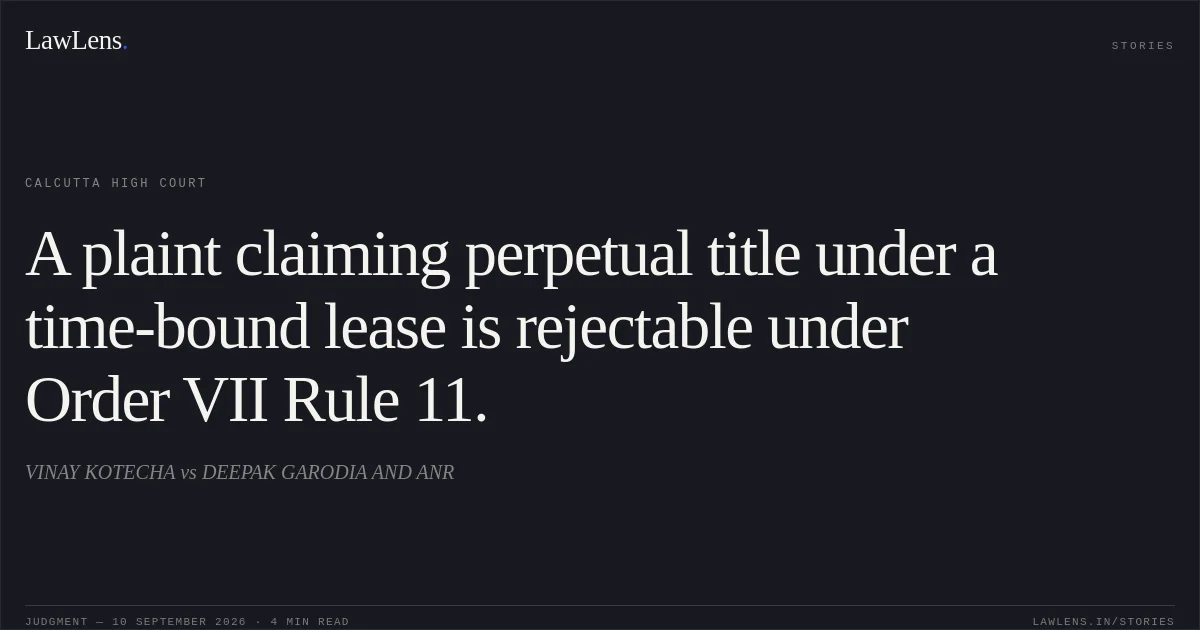
Source reference: paras. 17, 31The Court further applied the principle that a lease creates a limited leasehold interest and does not transfer ownership of the corpus of the property; a fixed-term lease, even with a renewal clause, does not create perpetual title.
Source reference: paras. 18, 29A plaint cannot be partially rejected where the reliefs are founded on the same inseparable cause of action.
Source reference: para. 28Reasoning
The Court examined the plaint together with the lease deed and sale deed relied upon by the plaintiff.
Source reference: paras. 23–24The sale deed expressly acknowledged and preserved the plaintiff’s leasehold rights. Consequently, the mere execution of the sale deed did not threaten or extinguish those rights and could not, by itself, constitute a cause of action for declaring the sale deed void as against the plaintiff.
Source reference: para. 25Although paragraph 12 of the plaint referred to alleged attempts in May 2023 to disturb the plaintiff’s possession, the specific cause-of-action paragraph—paragraph 27—relied only on the execution of the sale deed and the plaintiff’s obtaining a certified copy of it; it did not plead the alleged disturbance incident as the operative cause of action.
Source reference: para. 26The Court further found that the plaintiff’s challenge to the sale deed was founded on the assertion that the 99-year lease had created perpetual and indefeasible title, whereas the lease deed could, at its highest, confer a fixed-term lease with a possible further renewal for 99 years.
Source reference: paras. 27–29Such a limited lease could not be expanded into perpetual ownership or prevent the lessor from transferring the property subject to the lease.
Source reference: paras. 27–29Since the declaration of leasehold rights and the challenge to the sale deed arose from the same legally untenable premise, the reliefs could not be severed to preserve part of the suit.
Source reference: para. 28The plaint therefore disclosed no clear right to sue and was also barred by law insofar as it asserted perpetual title contrary to the lease deed and the statutory scheme.
Source reference: para. 30Holding
The High Court held that the plaint was vexatious and meritless, and that the plaintiff’s 99-year lease, even with a renewal clause, did not confer perpetual or indefeasible ownership rights.
The sale deed recognised the plaintiff’s leasehold interest and its execution did not, by itself, provide a cause of action to challenge the transfer.
Source reference: paras. 25–30The plaint was therefore rightly rejected under Order VII Rule 11(a) and (d) of the Code of Civil Procedure, 1908.
Source reference: para. 30The appeal, FA 65 of 2026, was dismissed on contest, affirming the Trial Court’s judgment and deemed decree dated 8 January 2026; CAN 1 of 2026 was consequently disposed of, with no order as to costs.
Source reference: paras. 32–35Original Court PDF
VINAY KOTECHAvsDEEPAK GARODIA AND ANR
Click to open original judgment
Original judgment, available to read, download and summarize on LawLens.in