Facts
The appellant supplied galvanized steel structures and allied materials to the respondents under a work order for 220 KV and 132 KV grid substations.
Source reference: p.2, paras 2–2.1The material was supplied by 20 August 2014, and payment was contractually due within 30 days. The respondents allegedly deducted ₹19,50,993 towards enhanced entry tax and ₹11,48,370 towards delayed supply, besides withholding interest and other amounts.
Source reference: p.2, paras 2–2.1The appellant pursued its claim before the Centralized Standing Committee, which rejected it on 8 July 2016. Its writ petition was dismissed on 4 May 2017, and its special appeal was withdrawn on 20 September 2018 with liberty to approach the competent civil court.
Source reference: p.2, para 2.2The appellant thereafter instituted a recovery suit on 7 September 2019. The Commercial Court rejected the plaint/dismissed the suit under Order VII Rule 11 CPC, holding it barred by limitation and, in part, by res judicata/Order II Rule 2 CPC. The appellant’s review petition was also dismissed.
Source reference: p.2, para 2.3Issues
1. Whether the suit was liable to be rejected under Order VII Rule 11(d) CPC as being ex facie barred by limitation on the basis of the plaint averments?
Source reference: pp.5–7, paras 7, 10–132. Whether the issue of res judicata or the bar under Order II Rule 2 CPC could be conclusively determined while exercising the limited jurisdiction under Order VII Rule 11 CPC?
Source reference: pp.3–4, paras 3–3.2; p.7, para 83. Whether the time spent in proceedings before the Standing Committee and the High Court either extended limitation or gave rise to a fresh cause of action?
Source reference: p.7, paras 12–13Law Applied
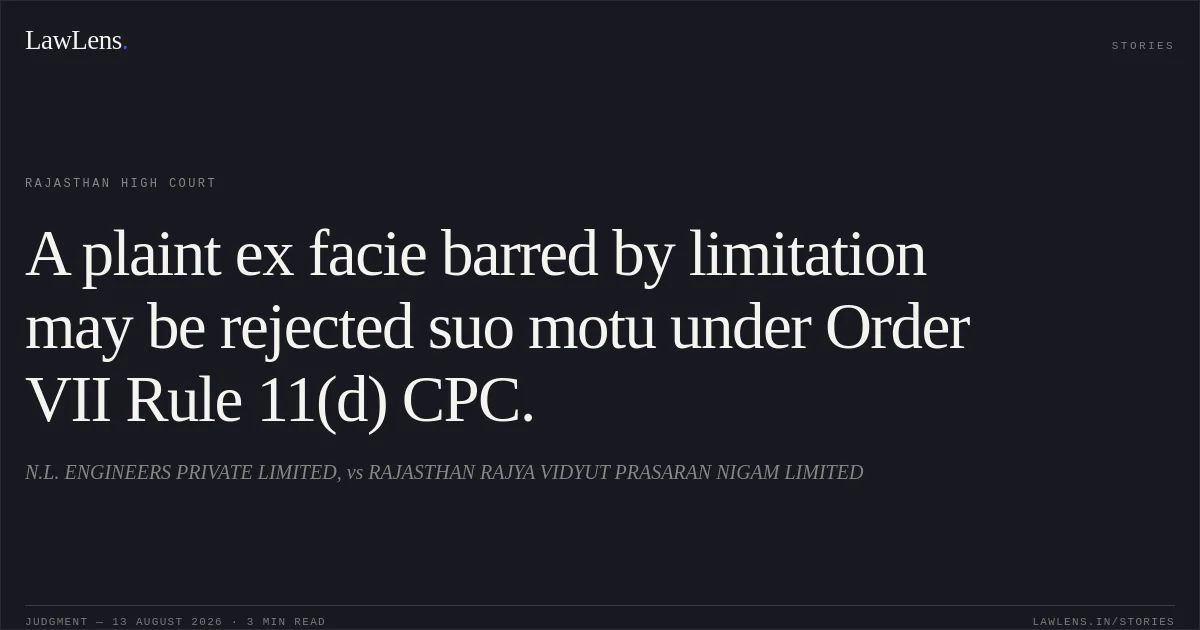
Order VII Rule 11(d) CPC permits rejection of a plaint where the suit appears from the plaint itself to be barred by law, including limitation; the court may act suo motu because the provision imposes an independent duty on the court.
Source reference: p.7, para 11Under the applicable limitation provisions, including Articles 18, 55 and 113 of the Limitation Act, a three-year period governed the claim.
Source reference: p.7, para 12Res judicata and Order II Rule 2 CPC ordinarily require examination of the pleadings, causes of action and judgments in the earlier proceedings and therefore cannot generally be adjudicated under Order VII Rule 11 solely on the basis of the plaint. The Court relied on Keshav Sood v. Kirti Pradeep Sood & Ors., 2023 SCC OnLine SC 2459, for this principle.
Source reference: p.7, para 8Section 14 of the Limitation Act does not automatically save time spent in prior proceedings, and liberty granted by a court to pursue a civil remedy does not create a fresh cause of action or fresh limitation period.
Source reference: p.7, para 13Reasoning
The Court distinguished between the limitation objection and the objections based on res judicata or Order II Rule 2 CPC.
Source reference: p.5, para 5Although res judicata could not properly be decided under Order VII Rule 11 because it required comparison of the earlier pleadings and judgments, limitation was apparent from the appellant’s own plaint.
Source reference: p.7, paras 10–11The plaint admitted that supplies were completed by 20 August 2014 and that payment became due within 30 days; limitation therefore commenced, at the latest, in September 2014.
Source reference: p.7, paras 10–11Even adopting the most favourable date of 8 July 2016, when the Standing Committee rejected the claim, the three-year period expired on 8 July 2019, whereas the suit was filed on 7 September 2019.
Source reference: p.7, para 12The writ proceedings did not extend limitation, and Section 14 was unavailable, particularly because the appellant waited nearly a year after withdrawal of the special appeal before filing the suit.
Source reference: p.7, para 13Accordingly, the limitation finding independently sustained dismissal, making the res judicata issue largely academic.
Source reference: p.5, para 5Holding
The High Court dismissed the appeal and upheld the Commercial Court’s judgment and decree dated 27 October 2021.
It held that the suit was ex facie barred by limitation and could be rejected under Order VII Rule 11(d) CPC, notwithstanding the absence of a separate application by the defendants.
Source reference: p.8, paras 14–15The Court did not accept the appellant’s challenge based on Keshav Sood, holding that the precedent was distinguishable because the operative basis of dismissal was limitation, not res judicata.
Source reference: p.8, paras 14–15Pending applications were also disposed of.
Source reference: p.8, para 16Acts & Sections Cited
5 provisions across 2 statutes referred to in this judgment. Each provision opens on LawLens.
Code of Civil Procedure, 19081
Limitation Act, 19634
Original Court PDF
N.L. ENGINEERS PRIVATE LIMITED,vsRAJASTHAN RAJYA VIDYUT PRASARAN NIGAM LIMITED
Click to open original judgment
Original judgment, available to read, download and summarize on LawLens.in