Facts
The respondents/plaintiffs filed O.S. No. 227/2025 seeking partition and separate possession of shares in the suit properties.
Source reference: p.11–12Their plaint referred to earlier litigation concerning the family properties and asserted that, after the Supreme Court dismissed SLP No. 19177/2024, they demanded partition.
Source reference: p.11–12The petitioner/defendant sought rejection of the plaint under Order VII Rule 11(a) and (d) CPC, contending that earlier proceedings had finally recognized a 1976 partition and that the present suit sought to reopen matters already decided.
Source reference: p.3–5The trial court dismissed the application, reasoning that the plaint and its supporting documents—not the defendant’s case—were to be considered, and that the res judicata plea could not be determined at that stage.
Source reference: p.5–7The defendant challenged that order in this revision petition.
Source reference: p.3Issues
1. Whether a plaint may be rejected under Order VII Rule 11 CPC where the plaint itself refers to prior proceedings that, on the High Court’s assessment, finally determined the relevant partition issue.
Source reference: p.18–192. Whether the Supreme Court’s dismissal of SLP No. 19177/2024 granted the plaintiffs liberty to institute the present suit.
Source reference: p.16Law Applied
Order VII Rule 11 CPC permits rejection of a plaint where the grounds in clauses (a) or (d) are established from the plaint and the materials properly considered with it.
Source reference: p.18–19Although a plea of res judicata ordinarily requires examination of the pleadings, issues and judgments in the former suit, and is generally unsuitable for determination under Order VII Rule 11(d), the court may consider the bar where it emerges from the plaint’s own averments and the proceedings on which the plaintiff relies.
Source reference: p.18–19The court also applied the principle of finality of adjudication: a party bound by a final determination cannot reopen the same concluded issue by commencing a fresh proceeding.
Source reference: p.17–18Section 6(5) of the Hindu Succession Act was invoked by the petitioner in support of the asserted effect of a pre-20 December 2004 partition, but the order’s operative reasoning rests on the prior adjudication and finality.
Source reference: p.9Reasoning
The High Court noted that the plaintiffs’ own plaint recounted the earlier proceedings and relied on them as part of the basis for the new claim.
Source reference: p.16–19It found that the plaintiff had been a party to those proceedings and that the 1976 partition had already been recognized and the relevant dispute had attained finality.
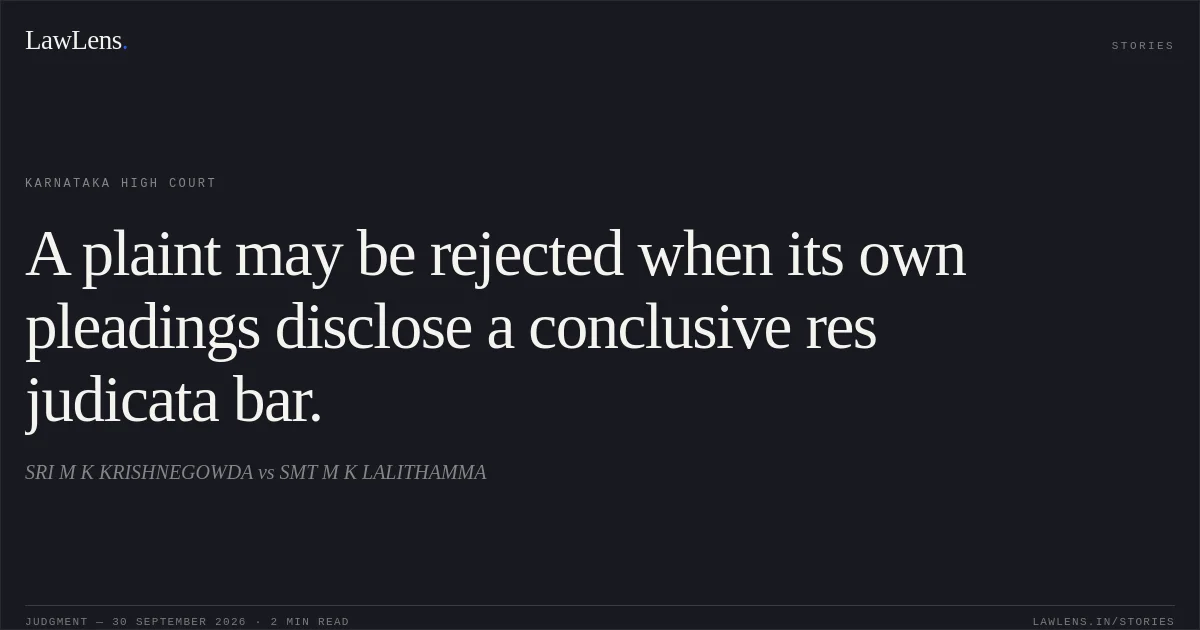
Source reference: p.16–19In those circumstances, the court held that determining the Order VII Rule 11 application did not require it to rely on the defendant’s written statement or an extraneous factual case; the asserted bar was apparent from the plaintiffs’ own pleadings and the proceedings they cited.
Source reference: p.19The court also found no liberty to file the present suit in the Supreme Court’s order dismissing SLP No. 19177/2024.
Source reference: p.16Holding
The High Court allowed the civil revision petition, set aside the trial court’s order dated 11 March 2026, allowed I.A. No. 3 and rejected the plaint in O.S. No. 227/2025.
Pending interlocutory applications were closed.
Source reference: p.20Acts & Sections Cited
2 provisions across 2 statutes referred to in this judgment. Each provision opens on LawLens.
Code of Civil Procedure, 19081
Hindu Succession Act, 19561
Original Court PDF
SRI M K KRISHNEGOWDAvsSMT M K LALITHAMMA
Click to open original judgment
Original judgment, available to read, download and summarize on LawLens.in
![Central age-relaxation rules do not apply to GNCTD recruitment absent adoption.. BHAWNA KHANNA vs Delhi Subordinate Services Selection Board. CAT - ['Delhi']. LawLens](/stories/thumbnails/central-age-relaxation-rules-do-not-apply-to-gnctd-recruitment-absent-adoption-8a54cd0dcc2941f4bfaf9fb4908d5805.webp)