Facts
The plaintiffs instituted a suit in June 2013 seeking declaration that a registered sale deed dated 19 January 1935 and a relinquishment/conveyance deed dated 24 March 1948 were null and void, along with consequential challenges to subsequent sale deeds and a permanent injunction.
Source reference: paras. 12–16The plaint itself stated that mutation in favour of defendants had taken place in 1953 and that the plaintiffs had earlier pursued correction of the revenue records, which was rejected by the Tehsildar on 22 May 2012 on the ground of limitation and delay.
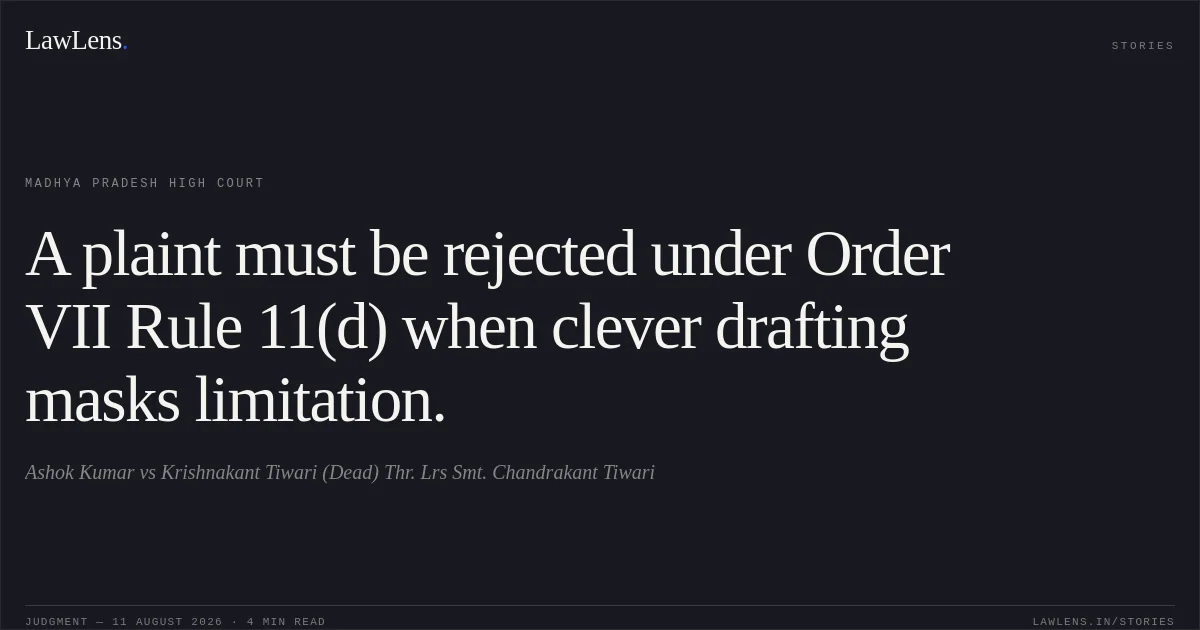
Source reference: para. 18The defendants applied for rejection of the plaint under Order VII Rule 11 CPC, principally contending that the suit was hopelessly barred by limitation and was based on clever drafting.
Source reference: paras. 1–2The trial Court rejected the application, holding that the objections raised mixed questions of law and fact requiring trial.
Source reference: paras. 1–2Issues
Whether, on a meaningful reading of the plaint, the suit seeking to invalidate documents executed in 1935 and 1948 was barred by limitation under Order VII Rule 11(d) CPC?
Source reference: paras. 17–25, 28–29Whether the plaintiffs’ assertion that they acquired knowledge of the disputed documents only in 2010–2011 disclosed a genuine cause of action, or constituted an illusory cause of action created by clever drafting?
Source reference: paras. 17–25, 28Whether the plaint was liable to be rejected under Order VII Rule 11 CPC notwithstanding the plaintiffs’ contention that limitation and knowledge were matters for trial?
Source reference: paras. 8–10, 25–29Law Applied
The Court applied Order VII Rule 11(a) and (d) CPC, under which a plaint may be rejected where it does not disclose a cause of action or where the suit appears from the plaint to be barred by any law.
Source reference: para. 26Under Articles 58 and 59 of the Limitation Act, the relevant limitation period is three years from the accrual of the right to sue or from the date on which the facts entitling the plaintiff to seek cancellation or setting aside of an instrument first become known.
Source reference: para. 6The Court relied on T. Arivandandam v. T.V. Satyapal, which requires a meaningful, rather than merely formal, reading of the plaint and permits rejection where clever drafting creates an illusion of a cause of action.
Source reference: paras. 25, 27It further relied on Dahiben v. Arvindbhai Kalyanji Bhanusali, holding that sham or vexatious litigation and an illusory cause of action may be terminated at the threshold under Order VII Rule 11.
Source reference: para. 26Ramisetty Venkatanna v. Nasyam Jamal Saheb recognises that clever drafting cannot be used to circumvent limitation.
Source reference: para. 27The Court also noted Dali Ben Valji Bhai v. Prajapati Kodar Bhai Kachra Bhai, holding that execution of a registered document does not, by itself, conclusively impute knowledge to all persons.
Source reference: para. 24Reasoning
Although the plaintiffs pleaded that they discovered the disputed documents only in 2010–2011, the Court found that the plaint itself admitted execution of the documents in 1935 and 1948 and mutation of the defendants’ names in 1953.
Source reference: paras. 18–19The plaintiffs’ predecessors allegedly claimed possession and cultivation of the land, yet neither they nor the plaintiffs challenged the mutation, paid land revenue, or asserted their rights for several decades.
Source reference: no citationThe Court held that, upon the coming into force of the Madhya Pradesh Land Revenue Code in 1959, any asserted cultivatory or occupancy rights should have been claimed, and the cause of action therefore arose at least by 1959–60.
Source reference: paras. 21–23Thus, the plea of recent knowledge was inconsistent with the material admissions in the plaint and amounted to suppression and clever drafting.
Source reference: no citationThe Court clarified that it was not applying an automatic rule that registration itself constitutes notice to everyone; rather, it concluded from the plaint’s own averments concerning mutation, revenue records and the plaintiffs’ prolonged inaction that the suit was manifestly vexatious and barred by limitation.
Source reference: paras. 23–25Since the bar was apparent from a meaningful reading of the plaint, evidence and trial were unnecessary.
Source reference: no citationHolding
The High Court held that the plaint disclosed an illusory cause of action and that the suit, instituted in 2013 to challenge transactions of 1935 and 1948 despite mutation in 1953 and the accrual of alleged rights by 1959, was barred by limitation under Order VII Rule 11(d) CPC.
The civil revision was allowed, the trial Court’s order dated 3 September 2014 was set aside, and the plaint was rejected as barred by law.
Source reference: paras. 28–29The Court expressly confined its decision to the ground of limitation and did not adjudicate the defendants’ other objections, including non-compliance with Section 80 CPC or failure to challenge subsequent conveyances.
Source reference: paras. 30–31Acts & Sections Cited
5 provisions across 3 statutes referred to in this judgment. Each provision opens on LawLens.
Code of Civil Procedure, 19081
Limitation Act, 19632
MP Land Revenue Code 19592
Original Court PDF
Ashok KumarvsKrishnakant Tiwari (Dead) Thr. Lrs Smt. Chandrakant Tiwari
Click to open original judgment
Original judgment, available to read, download and summarize on LawLens.in