Facts
The petitioners challenged the Trial Court’s refusal to accept a compromise petition filed by the parties in O.S. No. 824/2024, a suit seeking a declaration of ownership over the suit properties.
Source reference: p. 4–6The Trial Court considered that the claim rested on revenue documents, which do not by themselves establish title, and declined to grant a declaration solely on the basis of the compromise
Source reference: p. 4–6The petitioners sought supervisory relief under Article 227 of the Constitution; the respondents supported the compromise, stating that they admitted the petitioners’ title and the alienation in their favour
Source reference: p. 3–5Issues
Whether the Trial Court could reject a compromise petition seeking a declaration of title because the plaintiff had not produced prima facie material establishing title
Source reference: p. 5–6Whether the Trial Court’s refusal to accept the compromise warranted interference under Article 227 of the Constitution
Source reference: p. 7Law Applied
Order XXIII Rule 3 of the Code of Civil Procedure, 1908, permits a court to record a lawful compromise; Section 151 CPC preserves the court’s inherent powers.
Source reference: p. 6A court considering a compromise must assess the issues, the terms and nature of the compromise, and its consequences, and may decline to act on it if it does not provide a lawful basis for the relief sought
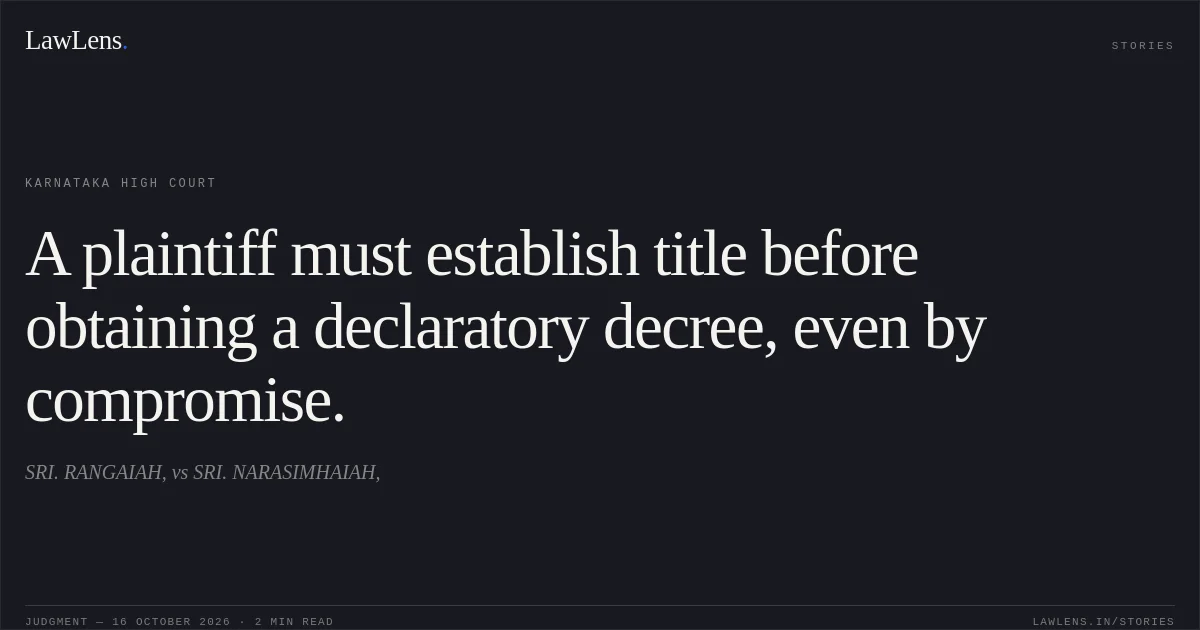
Source reference: p. 6In a suit for declaration of title, the plaintiff must establish title before the court can grant declaratory relief; the burden remains on the plaintiff even if the defendants do not oppose the claim
Source reference: p. 6Revenue documents, by themselves, are not documents of title
Source reference: p. 5No precedent was cited.
Source reference: no citationReasoning
The Court held that the requested compromise decree would declare ownership, so the parties’ consent alone could not supply the necessary basis for that relief.
Source reference: p. 5–6The plaintiff still had to establish title, and the Court found no prima facie material sufficient to do so; revenue documents alone were inadequate
Source reference: p. 5–6The Trial Court was therefore justified in refusing to accept the compromise.
Source reference: p. 7The parties remained free to establish their respective cases at trial
Source reference: p. 7Holding
The Court answered that the Trial Court was justified in rejecting the compromise petition in the absence of prima facie material establishing the plaintiff’s title.
Finding no ground for interference under Article 227, it dismissed the writ petition and left the parties to prove their respective cases at trial
Source reference: p. 7Acts & Sections Cited
1 provisions across 1 statute referred to in this judgment. Each provision opens on LawLens.
Code of Civil Procedure, 19081
Original Court PDF
SRI. RANGAIAH,vsSRI. NARASIMHAIAH,
Click to open original judgment
Original judgment, available to read, download and summarize on LawLens.in