Facts
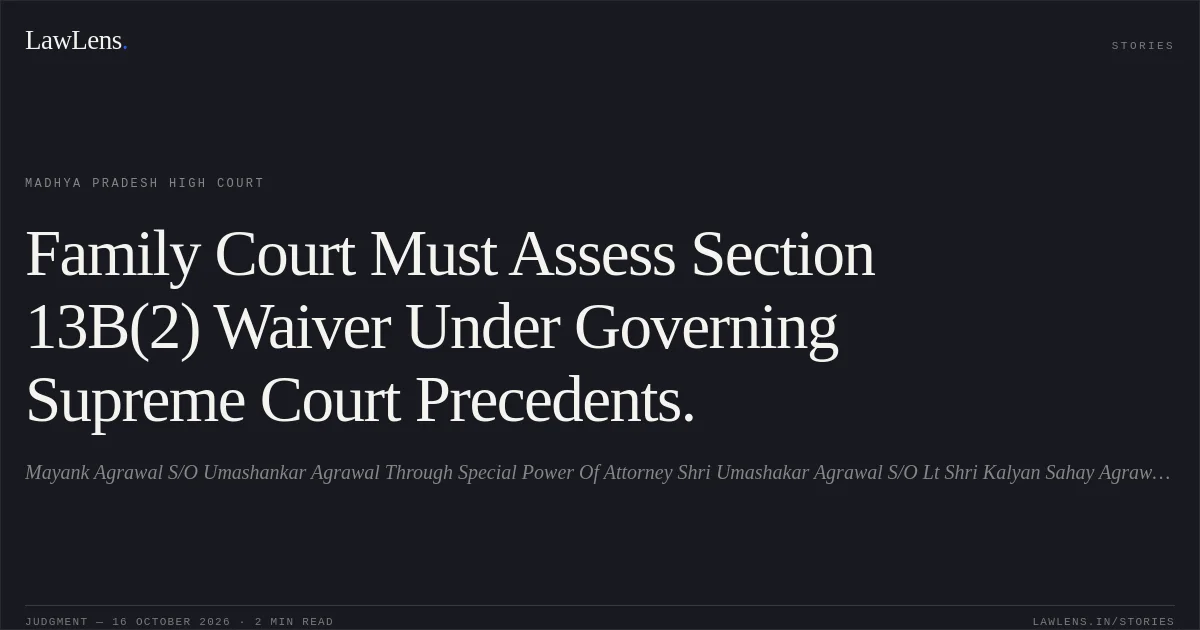
The parties jointly filed a petition for divorce by mutual consent under Section 13-B of the Hindu Marriage Act, 1955.
Source reference: para. 1–2The Family Court fixed the matter after the statutory six-month period and the parties sought waiver of that period, but their application remained undecided.
Source reference: para. 1–2The husband approached the High Court under Article 227, seeking an early decision on the waiver application and permission to participate in further proceedings by video conference because he resided abroad.
Source reference: para. 6–7Issues
Whether the Family Court should be directed to decide the parties’ application for waiver of the six-month cooling-off period in light of the applicable precedents.
Source reference: para. 2–6Whether the Family Court could use video conferencing to enable the husband’s participation in the proceedings.
Source reference: para. 1, 7Law Applied
Section 13-B(2) of the Hindu Marriage Act provides for a waiting period in proceedings for divorce by mutual consent; the Supreme Court in Amardeep Singh v. Harveen Kaur held that the period is directory and may be waived in an appropriate case, and observed that video conferencing may be used where justified.
Source reference: para. 5Amit Kumar v. Suman Beniwal clarified that the factors identified in Amardeep Singh are illustrative and that waiver is assessed in the circumstances of each case.
Source reference: para. 5The Court also relied on its order in M.P. No. 4144 of 2026, which directed reconsideration of a waiver application in light of the relevant precedents.
Source reference: para. 3, 5–6Reasoning
The High Court considered the waiver issue covered by its earlier order in M.P. No. 4144 of 2026.
Source reference: para. 5–7Rather than deciding whether the parties were entitled to waiver, it directed the Family Court to determine the pending application in light of the cited authorities.
Source reference: para. 5–7Given the husband’s stated residence abroad, it also noted that the Family Court could use video conferencing in conducting the proceedings.
Source reference: para. 5–7Holding
The petition was disposed of with a direction to the Family Court to decide the waiver application, preferably within 15 days of receiving a certified copy of the order, while considering the judgments referred to in the earlier order.
The Family Court may use video conferencing for the proceedings.
Source reference: para. 7The High Court did not itself grant the waiver.
Source reference: para. 6–8Acts & Sections Cited
1 provisions across 1 statute referred to in this judgment. Linked provisions open on LawLens.
Hindu Marriage Act, 19551
Original Court PDF
Mayank Agrawal S/O Umashankar Agrawal Through Special Power Of Attorney Shri Umashakar Agrawal S/O Lt Shri Kalyan Sahay AgrawalvsRoshni Mittal
Click to open original judgment
Original judgment, available to read, download and summarize on LawLens.in