Facts
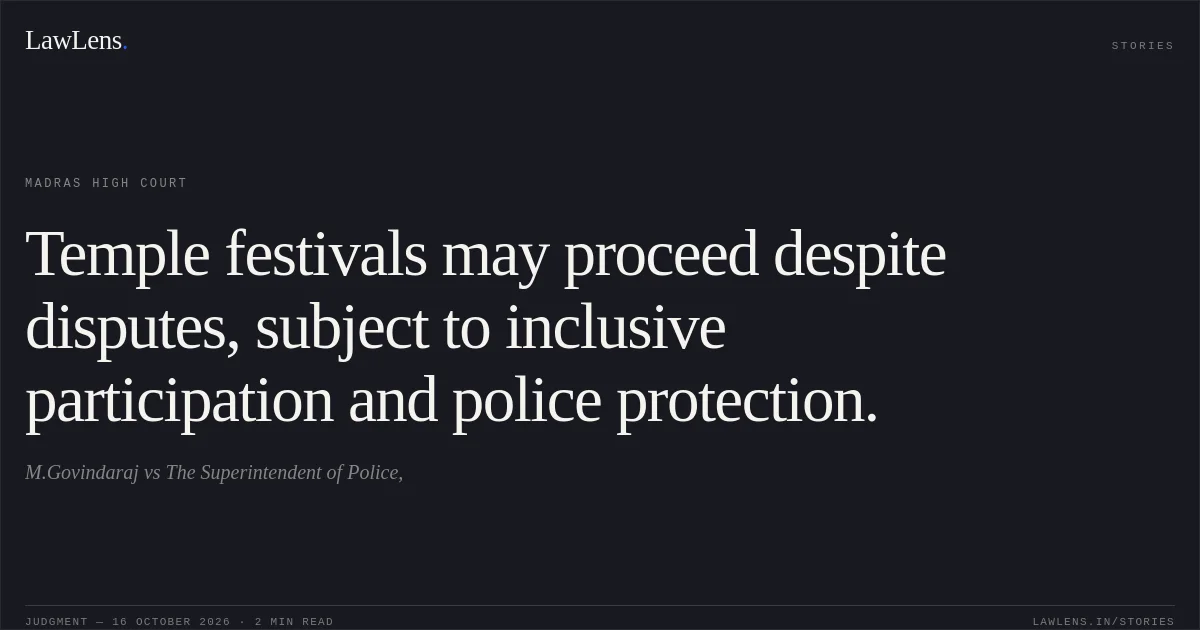
The petitioner sought permission for his community to conduct the Purattasi festival at Sri Pattatharasi Amman, Ayyanar and Sri Vinayagar Temples in Thoppulakarai Village from 12 to 15 October 2026.
Source reference: p. 2–4Disputes concerning worship and administration at a separate temple, Sri Irangi Muthamman, had previously been referred to the competent forum; the petitioner’s later representation sought permission only for the three temples named above.
Source reference: p. 2–4Following a peace committee meeting at which no consensus was reached, the authorities refused permission, citing continuing disputes and the risk of a breach of peace.
Source reference: p. 4The petitioner challenged the refusal under Article 226 of the Constitution and sought permission and police protection.
Source reference: p. 1–2Issues
1. Whether the authorities’ refusal to permit the Purattasi festival at Sri Pattatharasi Amman, Ayyanar and Sri Vinayagar Temples should be set aside
Source reference: p. 2–4, 82. Whether permission to conduct the festival could be granted subject to conditions and police protection to maintain public order and ensure inclusive participation
Source reference: p. 5–7Law Applied
The petition invoked the High Court’s jurisdiction under Article 226 of the Constitution of India.
Source reference: p. 1The judgment cited no specific statutory provisions or precedents.
Source reference: no citationIt applied the principles that a festival may be permitted subject to conditions safeguarding public order, that villagers must not be excluded on grounds of caste or community, and that disputes must be addressed through lawful channels rather than by taking the law into one’s own hands.
Source reference: p. 5–7Reasoning
The Court considered the requested festival distinct from the dispute concerning Sri Irangi Muthamman Temple: the petitioner had confined his request to the other three temples, while the earlier order directed the parties to establish their rights concerning the disputed temple before the competent forum.
Source reference: p. 2–3Although the authorities cited the lack of consensus and the likelihood of a breach of peace, the Court concluded that the festival could be conducted safely through conditions requiring non-discriminatory participation, prohibiting caste- or community-glorifying displays and political interference, requiring the parties to maintain peace, and directing the police to provide protection and act against violations.
Source reference: p. 4–7Holding
The Court allowed the writ petition and set aside the impugned proceedings dated 22 and 26 September 2026.
It permitted the festival subject to the conditions set out in the order, including police protection and participation by all villagers without discrimination.
Source reference: p. 5–8The permission confers no exclusive right on the petitioner or any group to control the festival or exclude other villagers.
Source reference: p. 5–8Original Court PDF
M.GovindarajvsThe Superintendent of Police,
Click to open original judgment
Original judgment, available to read, download and summarize on LawLens.in