Facts
The Central Government, by order dated 17 August 2018, directed an SFIO investigation into Educomp Solutions Limited (“ESL”) under Section 212(1)(c) of the Companies Act, 2013.
Source reference: para. 15, 94–96The order followed an Oversight Committee meeting that considered, among other things, inspection reports, complaints, a bank fraud-monitoring report, PMO references and a media article.
Source reference: para. 15, 94–96The petitioners challenged the order, contending that it gave no reasons and that the material considered did not establish a basis for an SFIO investigation.
Source reference: para. 11, 99–102The Regional Director’s inspection and supplementary reports had identified no fraud, siphoning or diversion of funds, although the first report noted certain regulatory and accounting contraventions.
Source reference: para. 11, 99–102SFIO subsequently filed an investigation report and prosecution complaint; the petitions sought to quash the initiating order and consequential proceedings.
Source reference: para. 26–28Issues
1. Whether the order under Section 212(1)(c) satisfied the statutory requirements for directing an investigation by the SFIO, including demonstrable consideration of relevant material and the necessity of assigning the investigation to that specialised office.
Source reference: para. 68–69, 782. Whether the Oversight Committee minutes and other material could supplement the reasons absent from the impugned order, and whether the alleged defects warranted quashing the consequential proceedings.
Source reference: para. 92–98, 121–127Law Applied
Section 212(1)(c) of the Companies Act, 2013 empowers the Central Government to assign an investigation to the SFIO when it forms the opinion that such an investigation is necessary in the public interest.
Source reference: no citationAlthough formation of that opinion is subjective, the relevant circumstances supporting it must be demonstrable; the decision must reflect application of mind to relevant material and must support both the need for investigation and assignment to the SFIO.
Source reference: para. 73–77Sections 206, 208 and 210 form part of the statutory framework for inspection, reporting and investigation; a Section 208 report that identifies no basis for further investigation is relevant to the assessment under Section 212.
Source reference: para. 70–72, 114–115Applying Barium Chemicals Ltd. v. Company Law Board, AIR 1967 SC 295, and Rohtas Industries Ltd. v. S.D. Agarwal, (1969) 1 SCC 325, the Court held that the circumstances underlying the statutory opinion must be demonstrable.
Source reference: para. 71–77Under Mohinder Singh Gill v. Chief Election Commissioner, (1978) 1 SCC 405, an order must stand on the reasons on which it was made and cannot be repaired by later explanations.
Source reference: para. 71–77Nita Puri v. Union of India, W.P.(C) 261/2025 (Delhi High Court, 28 August 2025), and the Supreme Court’s order affirming it, as well as Parmeshwar Das Aggarwal v. Union of India, 2016 SCC OnLine Bom 9276, were relied on for the requirements of relevant material, application of mind and justification for SFIO involvement.
Source reference: para. 71–77Reasoning
The impugned order merely recited the statutory power and directed an SFIO investigation; it did not identify the material considered or disclose why investigation by the SFIO was necessary.
Source reference: para. 79–82The Court declined to treat the Oversight Committee minutes as a cure for that defect and, in any event, found their cited material insufficient: the statutory reports did not disclose fraud or diversion; the Yes Bank report recorded a complaint to the EOW; and the PMO reference was not identified or produced.
Source reference: para. 93–109The MP’s letter and media article were allegations without independent corroboration and could not, on their own, justify the statutory action.
Source reference: para. 93–109The Court did not adjudicate the parties’ disputed allegations about corporate rivalry or determine the merits of the prosecution charges.
Source reference: para. 110–117, 124–129It held that the defect concerned the legal foundation for initiating the investigation, not the evidentiary merits to be tested at trial; subsequent investigation and prosecution could not cure that foundational defect.
Source reference: para. 110–117, 124–129Holding
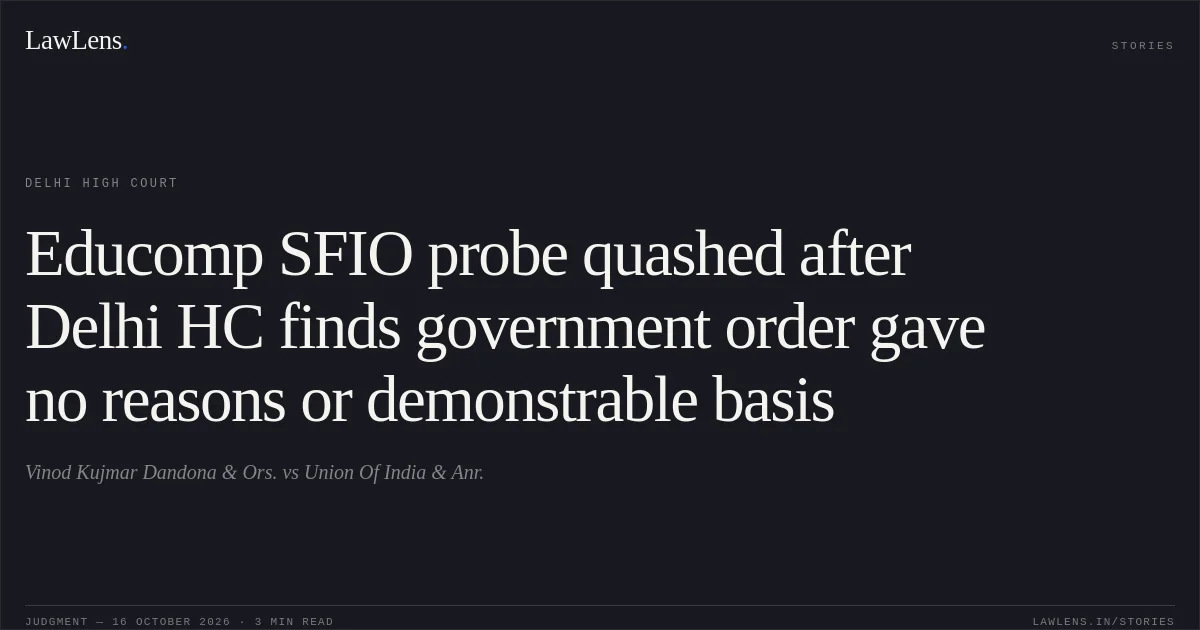
The Court held that the order dated 17 August 2018 was unsustainable because it did not demonstrate application of mind or a sufficient, relevant basis for assigning the investigation to the SFIO under Section 212(1)(c).
Both petitions were allowed, and the impugned order and all consequential proceedings emanating from it—including the SFIO investigation and prosecution proceedings—were quashed.
Source reference: para. 130–132Acts & Sections Cited
26 provisions across 4 statutes referred to in this judgment. Each provision opens on LawLens.
Code of Criminal Procedure, 19732
Companies Act, 2013
Insolvency and Bankruptcy Code, 2016.5
Indian Penal Code, 18604
Original Court PDF
Vinod Kujmar Dandona & Ors.vsUnion Of India & Anr.
Click to open original judgment
Original judgment, available to read, download and summarize on LawLens.in