Facts
Odisha’s Industrial Policy Resolution, 2015 (IPR 2015) provided incentives, including tax reimbursement for eligible Priority Sector units.
Source reference: no citationThe petitioners obtained in-principle project approval in 2015, received land in 2016, made their first fixed-capital investment on 31 July 2017, and applied for provisional Priority Sector status on 16 August 2017.
Source reference: paras. 2–14, 40Following inspection, the Regional Industries Centre (RIC) forwarded the application with a verification report and recommendation on 22 September 2017; no rejection was communicated within the prescribed period.
Source reference: paras. 2–14, 40The unit commenced commercial production on 1 May 2020.
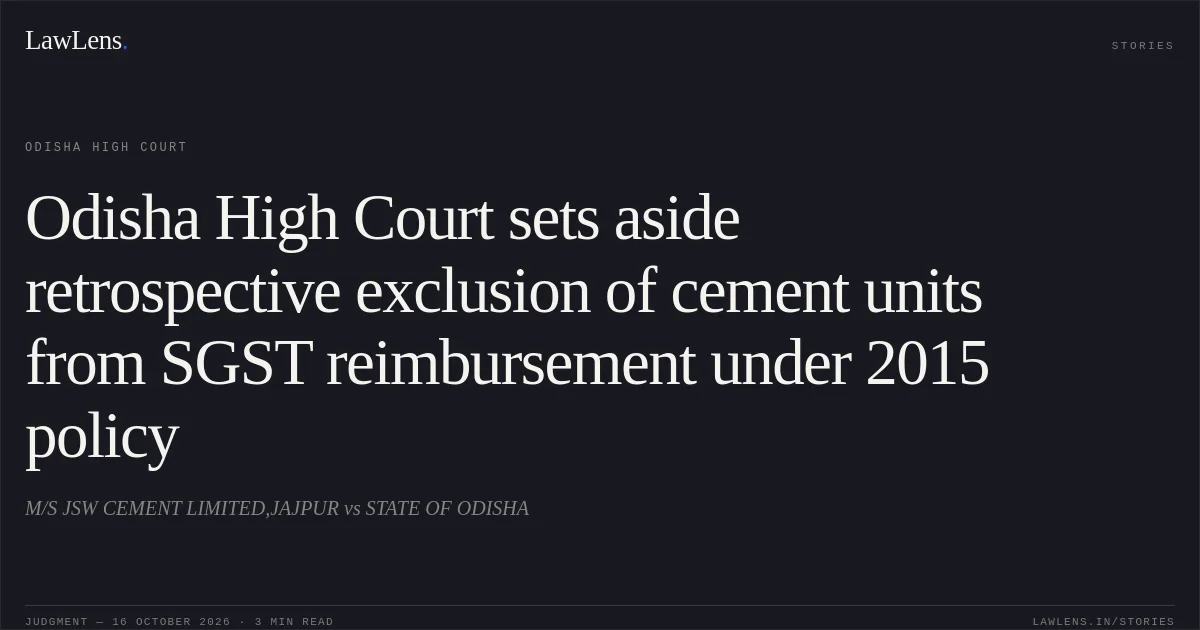
Source reference: paras. 2–14, 40On 18 August 2020, the State amended IPR 2015 to exclude cement manufacturing and grinding units from net SGST reimbursement, retrospectively from 1 July 2017.
Source reference: paras. 2–14, 40The State opposed the claim, relying on its power to revise policy, the absence of a final Priority Sector certificate, and the Negative List.
Source reference: paras. 2–14, 40Issues
1. Whether the 18 August 2020 amendment could retrospectively exclude cement manufacturing and grinding units from net SGST reimbursement under IPR 2015
Source reference: para. 38(A)2. Whether the petitioners’ 16 August 2017 application for provisional Priority Sector status attracted deemed approval under Section 11 of the Orissa Industries (Facilitation) Act, 2004, read with IPR 2015 and the applicable guidelines
Source reference: para. 38(B)3. Whether the petitioners’ unit fell within the Negative List and, if not, whether its SGST reimbursement claim could be considered under IPR 2015
Source reference: para. 38(C)Law Applied
Section 11 of the Orissa Industries (Facilitation) Act, 2004 provides for deemed issuance of a covered clearance when the authority fails to decide within the prescribed period; its communication requirements cannot be read to defeat that statutory consequence through administrative inaction.
Source reference: paras. 56–58Clause 4.2 of IPR 2015 and the Operational Guidelines prescribe a time-bound process for Priority Sector applications, including scrutiny, forwarding, decision and communication of rejection.
Source reference: para. 59The State may revise an industrial policy, but retrospective withdrawal of an incentive requires lawful authority and adequate justification; fiscal implications alone do not establish overriding public interest or justify impairing accrued rights.
Source reference: paras. 45–54The Court relied on Ultratech Cement Ltd. v. State of Odisha, MRF Ltd. v. Assistant Commissioner (Assessment), Sales Tax, and State of Uttar Pradesh v. Birla Corporation Ltd. for the principles governing retrospective withdrawal, promissory estoppel and legitimate expectation.
Source reference: paras. 45–54Eligibility remains subject to the applicable policy conditions and the terms of the relevant Negative List entry.
Source reference: paras. 67, 71–77Reasoning
The petitioners had progressed beyond a mere intention to invest: they obtained approvals and land, invested, applied for provisional status, and commenced production before the impugned amendment.
Source reference: paras. 40–54The State’s financial concerns could support a prospective policy change but, absent a sufficient public-interest justification, did not support applying the exclusion from 1 July 2017; the Court considered its reasoning in Ultratech Cement applicable to the same Resolution.
Source reference: paras. 40–54The application had been inspected and forwarded, and no timely rejection was shown; the 2020 request for further documents was not a rejection within the prescribed period.
Source reference: paras. 60–69The Court therefore applied Section 11’s deemed-approval consequence to the provisional-status application.
Source reference: paras. 60–69It also found that the State had not established that the unit fell within the Negative List, particularly in light of the investment threshold, the nature of the manufacturing activity and the RIC’s verification.
Source reference: paras. 70–75Reimbursement nevertheless remained subject to verification of the amount and compliance with applicable conditions.
Source reference: paras. 77–79Holding
The writ petition was allowed.
The petitioners were treated as having obtained deemed approval of their 16 August 2017 application for provisional Priority Sector status.
Source reference: paras. 80–81The retrospective exclusion of cement manufacturing and grinding units from SGST reimbursement under IPR 2015, with effect from 1 July 2017, was held arbitrary and unconstitutional and set aside.
Source reference: paras. 80–81The State was directed to determine and release the petitioners’ SGST reimbursement claim, with applicable interest, within four weeks.
Source reference: para. 82Acts & Sections Cited
1 provisions across 1 statute referred to in this judgment. Linked provisions open on LawLens.
Orissa Industries (Facilitation) Act, 20041
Original Court PDF
M/S JSW CEMENT LIMITED,JAJPURvsSTATE OF ODISHA
Click to open original judgment
Original judgment, available to read, download and summarize on LawLens.in