Facts
The petitioners claimed ownership and possession of portions of Plot No. 60/139, acquired by registered sale deeds from the legal heirs of Ramesh Chandra Dash, whose interest originated in a Government lease.
Source reference: pp. 2–4Their mutation application was rejected, and an appeal was dismissed after the authorities found that the lease had been cancelled in 2000 and the land restored to Government Khata No. 62 (Anabadi).
Source reference: pp. 2–4, 9–10The petitioners challenged the proposed construction of a crematorium on an adjoining site, alleging that the authorities had encroached upon their land and seeking to restrain further construction and preserve the status quo.
Source reference: pp. 5–6They also stated that the legality of the lease cancellation and resumption was under challenge in separate proceedings.
Source reference: p. 4The State and the Gram Panchayat opposed the writ petition on the grounds that the petitioners’ title was disputed and the matter required adjudication on evidence.
Source reference: pp. 8–9Issues
Whether the writ petition was maintainable where the petitioners’ claim to title and possession depended on a disputed, cancelled Government lease and contested revenue records.
Source reference: pp. 9–11Whether the petitioners’ claims concerning title, possession, and the boundary of the proposed crematorium site could be determined in writ proceedings or required adjudication by a Civil Court.
Source reference: pp. 10–11Law Applied
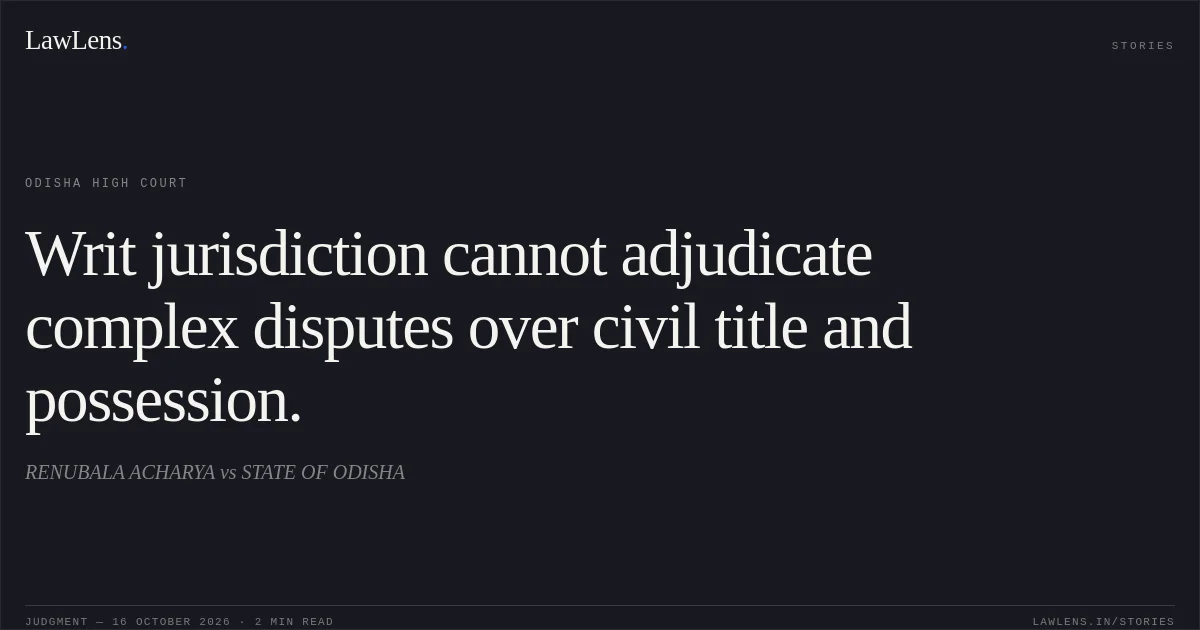
Articles 226 and 227 of the Constitution confer extraordinary jurisdiction on the High Court, but that jurisdiction is not ordinarily suited to resolving serious and contested questions of civil title, factual possession, or boundary that require pleadings and evidence.
Source reference: pp. 10–12The Court stated that where the dispute primarily concerns such matters, the appropriate remedy is before a competent Civil Court rather than through a writ petition.
Source reference: pp. 10–12Article 300-A was invoked by the petitioners, but the Court did not determine the merits of that claim.
Source reference: p. 7Reasoning
The Court found that the petitioners’ asserted title derived from a lease that had been cancelled and the land restored to the State’s Anabadi Khata; the resumption order had not been reversed by a competent authority.
Source reference: pp. 9–10The requested relief would therefore require examination of the validity and effect of the lease cancellation, the petitioners’ title and possession, and the disputed boundary between their claimed land and the proposed crematorium site.
Source reference: pp. 10–11Because those matters involved contested facts and required evidence, the Court held that they could not appropriately be adjudicated in writ proceedings.
Source reference: pp. 10–12Holding
The Court held that the writ petition was not maintainable in its present form because it raised complex and disputed questions of title, possession, and boundary.
It dismissed the petition and left the petitioners at liberty to pursue their grievances before the Civil Court, if so advised.
Source reference: p. 12Original Court PDF
RENUBALA ACHARYAvsSTATE OF ODISHA
Click to open original judgment
Original judgment, available to read, download and summarize on LawLens.in