Facts
The appellant, the deceased’s husband, was accused of subjecting her to harassment and torture that allegedly led to her suicide.
Source reference: para. 2.0–4.0The FIR invoked Sections 108, 115(2) and 54 of the Bharatiya Nyaya Sanhita, 2023, and Sections 3(2)(v) and 3(1)(r)(s) of the Scheduled Castes and Scheduled Tribes (Prevention of Atrocities) Act, 1989.
Source reference: para. 2.0–4.0After the charge-sheet was filed, the appellant sought regular bail under Section 483 of the Bharatiya Nagarik Suraksha Sanhita, 2023.
Source reference: para. 2.0–4.0The Sessions Court rejected the application; the appellant appealed under Section 14-A of the Atrocities Act.
Source reference: para. 2.0–4.0The appellant relied on completion of the investigation and the release on bail of his mother-in-law, while the State and complainant opposed bail, citing alleged audio and video material and risks of non-appearance and evidence tampering.
Source reference: para. 2.0–4.0Issues
Whether the appellant should be granted regular bail after filing of the charge-sheet, having regard to the allegations, completion of the investigation and the asserted risk of tampering or non-appearance.
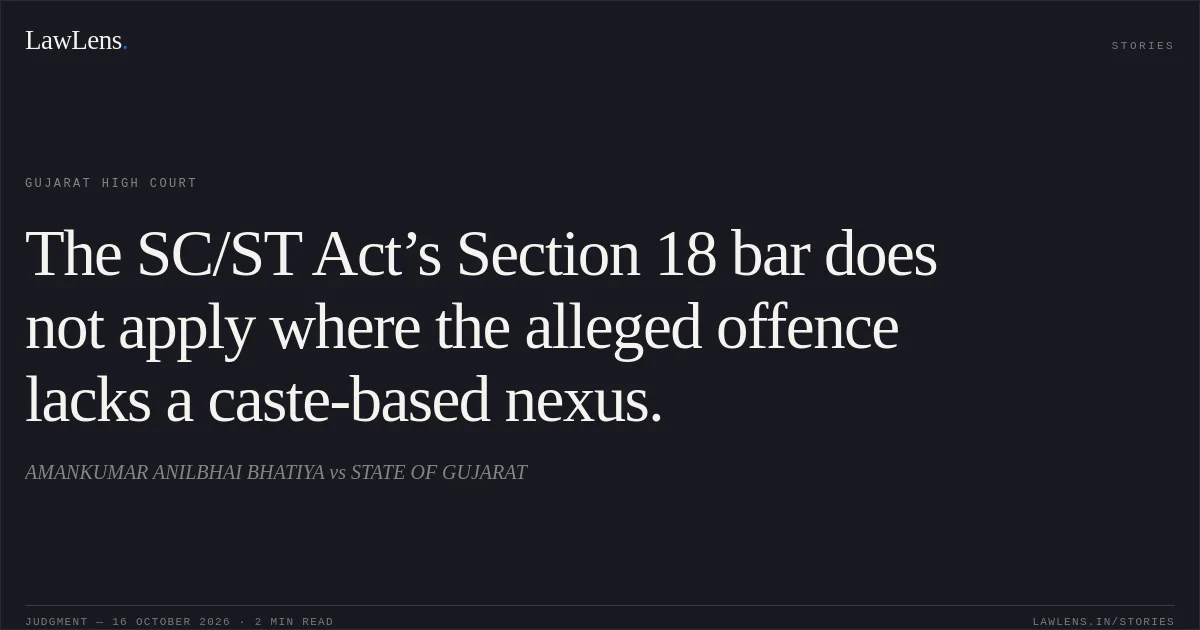
Source reference: para. 3.0–5.0Whether the bar under Section 18 of the Atrocities Act applied to the appellant’s bail request.
Source reference: para. 5.0Whether the appellant was entitled to bail on the ground of parity with the co-accused who had been released on bail.
Source reference: para. 5.0Law Applied
The Court considered the appeal under Section 14-A of the Atrocities Act and the regular-bail application under Section 483 of the BNSS.
Source reference: para. 2.0It relied on Hitesh Verma v. State of Uttarakhand, (2020) 10 SCC 710, in holding that the Section 18 bar of the Atrocities Act was not applicable in this case; on Sanjay Chandra v. Central Bureau of Investigation, (2012) 1 SCC 40, in applying the principles governing bail and pre-trial detention; and on Ramesh Batubhai Dabhi v. State of Gujarat, 2011 (3) GLR 1150, in considering parity with a bailed co-accused.
Source reference: para. 5.0The Court also invoked the principle that bail is the rule and jail the exception.
Source reference: para. 5.0Reasoning
The Court noted that the investigation was complete and no further recovery or discovery was required from the appellant.
Source reference: para. 5.0It considered the appellant’s pre-trial detention in light of the bail principles in Sanjay Chandra and concluded that continued custody would amount to pre-trial conviction.
Source reference: para. 5.0It further held that Section 18 did not bar bail, applying Hitesh Verma, and found parity relevant because the co-accused had been released on bail.
Source reference: para. 5.0The Court granted bail subject to conditions, including surrendering any passport, not leaving India without permission, monthly police-station attendance for six months, providing and maintaining a residential address, and not delaying the trial through unnecessary adjournments.
Source reference: para. 6.0Holding
The High Court allowed the appeal, set aside the Sessions Court’s order dated 15 July 2026, and directed the appellant’s release on regular bail on a personal bond of ₹15,000 with one surety for the like amount, subject to the stated conditions.
Release was conditional on the appellant not being required in another case; the trial court retained power to modify or relax the conditions, and the trial was not to be influenced by the Court’s prima facie observations.
Source reference: para. 7.0–8.0Acts & Sections Cited
6 provisions across 3 statutes referred to in this judgment. Each provision opens on LawLens.
Scheduled Castes and the Scheduled Tribes (Prevention of Atrocities) Act, 19892
Bharatiya Nagarik Suraksha Sanhita, 20231
Bharatiya Nyaya Sanhita, 20233
Original Court PDF
AMANKUMAR ANILBHAI BHATIYAvsSTATE OF GUJARAT
Click to open original judgment
Original judgment, available to read, download and summarize on LawLens.in