Facts
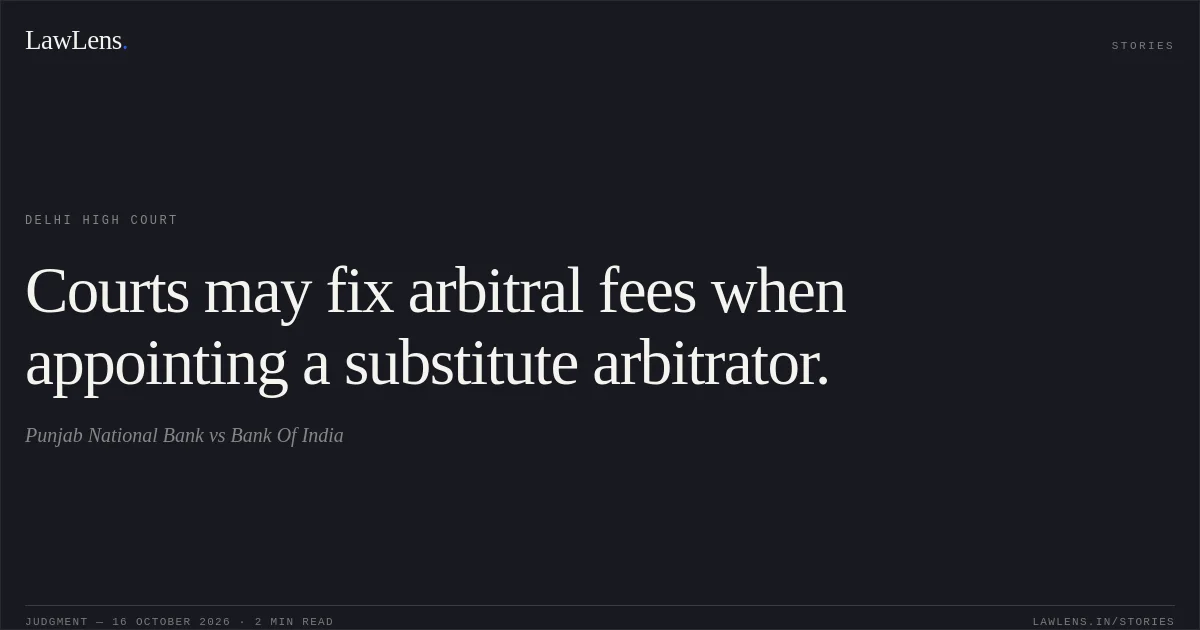
The parties’ 2018 Undertaking contained an arbitration clause providing for arbitration under the Arbitration and Conciliation Act, 1996, with New Delhi as the venue
Source reference: p. 2, para. 2After the first arbitrator declined to act because the parties could not agree on fees, the Court appointed a substitute arbitrator in February 2026. That reference also ended when the parties disagreed over the application of the Fourth Schedule to a claim seeking documents and related relief; the arbitrator closed the proceedings under Section 14(1)(b)
Source reference: pp. 2–4, paras. 3–7The respondent did not oppose appointment of another substitute arbitrator, but maintained that the fee should be governed by the Fourth Schedule. It had previously offered to pay Rs. 10,00,000 towards the fee, and the petitioner agreed to pay the same amount as its share
Source reference: pp. 4–5, paras. 9–12; p. 7, para. 18Issues
1. Whether a substitute Sole Arbitrator should be appointed under Section 15(2) after the prior arbitrator was unable to proceed and the parties did not oppose a further appointment.
Source reference: pp. 4–5, paras. 7–9, 132. Whether the Court should fix the substitute arbitrator’s fee at the time of appointment, rather than leave the parties to resolve the fee dispute again.
Source reference: pp. 5–7, paras. 13–18Law Applied
Section 15(2) of the A&C Act empowers the Court to appoint a substitute arbitrator when an arbitrator’s mandate terminates. Section 14(1)(b) addresses termination where an arbitrator becomes unable to perform their functions.
Source reference: pp. 4–6, paras. 7–16The Fourth Schedule provides a fee framework based on the “sum in dispute,” which may not readily resolve a dispute involving non-monetary relief.
Source reference: p. 6, para. 15In Oil and Natural Gas Corporation Ltd. v. Afcons Gunanusa JV, (2024) 4 SCC 481, the Supreme Court held that an arbitral tribunal cannot unilaterally determine its own fee, as doing so conflicts with party autonomy and the prohibition on deciding one’s own claim; it also directed that, where a court appoints arbitrators, the appointment order should stipulate their fee.
Source reference: p. 6, para. 16The Court treated that guidance as supporting its power to fix the fee at appointment.
Source reference: p. 7, para. 17Reasoning
The Court found that the parties’ references had failed twice at the threshold solely because they could not agree on the arbitrator’s fee, leaving the underlying dispute unadjudicated.
Source reference: p. 5, para. 13Because the petitioner sought documents before quantifying its claim, and the parties remained divided over how the Fourth Schedule applied to that non-monetary relief, leaving the fee unresolved risked a third failure.
Source reference: p. 6, para. 15The Court therefore fixed the fee at appointment, having regard to the nature and history of the reference and the respondent’s prior offer of Rs. 10,00,000 as its share, which the petitioner matched.
Source reference: p. 7, para. 18Holding
The Court appointed Ms. Justice (Retd.) Deepa Sharma as substitute Sole Arbitrator under Section 15(2).
It fixed the consolidated fee at Rs. 20,00,000, to be shared equally, with each party paying Rs. 10,00,000.
Source reference: p. 8, para. 22The parties’ rights and contentions on the claims and counterclaims were left open for determination on the merits, and the petition was disposed of.
Source reference: p. 8, paras. 23–25Acts & Sections Cited
5 provisions across 1 statute referred to in this judgment. Each provision opens on LawLens.
Arbitration and Conciliation Act, 19965
Original Court PDF
Punjab National BankvsBank Of India
Click to open original judgment
Original judgment, available to read, download and summarize on LawLens.in