Facts
On 9 December 2014, Sushev Kumar was travelling as an occupant in a car when a truck allegedly ran a red light at Tolstoy Marg and struck the car, dragging it approximately 15 metres.
Source reference: p. 1–2The accident killed the car’s driver and injured its occupants. Kumar sustained 30% permanent visual disability, assessed as causing 30% functional disability.
Source reference: p. 1–2The MACT awarded him ₹65,34,081 with 9% interest. The insurer appealed, alleging contributory negligence by the car’s driver and challenging the compensation assessment.
Source reference: p. 5–6Issues
1. Whether the insurer established contributory negligence by the car’s driver so as to require impleading the car’s insurer or reduce the claimant’s compensation.
Source reference: p. 2–62. Whether the MACT’s assessment of the claimant’s income, and consequently the compensation award, was justified.
Source reference: p. 5–6Law Applied
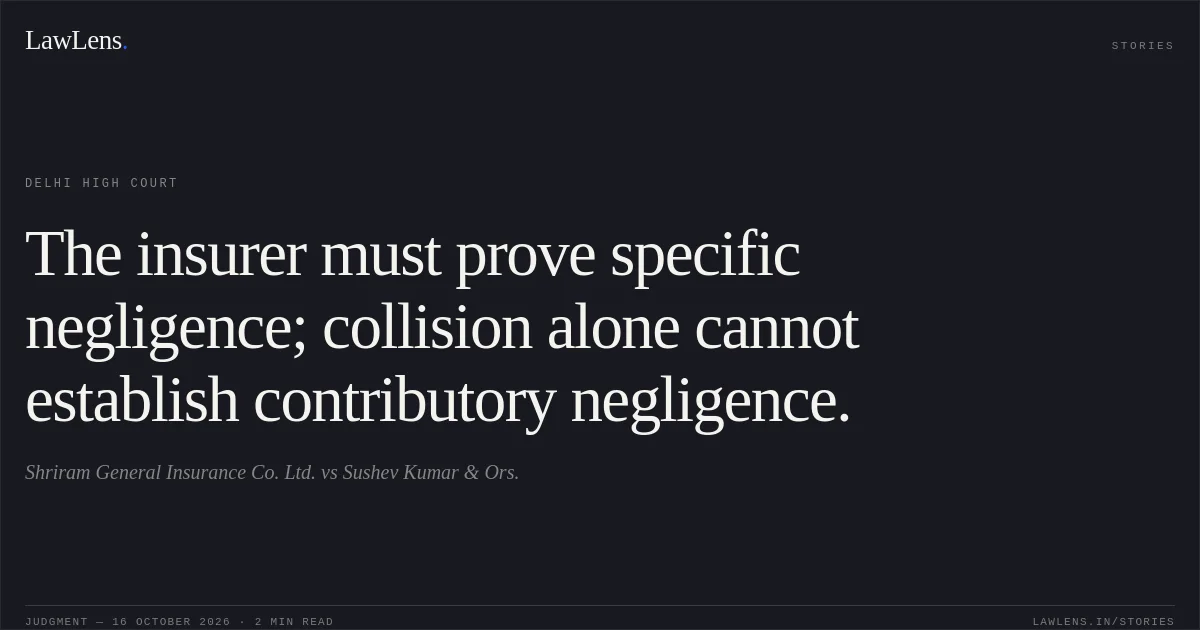
Contributory negligence requires evidence of an act or omission by the claimant, or conduct attributable to the claimant’s case, that amounts to a failure to take reasonable care and materially contributed to the loss; mere involvement in a collision does not establish it.
Source reference: p. 3–5The burden rests on the party alleging contributory negligence, which must prove the relevant breach by cogent evidence. The Court relied on Usha Rajkhowa v. Paramount Industries, (2009) 14 SCC 71, applying the principles in Pramodkumar Rasikbhai Jhaveri v. Karmasey Kunvargi Tak, (2002) 6 SCC 455, and on UPSRTC v. Subhash & Anr., 2026:DHC:7203.
Source reference: p. 3–5The judgment identifies no statutory provision as a basis for deciding the appeal.
Source reference: p. 3–5Reasoning
The Court found no evidence that the car’s driver failed to take reasonable care or otherwise contributed to the accident. The claimant’s testimony described the truck striking the car after running the red light, and the insurer did not produce evidence establishing negligence by the car’s driver. The Court therefore rejected the contributory-negligence argument.
Source reference: p. 2–5On quantum, it noted that the MACT had considered the claimant’s ₹50,000 gross monthly salary, the employment certificate and three months’ salary slips, the testimony of the employer’s director, and the claimant’s MCA qualification. The resulting monthly income assessment of ₹46,685 was held just and reasonable.
Source reference: p. 5–6Holding
The Court held that contributory negligence was not proved and that the MACT’s income assessment and compensation award were justified.
It dismissed the appeal, rendered any pending applications infructuous, and directed that the balance deposited amount and accrued interest continue to be released in accordance with the MACT’s scheme.
Source reference: p. 6–7Any statutory deposit was to be refunded only if the deposit order had been complied with.
Source reference: p. 6–7Original Court PDF
Shriram General Insurance Co. Ltd.vsSushev Kumar & Ors.
Click to open original judgment
Original judgment, available to read, download and summarize on LawLens.in