Facts
The plaintiff sought specific performance of a sale agreement dated 20 December 1999, under which the defendants allegedly agreed to sell the suit property for ₹1,50,000 and received ₹1,00,000 as advance.
Source reference: pp. 8–10The defendants disputed the sale agreement, asserting that the transaction was a ₹15,000 loan and that their signatures had been taken on blank stamp paper.
Source reference: pp. 8–10The Trial Court accepted the plaintiff’s evidence of execution and payment, but declined specific performance under Section 20 of the Specific Relief Act, 1963, and instead ordered repayment of ₹1,00,000 with interest at 18% per annum.
Source reference: pp. 10–18, 19–22On the plaintiff’s appeal, the First Appellate Court granted specific performance and directed the defendants to execute a sale deed, demolishing the structure on the property if necessary.
Source reference: pp. 23–28The defendants appealed under Section 100 CPC.
Source reference: pp. 3–5Issues
1. Whether the First Appellate Court’s points for determination and reasons complied with Order XLI Rule 31 CPC.
Source reference: p. 42. Whether the First Appellate Court was justified in granting specific performance on the evidence on record.
Source reference: p. 43. Whether the First Appellate Court was justified in reversing the Trial Court’s exercise of discretion under Section 20 of the Specific Relief Act, 1963.
Source reference: pp. 5–64. Whether the plaintiff had established continuous readiness and willingness to perform his part of the contract, as required by Section 16(c) of the Specific Relief Act, 1963.
Source reference: pp. 5–6Law Applied
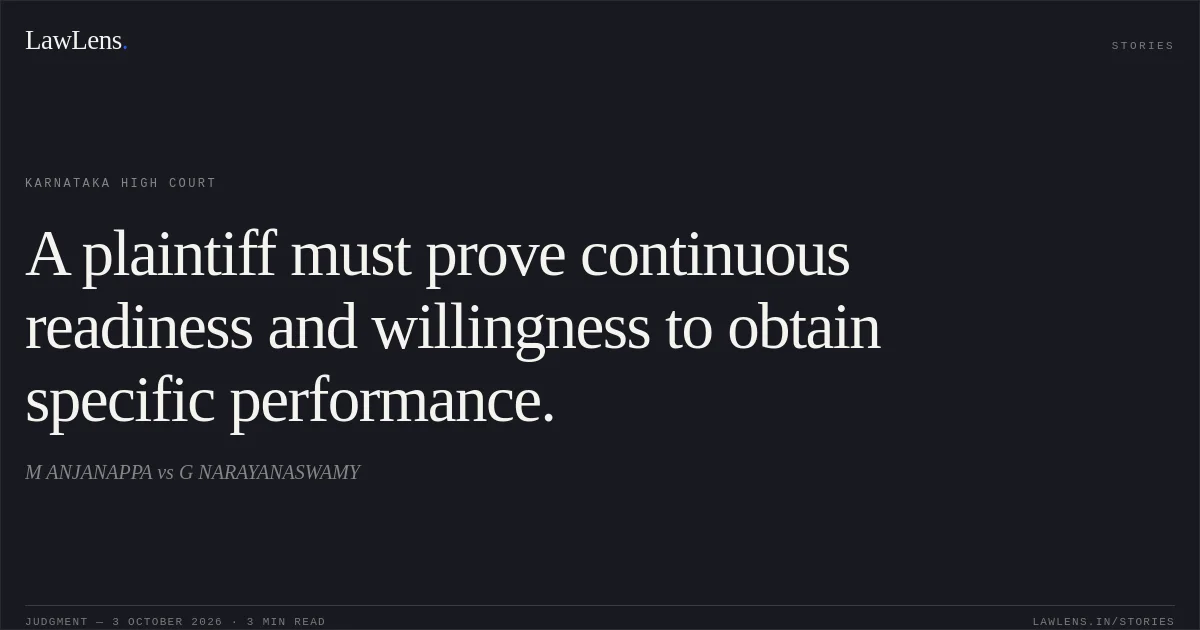
Under Section 16(c) of the Specific Relief Act, 1963, a plaintiff seeking specific performance must aver and prove continuous readiness and willingness to perform the essential terms of the contract from the agreement through the relevant proceedings.
Source reference: pp. 29–31Under Section 20, as applicable to this dispute, specific performance was discretionary and the discretion had to be exercised on sound judicial principles, including consideration of comparative hardship.
Source reference: pp. 19–21In a second appeal under Section 100 CPC, the High Court may interfere where the First Appellate Court’s decision raises a substantial question of law; Order XLI Rule 31 requires the appellate court to frame points for determination and give reasons for its decision.
Source reference: p. 4Reasoning
The High Court held that the First Appellate Court had not properly assessed the Trial Court’s reasoned exercise of discretion under Section 20, including the evidence that the defendants constructed a house on the property during the suit and the Trial Court’s finding that specific performance would cause them comparative hardship.
Source reference: pp. 18–22, 28–29The Court also found that the plaintiff had not shown continuous readiness and willingness: although the agreement was dated 20 December 1999, he issued notice only on 1 September 2002, provided no adequate explanation for the intervening inaction, and produced no evidence of funds or capacity to raise them for the relevant period; the bank passbook relied upon covered a later period.
Source reference: pp. 29–31The Trial Court’s finding on readiness and willingness therefore could not stand, and the First Appellate Court’s decree granting specific performance was unsustainable.
Source reference: pp. 31–35Holding
The High Court answered the substantial questions of law in favour of the defendants and allowed the appeal.
It set aside the First Appellate Court’s judgment and decree dated 16 September 2017 and restored the Trial Court’s judgment and decree dated 2 December 2015, including the order requiring repayment of the ₹1,00,000 advance with interest at 18% per annum from 20 December 1999 until realization.
Source reference: pp. 34–35Acts & Sections Cited
5 provisions across 2 statutes referred to in this judgment. Each provision opens on LawLens.
Code of Civil Procedure, 19082
Specific Relief Act, 19633
Original Court PDF
M ANJANAPPAvsG NARAYANASWAMY
Click to open original judgment
Original judgment, available to read, download and summarize on LawLens.in