Facts
The plaintiffs sought partition of a two-acre portion of S.F. No. 127/3, claiming that it had remained joint after an earlier oral partition between the parties’ family branches.
Source reference: pp. 3–8The defendants disputed that claim, asserting that the suit property had been allotted to their predecessor in the earlier partition.
Source reference: pp. 3–8The trial court granted a preliminary decree dividing the property into two shares; the first appellate court reversed, finding that the plaintiffs had not proved the property remained available for partition. Some plaintiffs appealed to the High Court.
Source reference: pp. 15–17The High Court also considered the plaintiffs’ challenge to the first appellate court’s treatment of additional evidence and the defendants’ non-examination as witnesses.
Source reference: pp. 10, 20–23Issues
Whether the plaintiffs had to prove that the suit property remained joint and available for partition, notwithstanding that the suit was for partition and the defendants had not entered the witness box.
Source reference: p. 10; pp. 18–19, 22–23Whether the first appellate court’s failure to discuss the additional documents received under Order 41 Rule 27 of the Code of Civil Procedure vitiated its judgment.
Source reference: p. 10; pp. 20–22Whether the first appellate court could rely on the evidence of a non-party witness who was not shown to have personal knowledge of the earlier oral partition.
Source reference: p. 10; pp. 18–19Law Applied
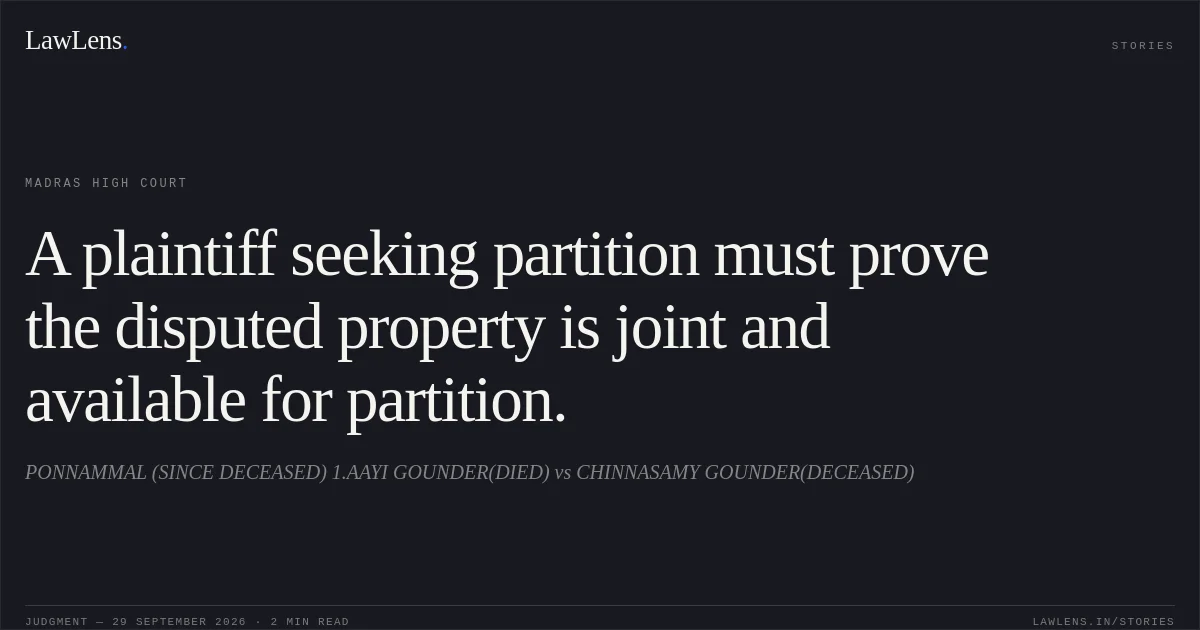
Under Section 101 of the Evidence Act, the party asserting a right must prove the facts necessary to establish it; a plaintiff seeking partition must prove that the property is joint and available for partition where the defendants deny that claim. The plaintiff cannot succeed merely by pointing to weaknesses in the defence.
Source reference: pp. 18–23Order 41 Rule 27 CPC permits additional evidence in the circumstances prescribed by that provision, and an appellate court receiving such evidence must address the application and consider the documents, with an opportunity for the opposing party to respond. The Court cited no judicial precedents in its reasoning.
Source reference: pp. 18–23Reasoning
The Court held that the parties accepted that other family properties had been orally partitioned, making it incumbent on the plaintiffs to establish why this particular property remained joint and available for division. The plaintiffs did not adequately explain that claim or establish joint possession; the evidence also included admissions concerning the earlier partition, patta, and non-payment of tax.
Source reference: pp. 15–17, 19The non-examination of the defendants did not discharge the plaintiffs’ burden, and the non-party witness’s evidence was not helpful to the defence; neither circumstance cured the plaintiffs’ failure of proof.
Source reference: pp. 18–19, 22–23Although the first appellate court failed to pass a reasoned order on the Order 41 Rule 27 application and discuss the additional documents, the High Court concluded that its reversal rested on the evidence already on record, so that omission did not vitiate the result.
Source reference: pp. 20–22Holding
The High Court answered the substantial questions of law against the appellants, upheld the first appellate court’s finding that the plaintiffs had failed to prove the suit property was available for partition, and dismissed the second appeal.
Connected miscellaneous petitions were closed, with no order as to costs.
Source reference: pp. 23–24Acts & Sections Cited
1 provisions across 1 statute referred to in this judgment. Each provision opens on LawLens.
Code of Civil Procedure, 19081
Original Court PDF
PONNAMMAL (SINCE DECEASED) 1.AAYI GOUNDER(DIED)vsCHINNASAMY GOUNDER(DECEASED)
Click to open original judgment
Original judgment, available to read, download and summarize on LawLens.in