Facts
The petitioner instituted a public-interest writ petition in 2021 alleging chaotic traffic conditions in Hazaribagh, including inadequate traffic signals and surveillance, insufficient parking, footpath encroachments, and risks to pedestrians and road users.
Source reference: paras. 2–4, pp. 1–2An Advocate Commissioner’s report substantially confirmed the problems, including non-functional CCTV cameras, haphazard parking, deficient traffic personnel, and weak enforcement.
Source reference: paras. 6–7, pp. 2–3Although the respondents later reported increased police deployment, enforcement measures, anti-encroachment action, and a traffic-signal contract, the petitioner maintained that implementation remained inadequate.
Source reference: paras. 13–19, pp. 5–7The Court found that further steps and effective monitoring were required.
Source reference: para. 19, p. 7Issues
1. Whether the respondents’ measures adequately discharged their constitutional and statutory duties to address Hazaribagh’s traffic-management and pedestrian-safety problems.
Source reference: paras. 19–22, pp. 7–82. Whether further time-bound and monitored directions were required to secure effective implementation of traffic, parking, pedestrian-safety, and related civic measures.
Source reference: paras. 27–29, pp. 9–10Law Applied
Article 21 protects the right to a clean, dignified, and reasonably safe urban life, while Article 19(1)(d) protects freedom of movement, including movement as a pedestrian.
Source reference: para. 20, p. 7The Motor Vehicles Act, 1988; the applicable municipal legislation, including the Jharkhand Municipal Act, 2012; the Noise Pollution (Regulation and Control) Rules, 2000; and the Street Vendors (Protection of Livelihood and Regulation of Street Vending) Act, 2014 impose relevant duties concerning traffic regulation, civic management, noise control, and the lawful regulation of street vending.
Source reference: paras. 20–21, pp. 7–8In Municipal Council, Ratlam v. Vardhichand, the Supreme Court rejected financial inability as a defence to discharging public duties relating to civic safety and sanitation.
Source reference: para. 22, p. 8Ahmedabad Municipal Corporation v. Nawab Khan Gulab Khan, Sudhir Madan v. Municipal Corporation of Delhi, M.C. Mehta v. Union of India, and Maniyar Iliyaz @ Shaik Riyaz v. P. Ayyappan support the protection of public footpaths for safe public use and the prohibition of their occupation or use for parking, while recognising the corresponding municipal duty to protect pedestrian infrastructure.
Source reference: paras. 23–25, pp. 8–9Street-vending regulation should enable vending to coexist with motorable carriageways and walkable footpaths rather than impose its complete exclusion.
Source reference: para. 26, p. 9Reasoning
The Commissioner’s report and the respondents’ affidavits established that the traffic problems were real, while the record showed that some remedial action had been taken but that implementation and inter-agency coordination remained deficient.
Source reference: paras. 7–10, 13–19, pp. 3–7Because traffic safety, pedestrian access, and civic management engage constitutional rights and statutory responsibilities, the authorities could not rely on financial constraints, administrative inconvenience, or lack of coordination to avoid their duties.
Source reference: paras. 20–22, p. 8The Court therefore required coordinated, verifiable, and time-bound action, while directing that encroachment control and traffic management be carried out consistently with applicable law and the statutory framework for street vendors.
Source reference: paras. 26–29, pp. 9–10Holding
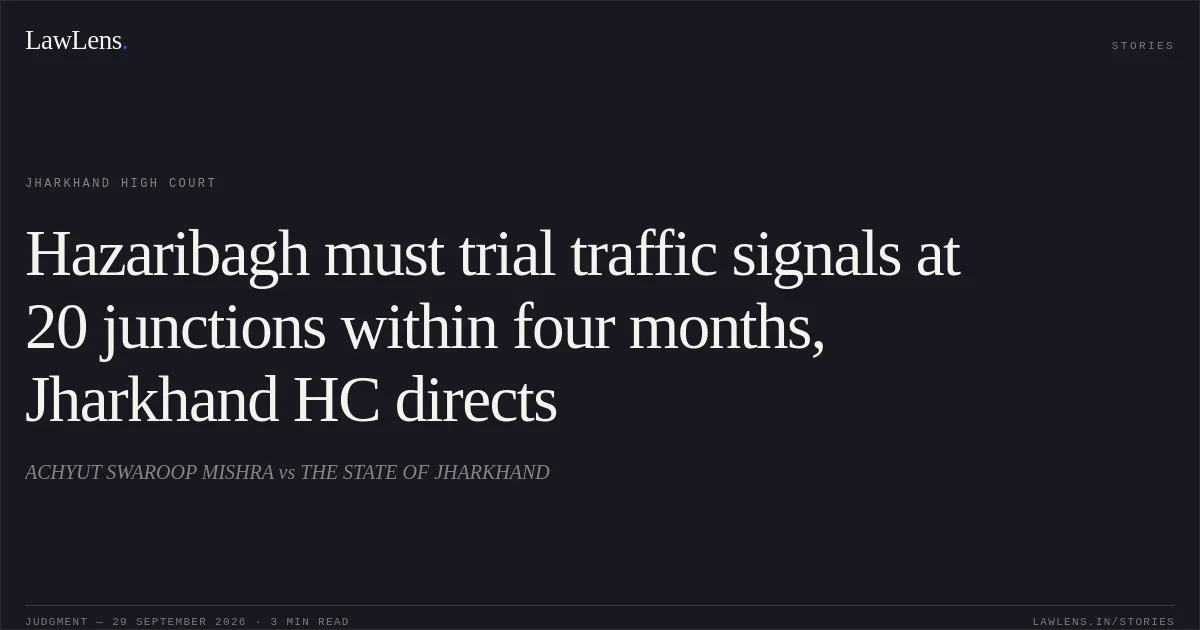
The Court disposed of the petition and directed the Municipal Commissioner to complete and operationally trial the automated traffic-light system within four months, covering at least twenty identified intersections, with specified certification, signage, and monitoring requirements.
It also ordered a CCTV inventory and repairs, peak-hour deployment reporting and personnel training, enforcement of the notified heavy-vehicle restriction, mapping and protection of parking spaces, completion of vending-zone notifications, lawful removal of encroachments, notification and enforcement of silence zones, and reporting on the proposed bus terminal and bus-stand relocation.
Source reference: para. 29(vii)–(xv), pp. 11–13The Deputy Commissioner, Superintendent of Police, and Municipal Commissioner must each file a personal compliance affidavit within four months and serve copies on the petitioner.
Source reference: para. 29(xvi)–(xvii), pp. 13–14The Court clarified that these directions supplement, and do not replace, the respondents’ continuing statutory duties; no costs were awarded.
Source reference: paras. 30–32, p. 14Acts & Sections Cited
1 provisions across 1 statute referred to in this judgment. Linked provisions open on LawLens.
Street Vendors (Protection of Livelihood and Regulation of Street Vending) Act, 20141
Original Court PDF
ACHYUT SWAROOP MISHRAvsTHE STATE OF JHARKHAND
Click to open original judgment
Original judgment, available to read, download and summarize on LawLens.in