Facts
The wife petitioned under Section 9 of the Hindu Marriage Act, 1955, seeking restitution of conjugal rights, alleging that her husband left the matrimonial home on 6 June 2022 without justifiable cause.
Source reference: pp. 4–7, paras. 3–6The husband denied paternity of their son and sought divorce by counterclaim under Sections 13(1)(i), (i-a) and (i-b) of the Act, alleging adultery, cruelty and desertion.
Source reference: pp. 4–7, paras. 3–6The Family Court allowed the wife’s petition and rejected the counterclaim, relying in part on the husband’s admissions in an earlier divorce petition that the marriage was consummated and the child was born of the marriage.
Source reference: pp. 9–10, para. 9The husband appealed, arguing that he had been denied an opportunity to present evidence and that the wife’s criminal complaint constituted cruelty.
Source reference: pp. 11–12, para. 12Issues
1. Whether the Family Court was justified in granting restitution of conjugal rights and rejecting the husband’s divorce counterclaim.
Source reference: p. 13, para. 142. Whether the proceedings suffered from procedural unfairness because the husband was allegedly denied an opportunity to cross-examine a witness and lead evidence.
Source reference: pp. 11–12, para. 12; p. 16, paras. 19–203. Whether the wife’s criminal complaint, or the allegations and conduct relied on by the husband, established a ground for divorce.
Source reference: pp. 17–20, paras. 21–24Law Applied
Under Section 9 of the Hindu Marriage Act, a spouse may seek restitution of conjugal rights where the other spouse has withdrawn from their society without reasonable excuse.
Source reference: no citationA party seeking divorce under Section 13(1)(i), (i-a) or (i-b) bears the burden of proving the asserted ground.
Source reference: no citationUnder Section 58 of the Evidence Act, clear judicial admissions in pleadings are binding and may dispense with proof; the Court relied on Nagindas Ramdas v. Dalpatram Ichharam, (1974) 1 SCC 242, for that principle.
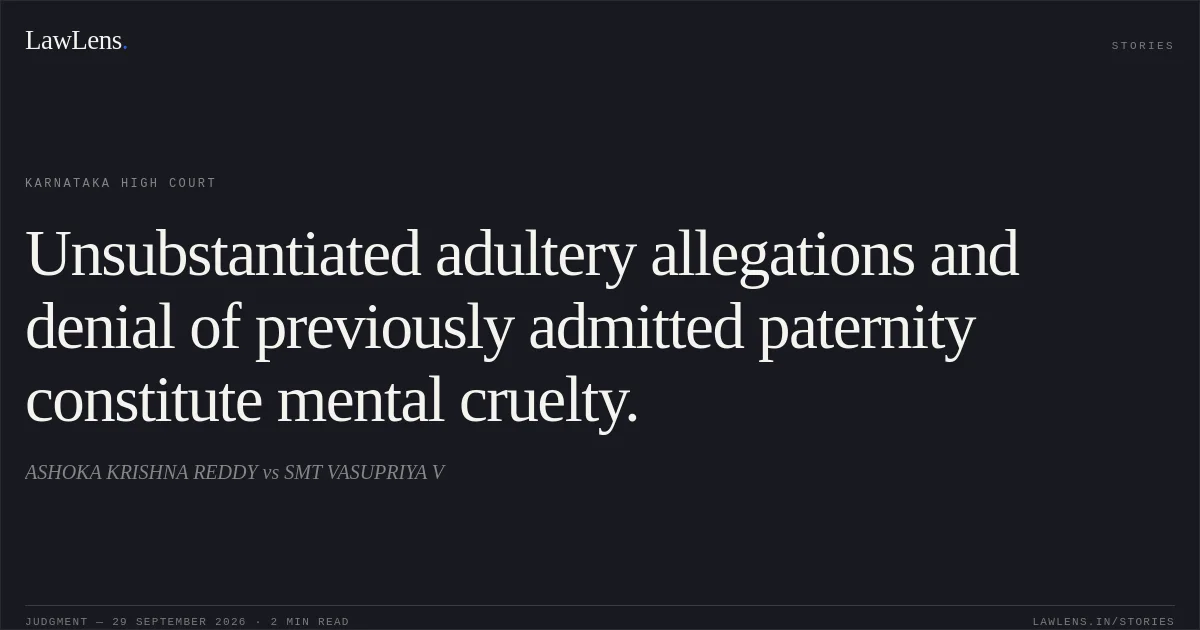
Source reference: pp. 14–15, paras. 17–18Unsubstantiated allegations of adultery against a spouse may constitute mental cruelty, while resort to criminal process does not, by itself, amount to matrimonial cruelty absent cogent proof that the complaint was knowingly false or malicious.
Source reference: pp. 17–20, paras. 21–24Reasoning
The husband’s earlier pleading expressly admitted consummation of the marriage and the child’s birth from the marriage; the Court therefore held that he could not resile from those judicial admissions to dispute paternity or seek DNA testing.
Source reference: pp. 14–15, paras. 16–18The husband had appeared, cross-examined the wife, but did not cross-examine her witness or lead evidence; the Court found no indication that he had sought to reopen the evidence or recall witnesses before the Family Court.
Source reference: p. 16, paras. 19–20It rejected his medical explanation as insufficient to establish procedural unfairness.
Source reference: p. 16, paras. 19–20The husband also failed to prove adultery, cruelty or desertion in support of his counterclaim.
Source reference: pp. 17–20, paras. 21–24The Court considered his allegations against the wife, including disputing their child’s paternity despite his prior admissions, to be unsubstantiated and cruel.
Source reference: pp. 17–20, paras. 21–24It held that the wife’s criminal complaint was not, without proof of falsity or malice, a ground for finding cruelty.
Source reference: pp. 17–20, paras. 21–24Holding
The High Court answered the principal issue in the affirmative and held that the Family Court’s decision disclosed no legal or procedural error warranting interference.
It dismissed both appeals, affirmed the decree granting restitution of conjugal rights and rejecting the husband’s divorce counterclaim, and directed the husband to comply with the restitution decree within four weeks of receiving a copy of the judgment.
Source reference: pp. 20–21, para. 26Acts & Sections Cited
5 provisions across 3 statutes referred to in this judgment. Each provision opens on LawLens.
Family Courts Act, 19841
Hindu Marriage Act, 19552
Indian Penal Code, 18602
Original Court PDF
ASHOKA KRISHNA REDDYvsSMT VASUPRIYA V
Click to open original judgment
Original judgment, available to read, download and summarize on LawLens.in