Facts
The prosecution alleged that on 22 February 2019 the accused struck Jivanbhai Babbabhai on the head with a wooden log and took his mobile phone, causing injuries from which he died.
Source reference: para. 1–2The accused was arrested on 10 March 2019; the prosecution relied principally on the alleged recovery of the phone and CCTV footage.
Source reference: para. 4.1The Sessions Court acquitted him of offences under Sections 302 and 392 IPC, Section 135 of the Gujarat Police Act and Section 3(2)(v) of the SC/ST (Prevention of Atrocities) Act, finding the circumstantial evidence insufficient.
Source reference: para. 8–9The deceased’s daughter appealed against the acquittal under Section 413 BNSS.
Source reference: para. 1–2, 4.1, 8–9Issues
Whether the prosecution established a complete chain of circumstances pointing only to the accused’s guilt
Source reference: para. 16–17Whether the Trial Court’s acquittal was perverse or otherwise warranted appellate interference
Source reference: para. 12, 14, 21Law Applied
Under Sharad Birdhichand Sarda v. State of Maharashtra, (1984) 4 SCC 116, a conviction based solely on circumstantial evidence requires that each circumstance be fully established, that the circumstances be consistent only with guilt, and that the chain exclude every reasonable hypothesis of innocence.
Source reference: para. 15In an appeal against acquittal, the appellate court should respect the reinforced presumption of innocence and avoid interference where the Trial Court’s view is reasonably possible; interference is justified in exceptional cases, including where the judgment is perverse.
Source reference: para. 14Section 25 of the Evidence Act bars proof against an accused of a confession made to a police officer, while the judgment also considered the absence of a certificate under Section 65B in assessing the CCTV evidence.
Source reference: para. 19(1)–(2)Reasoning
The Court found that the alleged motive and recovery were not reliably proved: the deceased’s family had not reported that his phone was stolen, the arrest-panchnama witnesses did not support the prosecution, and ownership of the phone was not established by an invoice.
Source reference: para. 19(1)The accused’s alleged confession to police could not prove the case.
Source reference: para. 19(1)The CCTV footage did not establish the accused’s identity, and the required Section 65B certificate had not been issued by the person controlling the electronic evidence.
Source reference: para. 19(2)Because the recovery itself was doubtful, the accused’s failure to explain it could not supply a missing link in the prosecution case.
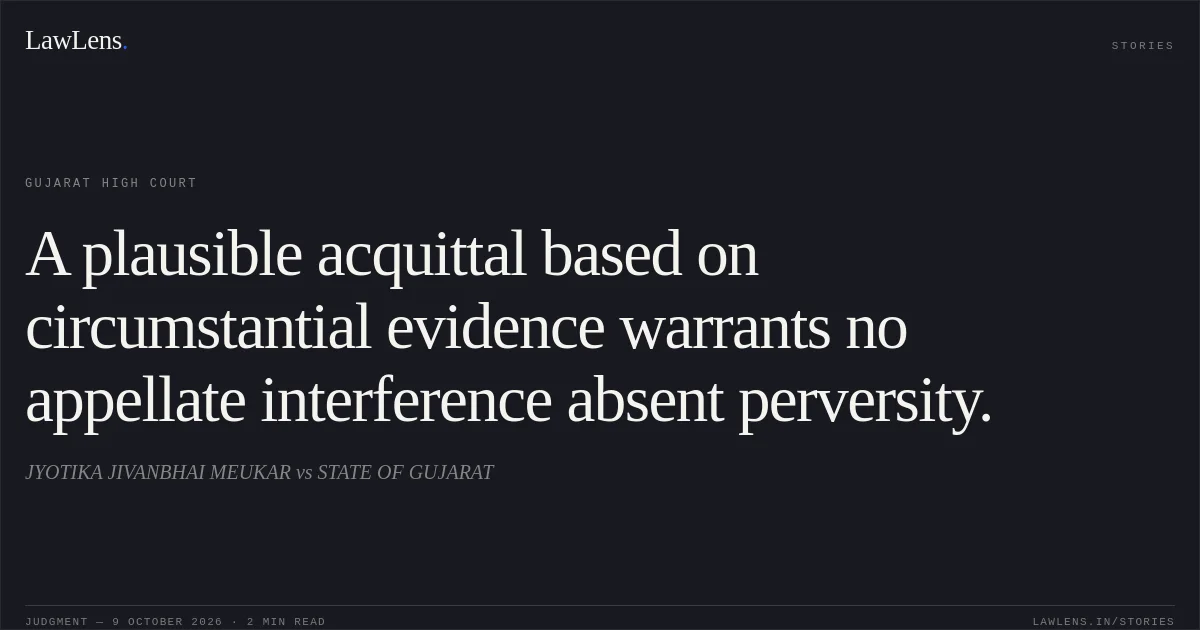
Source reference: para. 19(3)The circumstances therefore did not form a complete chain excluding reasonable doubt, and the Trial Court’s conclusion remained a plausible view.
Source reference: para. 20–21Holding
The High Court held that the prosecution had not proved the necessary circumstances through reliable and clinching evidence, and found no perversity in the acquittal warranting appellate interference.
The appeal was dismissed at the admission stage, leaving the acquittal undisturbed.
Source reference: para. 21Acts & Sections Cited
6 provisions across 4 statutes referred to in this judgment. Each provision opens on LawLens.
Bharatiya Nagarik Suraksha Sanhita, 20232
Indian Penal Code, 18602
Gujarat Police Act, 1951.1
Scheduled Castes and the Scheduled Tribes (Prevention of Atrocities) Act, 19891
Original Court PDF
JYOTIKA JIVANBHAI MEUKARvsSTATE OF GUJARAT
Click to open original judgment
Original judgment, available to read, download and summarize on LawLens.in