Facts
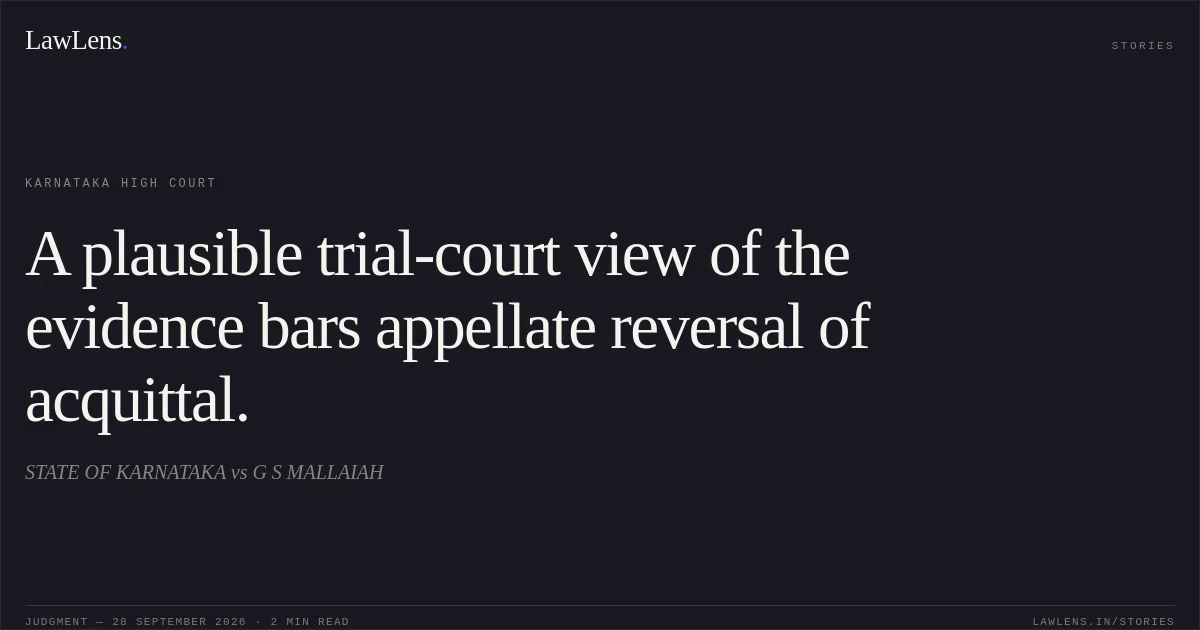
The State appealed the Sessions Court’s acquittal of five accused charged under Sections 143, 147, 148, 120-B and 302 read with Section 149 of the Indian Penal Code.
Source reference: para. 1, pp. 3–4The prosecution alleged that the accused conspired to murder Muniraju because of his relationship with the daughter of accused No. 1, and that they killed him on 6 November 2011.
Source reference: paras. 1–2, pp. 3–4The prosecution relied principally on circumstantial evidence, including alleged last-seen evidence, motive and recovery of weapons.
Source reference: paras. 5–6, pp. 4–5The trial court found the evidence unreliable and acquitted the accused on 12 April 2018.
Source reference: paras. 50–54, pp. 32–46The State challenged that acquittal under Section 378(1) and (3) of the Code of Criminal Procedure.
Source reference: p. 2Issues
Whether the State had established a ground to interfere with the trial court’s judgment of acquittal.
Source reference: para. 9, p. 9Whether the evidence on record proved the accused’s guilt beyond reasonable doubt so as to displace the acquittal.
Source reference: paras. 11, 50–55, pp. 10–11, 32–47Law Applied
The appeal was considered under Section 378 of the Code of Criminal Procedure.
Source reference: p. 2Relying on Constable 907 Surendra Singh v. State of Uttarakhand, Babu Sahebgouda Rudragoudar v. State of Karnataka, Chandrappa v. State of Karnataka and H.D. Sundara v. State of Karnataka, the Court reiterated that an appellate court may reappreciate evidence in an appeal against acquittal, but must respect the reinforced presumption of innocence.
Source reference: para. 11, pp. 9–11It may reverse an acquittal only where the trial court’s view is not a plausible one, the judgment is perverse or materially overlooks evidence, and the evidence permits no reasonable conclusion other than guilt.
Source reference: para. 11, pp. 9–11The prosecution bore the burden of proving the charged offences under Sections 143, 147, 148, 120-B and 302 read with Section 149 IPC beyond reasonable doubt.
Source reference: paras. 2, 12, pp. 3–4, 11–12Reasoning
The Court accepted that the medical and inquest evidence established Muniraju’s homicidal death, but held that this did not establish the accused’s participation.
Source reference: paras. 49–50, pp. 31–32The alleged last-seen witnesses, PWs 1 and 2, turned hostile; the evidence of other material witnesses contained contradictions and omissions, and the alleged recovery of weapons was also found doubtful.
Source reference: paras. 50–53, pp. 32–37On independently reappraising the record, the Court concluded that the trial court had reasonably assessed these weaknesses and that its acquittal was a plausible view, not one warranting appellate interference.
Source reference: paras. 54–55, pp. 37–47Holding
The Court answered in the negative the question whether the State had made out grounds to interfere with the acquittal.
It found no factual or legal error in the trial court’s assessment and dismissed the appeal, leaving the acquittal in force.
Source reference: paras. 55–56, p. 47Acts & Sections Cited
9 provisions across 2 statutes referred to in this judgment. Each provision opens on LawLens.
Code of Criminal Procedure, 19734
Indian Penal Code, 18605
Original Court PDF
STATE OF KARNATAKAvsG S MALLAIAH
Click to open original judgment
Original judgment, available to read, download and summarize on LawLens.in
![Compassionate appointment claims must be freshly assessed on merits despite an earlier adverse committee decision.. Rajiv Kumar vs DEPTT OF POSTS. CAT - ['Lucknow']. LawLens](/stories/thumbnails/compassionate-appointment-claims-must-be-freshly-assessed-on-merits-despite-an-earlier-adv-f5df2ba705144ec3bc80aa83e06181b8.webp)
![Transfer is upheld where no evidence shows it was made to accommodate another employee.. Ravi Prakash vs General Manager N C Rly. CAT - ['Allahabad']. LawLens](/stories/thumbnails/transfer-is-upheld-where-no-evidence-shows-it-was-made-to-accommodate-another-employee-37ed291d2a134d26bd55c6626a676d91.webp)